





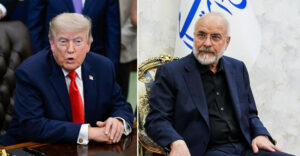
Certain points from the Memorandum of Understanding between the United States and Iran have been released, providing for the immediate cessation of military operations, the reopening of the Strait of Hormuz, the lifting of all US sanctions, and the creation of a $300 billion fund for the reconstruction and economic development of the Islamic Republic.
As reported by the BBC, a meeting took place in which the US side presented the main terms of the 14-point text. According to the report, the agreement sets out a framework for ending the crisis and shaping a new relationship between the two countries.
According to the text, it provides for the “immediate and permanent termination of military operations on all fronts, including Lebanon.” This reference extends the scope of the agreement beyond the direct confrontation between Washington and Tehran, incorporating the Lebanese dimension of the regional crisis.
The agreement also establishes a clear timetable for reaching a final settlement. The United States and the Islamic Republic of Iran commit to negotiate and conclude a final agreement within a maximum period of 60 days, with an extension possible only by mutual consent of both sides.
One of the most significant points concerns the US naval presence in the region. The United States undertakes to lift the naval blockade of Iran within 30 days. During this transitional period, maritime traffic will be gradually restored to pre-war levels under the management of the Islamic Republic.
At the same time, Washington commits to withdrawing its military forces from the vicinity of Iran within 30 days of reaching a final agreement.
Of particular importance is the provision regarding the Strait of Hormuz, one of the world’s most important maritime energy corridors. The agreement stipulates that passage through the Strait will remain toll-free for a period of 60 days.
According to a senior official involved in the talks, Iran will then seek to cooperate not only with Oman but also with Gulf states to create a broader and more long-term agreement regulating the operational framework of the Strait of Hormuz.
A significant economic component of the agreement is the US commitment to work with regional partners to establish a fund worth at least $300 billion (approximately £224 billion).
This fund is intended for the reconstruction and economic development of the Islamic Republic of Iran, marking one of the largest financial commitments ever linked to a de-escalation agreement in the Middle East.
At the same time, the US side undertakes to terminate “all types of sanctions” imposed on Iran. The exact timeline for lifting restrictions will be defined at a later stage through a special implementation programme agreed by both sides.
At the core of the agreement is also the issue of Iran’s nuclear programme. The two countries agree that Iran will never acquire a nuclear weapon.
To ensure compliance with this commitment, the United States and Iran have agreed to work together on eliminating the country’s enriched nuclear material through an on-site dilution and blending process under the supervision of the International Atomic Energy Agency (IAEA).
This provision is considered crucial, as it represents the main mechanism proposed to ensure that Iran’s nuclear programme remains strictly peaceful in nature.
Ask me anything
Explore related questions




