





The challenges shaping the future of global shipping—from decarbonisation and digital transformation to leadership development and workforce readiness—were the focus of the seminar “Maritime Innovation Outlook: Resilience and Future Readiness”, held during Posidonia 2026 by Imperial College London with the support of the Imperial College Alumni Association of Greece.
The event brought together academics, industry leaders and maritime professionals to discuss how the sector can navigate an increasingly complex landscape marked by technological disruption, environmental regulation and evolving workforce demands.
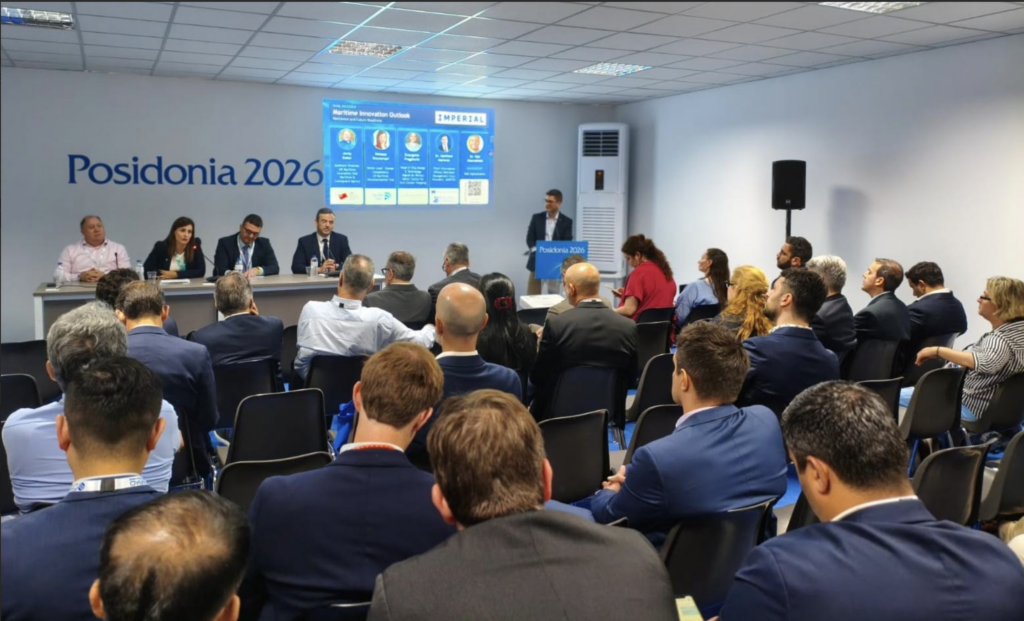
Opening the seminar, Dr. Ioannis K. Karmpadakis, Associate Professor at Imperial College London, presented the university’s Imperial Convergence Science initiative, which promotes collaboration across engineering, technology, management and public policy to address complex global challenges.
The first panel, “Maritime Innovation, Resilience and Future Readiness,” examined the opportunities and challenges arising from the industry’s transition towards a lower-carbon future. Discussions focused on digitalisation, operational resilience and the role of emerging technologies in maintaining competitiveness across the maritime sector.
Panelists included Dr. Matthew Maheras, CIO of Metrostar Management Corp., President of AMMITEC and Board Member of the Imperial College Alumni Association of Greece; Jonathan Slater of the UK Maritime Innovation Hub and the Maritime and Coastguard Agency; Evangelos Fragkoulis of the Mærsk Mc-Kinney Møller Center for Zero Carbon Shipping; and Anastasia Kouvertari of the Lloyd’s Register Maritime Decarbonisation Hub.
Particular attention was given to the human dimension of the industry’s transformation during the second panel, “Maritime Leadership and Future Skills.” The discussion explored how artificial intelligence, digital technologies and changing business models are reshaping the skills required by future maritime leaders.
Participants included Professor Laura Mainini of Imperial College London, Dr. Laura Benzonana, CEO of Health4Crew, Dimitris Patrikios, Managing Director Greece & Med Cluster at V.Ships, and Dr. Panos Theodossopoulos, Chief Executive Officer of METIS Cyberspace Technology.
A recurring theme throughout both discussions was that technological progress alone will not determine the future of shipping. Speakers stressed that long-term success will depend on leaders capable of combining innovation with interdisciplinary thinking, strategic decision-making and practical implementation.
The event also highlighted the growing presence of Greek Imperial College alumni in senior positions across the international maritime industry, underscoring their contribution to technological innovation and the sector’s ongoing transformation at a time when shipping is facing some of the most significant changes in its modern history.
Ask me anything
Explore related questions




