





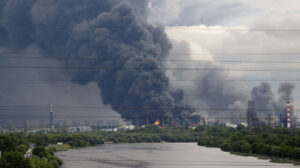
Ukraine’s strike on oil facilities on the outskirts of Moscow today was remarkable both for the scale of the assets deployed against critical targets and for the dramatic images it produced — a significant propaganda victory for Kyiv.
Russian authorities claimed that air defence systems shot down 190 Ukrainian drones from the early hours of the day. If that figure is accurate (adding roughly seven that reached their targets), it would represent Kyiv’s largest drone attack since the war began in February 2022.
The result was damage to a major oil refinery and the partial evacuation of Vnukovo Airport, Russia’s largest airport, while disruptions were also reported at the country’s other two major airports.
The image of a storage tank lid being blasted high into the air following an explosion is perhaps one of the most striking visuals seen during the war so far.
Ukrainian President Volodymyr Zelensky linked the attack to a recent Russian strike on a historic monastery outside Kyiv. “We did not want this war, but if Ukraine is to burn, then Moscow will burn too,” he said.
For Russia, however, the attack appears to mark a turning point. The message delivered by the head of Russian diplomacy was clear: “enough words and statements — only action.”
Russian Foreign Minister Sergey Lavrov said on Thursday that Russia would continue carrying out large-scale attacks on targets in Ukraine on a regular basis, targeting sites that Moscow considers critical to the functioning and operational capabilities of the Ukrainian armed forces.
Speaking to journalists, Lavrov recalled that Russian President Vladimir Putin had recently announced Russia’s intention to launch coordinated large-scale strikes in response to attacks that Moscow attributes to Kyiv.
Lavrov also argued that the recent Ukrainian drone attack on the greater Moscow area requires a concrete response from Russia, insisting that condemnatory statements alone are insufficient and that action is required.
Refinery Was the Main Target
The attack was clearly aimed at disrupting operations at the key oil refinery in the Kapotnya district.
Videos circulating online show columns of smoke rising from the refinery. The strike was the second against the facility in two days and, according to local authorities, resulted in at least 17 injuries, including two children.
The refinery supplies up to 40% of the capital’s petrol and around 50% of the diesel fuel consumed in Moscow.
The Guardian notes that the attack caught most residents off guard in a city where air raid sirens are not normally used to warn the population, triggering a wave of panic messages on social media.
Many residents of Moscow’s outer suburbs, far from the city centre, only became aware of the attack when they saw drones flying overhead.
Kyiv appears to have used Bars-type munitions — a hybrid between a cruise missile and a drone — which have a range of more than 800 kilometres and are designed for precision strikes.
Ask me anything
Explore related questions




