





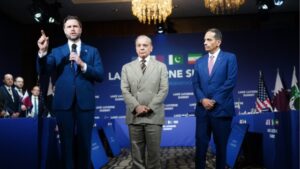
The first round of talks between the United States and Iran in Switzerland has ended with agreement on a 60-day roadmap towards a final settlement and the creation of new oversight mechanisms, despite tensions triggered by Donald Trump’s remarks on the Strait of Hormuz.
Both sides reported progress on key issues after the talks, with technical teams now expected to take over negotiations on sanctions, oil exports and Iranian assets frozen abroad.
Iranian Foreign Ministry spokesman Esmail Baghaei said the work of the negotiating delegations had been completed and that the next phase would continue in Switzerland throughout the week. He said “good progress” had been made on the implementation of commitments undertaken by both sides, and confirmed that an agreement had been reached on a mechanism to ensure the safe passage of ships through the Strait of Hormuz, one of the world’s most important oil transit routes.
Sanctions, oil and frozen assets on the table
According to Baghaei, the talks focused on the unresolved issues needed to move negotiations into their final phase.
These include the release of Iranian assets frozen overseas and exemptions from sanctions restricting Iranian oil exports.
Earlier, Hossein Ghorbanzadeh, a member of the Iranian negotiating team, told Iranian state television that the two sides had discussed procedures for releasing frozen funds, as well as the final draft proposal for the temporary lifting of restrictions on exports of oil and petroleum products.
Roadmap to a final agreement
Qatar and Pakistan, which are mediating between Washington and Tehran, said the talks had taken place in a “positive and constructive atmosphere” and that “encouraging progress” had been made.
In a joint statement, the two mediators said the parties had agreed to set up a High-Level Committee to provide political oversight of the process.
The chief negotiators will regularly brief the committee, while special working groups will be created to deal with Iran’s nuclear programme, sanctions, monitoring arrangements and the resolution of disputes that may arise during implementation of the memorandum of understanding.
The mediators also said the two sides had agreed on a roadmap aimed at reaching a final agreement within 60 days.
New mechanism for Lebanon
Another significant outcome of the talks was an agreement to establish a special de-escalation mechanism for Lebanon, facilitated by Qatar and Pakistan.
The aim is to monitor the security situation and secure a halt to military operations in Lebanon, where clashes between Israel and Hezbollah, the Iran-backed Lebanese militant and political movement, have continued despite ceasefire agreements.
Trump’s threats and Tehran’s response
The negotiations were overshadowed by renewed tension after US President Donald Trump told Fox News that the United States could “seize” the Strait of Hormuz if no agreement was reached.
“We may take over the Strait, if necessary. If they don’t reach an agreement, we’ll charge a toll,” Trump said.
In the same interview, he warned that US airstrikes could resume and made clear that any closure of the strategic sea lane would have serious consequences.
The comments drew a strong response from Mohammad Bagher Ghalibaf, the head of Iran’s delegation, who called on Washington to “measure its words” and warned that Iran’s armed forces were ready to respond.
Temporary impasse, but no collapse in talks
During the talks, the Iranian delegation temporarily left the negotiating room. Iran’s IRNA news agency attributed the move to Trump’s comments and social media posts.
Despite the incident, sources in Tehran said the process had not collapsed and had only been temporarily suspended.
Iranian state television also reported that the first round of talks did not focus on the nuclear programme itself, but on the implementation of the memorandum signed last week, the situation in Lebanon and economic issues.
Market reaction
Trump’s remarks on the Strait of Hormuz had an immediate impact on international energy markets.
Brent crude rose by 1.35% to $81.66 a barrel, while US crude climbed 2.4% to $77.66.
Investors remain concerned that any disruption in the Strait of Hormuz, through which a significant share of global oil trade passes, could trigger further market turmoil.
Optimism from Vance
US Vice President JD Vance described the talks as “historic” and said they could mark the beginning of a new relationship between Washington and Tehran.
He also referred to “significant progress” in efforts to de-escalate tensions in Lebanon, expressing hope that the process would lead to a broader agreement on stability in the Middle East.
Ask me anything
Explore related questions




