





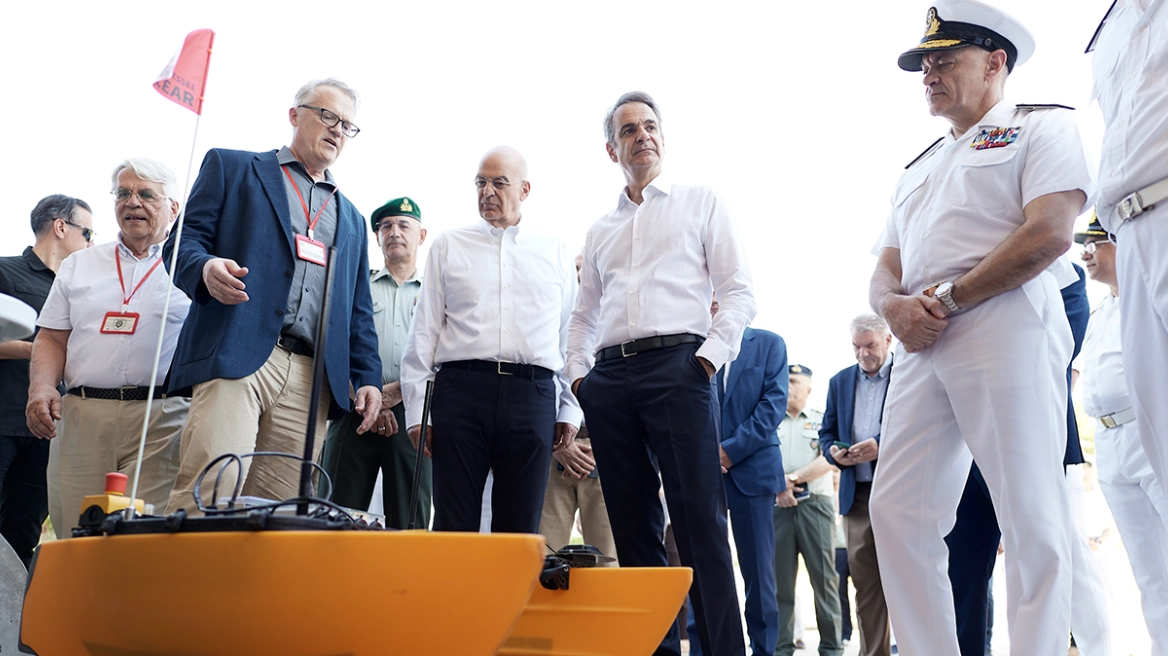
The message that Greece must stand at the forefront of technological and defence innovation in order to ensure the country’s security was delivered by Kyriakos Mitsotakis from the Hellenic Naval Academy, where he attended the training programme on autonomous maritime systems and drones being implemented in cooperation with the leading US university, MIT.
Accompanied by the Minister of National Defence Nikos Dendias, the Prime Minister observed the training of Armed Forces and Coast Guard personnel in cutting-edge technologies concerning unmanned maritime systems, autonomous vehicles, and drone “swarms”, which are now shaping the new operational reality.
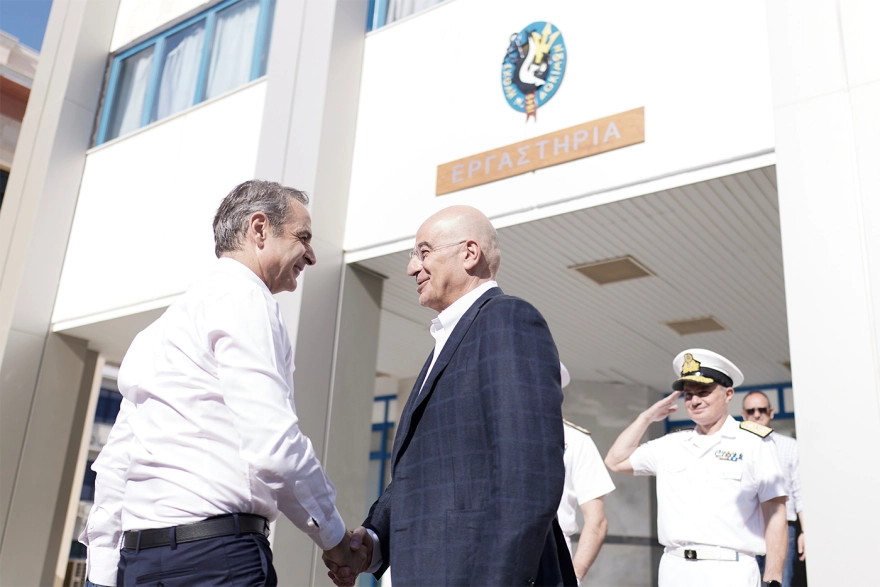
“This that we are seeing today is not simply an image of the future; it is an image of the present of a theatre of operations that is changing dramatically,” Mr Mitsotakis said, stressing that new technologies are transforming the way military operations are conducted.
The Prime Minister placed particular emphasis on the dimension of national security, noting: “We have an obligation, in order to keep our homeland safe, to be at the forefront of global expertise and innovation.”
As he underlined, cooperation between the Greek Armed Forces and MIT, and the transfer of know-how to Greece, constitute critical steps so that the new generation of officers becomes fully familiar with technologies that are already changing the battlefield.
“We are laying the foundations to train our next generation of officers to think not only as captains but also as scientists,” he said.
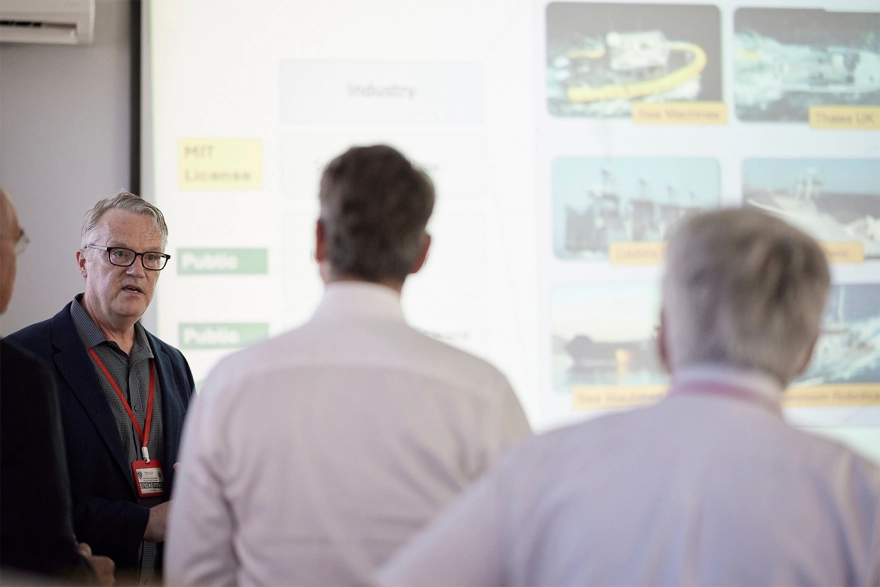
The aim of the program, implemented on the initiative of the Ministry of National Defence by the Hellenic Centre for Defence Innovation (ELKAK), is the transfer to Greece and absorption of cutting-edge know-how in the field of unmanned maritime systems, both in terms of design and operational utilisation in the theaters of operations of the new era.
“For the homeland, it is unique: seminars by MIT professors to Greek cadets on the creation of swarms of autonomous drones at sea and elsewhere,” said Nikos Dendias, explaining that “we are bringing cadets into contact with the new operational reality, with the new era.”
“The professors showed the Prime Minister how new technology affects operations at sea and how it can become a huge advantage for the homeland,” Mr Dendias concluded, thanking the Prime Minister for his support and presence in this new effort.
The Prime Minister was briefed on the two sections of the curriculum, which concern, on the one hand, the electrical and mechanical design of robotic systems and, on the other, autonomy, sensors and communication in the maritime environment.
Kyriakos Mitsotakis was also given a tour of the laboratories and the small harbour of the Academy, where trainees carry out tests with autonomous systems, gaining hands-on experience, for example on drone “swarms”.
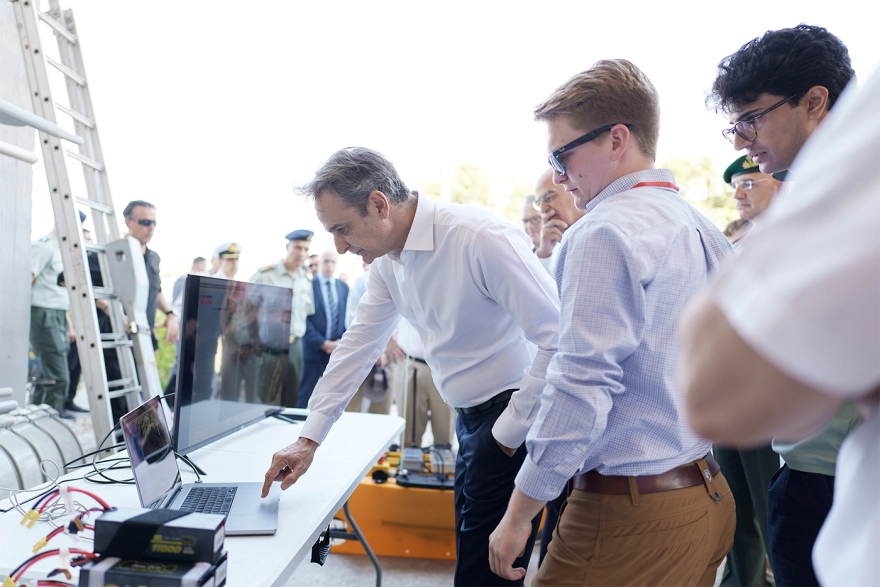
He had the opportunity to speak with program professors, Armed Forces personnel and members of the Coast Guard participating in the initiative, where it was emphasised that such training contributes to forming a core of uniformed personnel specialised in emerging technologies and familiar with their practical application. The adaptation of maritime drones to the geographical particularities of the region was also discussed, as well as alternative uses of autonomous vehicles, for example in support of commercial shipping.
The Commander of the Hellenic Naval Academy, Rear Admiral Ioannis Retsas, noted that the materials and systems designed within the framework of the program will remain in Greece, contributing both to the dissemination of know-how within the Armed Forces and to the replication of training for future classes of personnel, while also upgrading the role of military academies.
During the tour, it was also highlighted that, thanks to the transfer of know-how, the capacity of the Armed Forces to develop autonomous systems is being strengthened, and the broader mission of ELKAK to foster domestic innovative solutions is being supported.
Ask me anything
Explore related questions




