





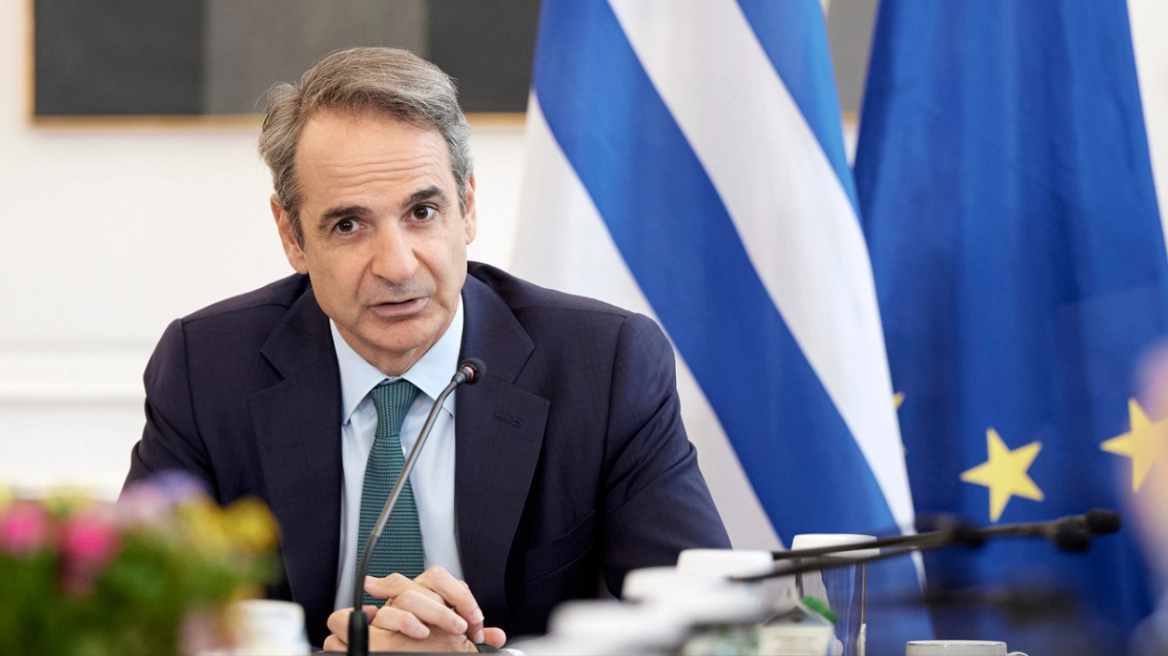
Prime Minister Kyriakos Mitsotakis adopts a particularly tough stance against political violence while reaffirming his determination to complete the government’s full four-year term in an interview with Liberal, in which he addresses terrorism, political developments and the next general election.
Referring to the fatal attack in Thessaloniki, the Prime Minister makes clear that it was not simply an “intervention”, but a purely criminal act. As he stresses, the complete and unequivocal condemnation of such acts is a prerequisite for safeguarding democratic institutions, emphasising that in a modern democracy political differences must be resolved through argument, not violence.
At the same time, he expresses concern over the increasingly inflammatory tone of public discourse, arguing that certain political rhetoric and practices create an environment that can serve as justification for extremist acts. In the same context, he notes that the government has confronted organised groups which, he says, had enjoyed political immunity for years.
On Turkey
“In no circumstances do we foresee war. However, we must continue strengthening our deterrent capability,” he says regarding Turkey.
Speaking about Greek-Turkish relations, he adds: “Greece can and wants to resolve the one major outstanding issue with Turkey, namely the delimitation of maritime zones.”
Responding to accusations of being “too conciliatory”, he says: “These accusations of ‘appeasement’ are something I genuinely cannot understand. I find them more than unfair.”
Elections in Spring 2027
On the political front, Kyriakos Mitsotakis reiterates that the next general election will take place at the end of the government’s term, in spring 2027, ruling out any possibility of an early election.
He also insists that New Democracy will once again seek an outright parliamentary majority, describing the objective as entirely realistic and achievable.
According to the Prime Minister, the stability provided by majority governments is the best option for the country. He also argues that there is currently no credible alternative governing proposal, nor any realistic prospect of meaningful cooperation between the opposition parties.
Criticising his political opponents, Mr Mitsotakis accuses the opposition of ideological stagnation, arguing that it continues to recycle the same arguments without presenting new proposals capable of addressing today’s challenges.
On Tsipras
The Prime Minister is particularly critical of Alexis Tsipras, noting that voters had made him his principal political opponent in the 2023 election. However, he says, Mr Tsipras abandoned that responsibility by handing over his party and is now attempting to return with a new political movement while using the same rhetoric and displaying the same political characteristics.
By contrast, Mr Mitsotakis says he has chosen the problems facing citizens as his true “opponent” and has set his sights on Greece in 2030.
In this context, he argues that the next four-year parliamentary term will be decisive, as international developments are expected to fundamentally reshape the geopolitical and economic landscape. According to the Prime Minister, the real question at the next election will be which government and which prime minister are best equipped to manage those uncertainties so that Greece emerges among the winners.
On Samaras
Mr Mitsotakis also comments on the removal of Antonis Samaras from New Democracy, maintaining that his expulsion from the party was unavoidable because of his public statements.
He adds that the positions the former prime minister continues to express only reinforce, in his view, the correctness of that decision.
Ask me anything
Explore related questions




