





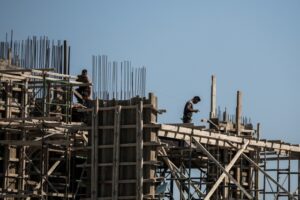
Emergency measures to protect private sector workers from heat stress come into force on Wednesday, 22 July 2026, as particularly high temperatures are forecast across several regions of the country.
According to a circular issued by Greece’s Ministry of Labour and Social Security and signed by the General Secretary for Labour Relations, Nikos Milapidis, employers are required to take the necessary technical and organisational precautions to protect employees under dependent employment relationships, in line with the framework for preventing heat stress.
Specifically, a mandatory suspension of outdoor manual labour will apply from 13:00 to 17:00 in eastern Central Greece, Thessaly, the eastern Peloponnese and the whole of Attica.
The measure covers, among other activities, work on technical and construction projects, building sites and ship repair zones, as well as the delivery and transport of goods by two-wheeled vehicles, scooters or roller skates.
The mandatory suspension applies to all workers regardless of their form of employment, including those working through digital platforms.
For delivery businesses, the suspension applies to both physical stores and digital platforms. However, order collection from stores will remain available, as will delivery by private or public vehicles fitted with air conditioning, excluding motorcycles and mopeds.
Exemptions
Activities linked to critical social infrastructure in the health, transport and public utility sectors are exempt from the mandatory suspension. These exemptions include, among others, healthcare units, water supply, electricity supply, air transport, ground handling, and sea, land and rail transport.
Continued operation is conditional on the application of the required technical and organisational protective measures, including appropriate organisation of working time.
Penalties
As stated in the circular, in the event of a breach of the mandatory suspension, the Labour Inspectorate may impose a fine of 2,000 euros per employee at the company concerned.
Finally, for workers belonging to high-risk groups who are exposed to aggravating conditions in the affected areas, businesses must ensure the option of remote work is provided, where this is permitted by the nature of the job.
To facilitate changes to arrival and departure times, employers in the areas where the emergency measures apply are not required to pre-register any changes to working time arrangements in the ERGANI information system.
Ask me anything
Explore related questions




