





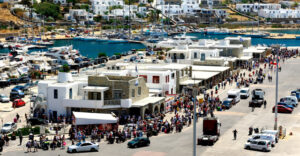
Greece’s new Special Spatial Framework for Tourism has entered its final stage before approval, with several targeted amendments introduced following months of public consultation. While the overall strategy remains unchanged, the latest revisions include stricter rules for tourism development in saturated destinations, a cap on the size of new hotel projects, updated provisions for short-term rentals, and revised criteria for classifying tourism destinations.
The draft has now been submitted to the political leadership of the Ministry of Environment and Energy for final review before the Joint Ministerial Decision (JMD) is signed by Environment and Energy Minister Stavros Papastavrou.
Advisory opinion submitted
According to sources, the amendments incorporated during meetings of the National Council for Spatial Planning mainly refine specific provisions rather than alter the framework’s overall philosophy.
The most significant changes concern:
- Strategic tourism investments
- Maximum capacity of new hotels
- Regulation of short-term rentals
- Minimum distance of tourism developments from the coastline
- Procedures for revising destination classifications
The Council’s opinion has already been forwarded to the Ministry, but it remains advisory rather than binding. The government retains the final say on the wording of the Joint Ministerial Decision, meaning further adjustments remain possible before adoption.
The timetable is tight, as the Special Spatial Frameworks must be approved by the end of the month to meet a key milestone under Greece’s Recovery and Resilience Fund commitments.
Stricter rules for strategic tourism investments
One of the most important changes affects Greece’s highly developed and saturated island destinations.
Unlike the version released for public consultation, the revised proposal explicitly prohibits strategic tourism investments through Special Spatial Development Plans (ESCHASE and ESCHADA) on:
- Group I islands (over 250 sq km)
- Group II islands (20–250 sq km)
Instead, only Organized Tourism Development Areas (OUTD) provided for under spatial planning regulations will be permitted.
Group I includes islands such as Corfu, Kefalonia, Rhodes, Kos, Lesvos, Samos, Chios, Naxos and Zakynthos.
Group II includes destinations such as Mykonos, Santorini, Paros, Tinos, Syros, Milos, Sifnos, Skiathos, Skopelos and Aegina.
The restriction had long been requested by planning experts and local authorities, who argued that previous planning tools effectively allowed major investments to bypass development limits imposed on conventional tourism projects.
350-bed cap for new hotels
Another major amendment introduces a maximum capacity of 350 beds for new hotels in highly developed and saturated tourism areas (Categories A and B).
Although minimum land requirements remain unchanged, the new cap is intended to reduce development intensity by limiting the number of beds relative to land area.
Sources say authorities considered applying the restriction only to islands, but the proposal ultimately recommends applying it uniformly across all Category A and B destinations.
Short-term rentals excluded from destination classification
Short-term rentals, including Airbnb-style accommodation, generated significant debate during consultations.
Officials concluded that counting these properties as part of a destination’s total accommodation capacity could dramatically alter tourism classifications, pushing many developing areas into more restrictive categories simply because of rapid growth in short-term rentals.
As a result, short-term rental beds will not be included when calculating destination classifications through the Carrying Capacity Assessment Report (EKEFY).
However, they may still be considered during individual urban planning assessments.
Minimum distance from the coastline maintained
The revised framework retains the requirement that new tourism developments must be located at least 25 metres from the coastline.
The proposal also clarifies how tourism destination classifications may be revised through Regional Spatial Frameworks and Local Urban Plans.
Classifications may only change one category at a time, preventing abrupt shifts between “saturated” and “developing” destinations. The aim is to ensure gradual changes based on documented planning data.
Minimum plot size requirements remain
The framework keeps its minimum land-size requirements for tourism developments, which will also serve as reference standards for Local Urban Plans.
The main restriction remains the increase in minimum plot size to:
- 16 hectares in the most developed (controlled development) areas
- 12 hectares in developed destinations
- Existing requirements elsewhere
Five categories of tourism destinations
The new framework classifies Greece’s 1,035 municipal units into five categories based on tourism development and future growth potential:
Category A – Controlled Development Areas
Highly saturated destinations facing the strictest restrictions, including Mykonos, Santorini, Skiathos, and parts of Corfu, Rhodes, Kos, Crete and Katerini.
Category B – Developed Tourism Areas
Established destinations with strong tourism infrastructure but not yet considered saturated, including Paros, Naxos, Patmos, Folegandros, Koufonisia, Agios Nikolaos, Rethymno and Chios.
Category C – Developing Tourism Areas
Regions with growing tourism potential, such as Milos, Mytilene, Astypalaia, Leros, Kythnos, Serifos, southern Rhodes, parts of Pelion and Halkidiki.
Category D – Early-Stage Tourism Areas
Destinations where tourism remains in its early stages and moderate growth is encouraged, including the Lasithi Plateau, Kasos, Nisyros and selected municipalities across mainland Greece.
Category E – Areas Requiring Special Development Support
Regions with unique geographic or development characteristics that will receive targeted incentives to encourage sustainable tourism growth, including Fournoi, Irakleia, parts of Naxos, Karpathos and Messinia.
Ask me anything
Explore related questions




