





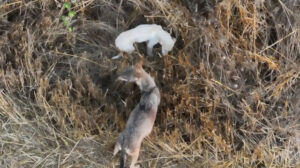
Deeply saddened by the death of the white puppy that had been living with a wolf pack in Central Macedonia, Dr. Theodoros Kominos stressed that, as a wildlife researcher, he is bound by the principle of not interfering with natural processes.
The puppy had lived alongside the pack for several weeks. As ProtoThema.gr reported in early July, it appeared to have been fully accepted by the wolves, who guided it to water sources, brought it food, and even allowed it to play with their young cubs.
Kominos had been monitoring the wolf pack for research purposes when, about 40 days ago, he observed that the white puppy had effectively been “adopted” by the animals.
According to a social media post he published today, just six days ago the puppy was still in excellent condition—playing with the wolf cubs, following the female wolf as she hunted mice and grasshoppers, and moving naturally with the pack.
However, everything changed three days ago.
He observed the puppy “clearly weakened, suffering from severe diarrhea and barely able to move.”
“Everything suggests it developed a serious gastrointestinal condition, which could have been caused by a number of factors, including a parasitic infection, bacterial illness, spoiled food, or even the stress of adapting to a wild environment. Without proper examinations, however, we cannot determine the exact cause of death, and any conclusion would simply be speculation. The puppy isolated itself in one area and never got up again. This morning we found it dead in exactly the same place.”
His post ended with the words: “Safe travels, little one…”
The news of the puppy’s death moved many people, with some questioning why the researcher did not attempt to rescue it himself or alert authorities who could have tried to save it.
“You Don’t Intervene”
Speaking to ProtoThema.gr, Kominos explained why intervention was never an option.
“It is simply not possible for me to intervene. We maintain scientific distance. Nor can I send a veterinarian into an area where there is an active wolf pack—it would be dangerous.”
He explained that he monitors the animals from approximately two kilometers away, using a drone to observe the wolves and the puppy without disturbing them.
“The animals are completely unaware of my presence. Even in this case, you do not intervene. When I saw the puppy in that condition, I was deeply upset, and seeing it dead was even harder—not because I lost a research subject, but because I genuinely felt sorry for it. Until then, it had been full of life.”
Kominos also explained why the research team did not collect the puppy’s body.
“We did not recover the carcass. Decomposition had already begun, and approaching the site would have caused unnecessary disturbance to the wolf family. At that stage, we believed that respecting the wild animals and avoiding unnecessary interference was the right decision.”
Only One Wolf Cub Has Survived
The researcher also highlighted another worrying aspect of the study.
Of the six wolf cubs born to the female wolf this year, only one is known to have survived.
- One was killed by a vehicle.
- Two were found dead, likely due to serious health problems.
- Two others disappeared, and their fate remains unknown.
“This is the first time in three years that this wolf family has lost almost all of its cubs. There has to be a reason. Why did this happen while the puppy was also living with them?”
Kominos said that after observing the sick puppy, he showed the footage to colleagues at the university.
“They believed it was suffering from an intestinal disease and that it was unlikely to survive—it was clearly not in the same condition as the wolf cubs.”
He added that the disappearance of the cubs raises important scientific questions.
“I began wondering, together with my colleagues, whether the puppy—or perhaps other dogs in the area—could have transmitted a disease to the wolf cubs. Wolves are generally less adapted to diseases commonly carried by domestic dogs. But unless this is properly investigated, it remains only a hypothesis.”
The researcher emphasized that determining whether disease transmission occurred will require scientific investigation, and no conclusions can be drawn without evidence.
Ask me anything
Explore related questions




