





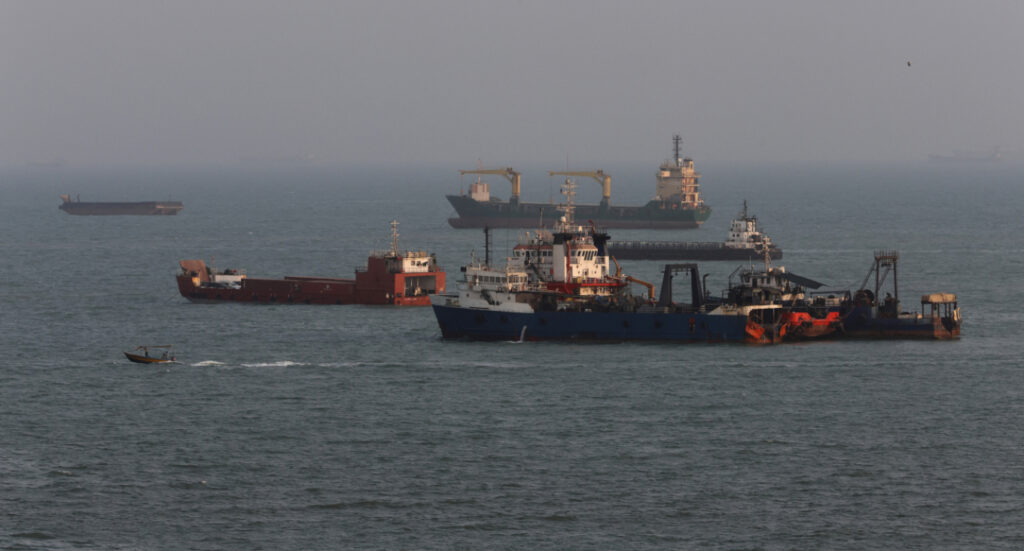
On the afternoon of 25 July, a supertanker docked at Qatar’s Mesaieed oil terminal, about 40 kilometres south of Doha. Four days later, loaded with crude oil, it passed through the Strait of Hormuz and continued on into the Persian Gulf.
On 31 July, however, shortly after 2pm and while off the coast of Dubai, the ship vanished from tracking screens. The supertanker had switched off its Automatic Identification System (AIS), the transponder that broadcasts a vessel’s identity, position, course and speed. For the services that monitor international shipping, the very large crude carrier (VLCC), over 300 metres long, had temporarily ceased to exist.
At 10am on 1 August, its signal reappeared. By then, though, the supertanker had already passed to the other side of the Strait of Hormuz.
Its route was not an isolated incident. As CNN reports in an extensive investigation, it forms part of a new tactic adopted by the oil industry: night time “dark” passages, transponders switched off, under US military escort, aimed at reducing the risk of Iranian drone attacks. The same vessel had been targeted about a month earlier, hit by a drone, although its cargo did not explode.
The 8 to 9 million barrels the market cannot see
With the assistance of the US Navy, oil companies from Saudi Arabia, Kuwait, Qatar and the United Arab Emirates have chartered tankers that cross the Strait with their transponders switched off.
The ships carry oil from the Persian Gulf to the Gulf of Oman, where it is transferred to other tankers owned or chartered by the end buyers. The original vessels then return to the Persian Gulf to collect a new cargo.
In this way, much of the insurance and physical risk involved in a Hormuz crossing shifts from international commercial charterers to the oil producing countries themselves, and, where the safety of the crossings is concerned, to the United States.
The practice appears to have achieved more than the markets are recording.
According to the US Department of Energy, an average of 8 to 9 million barrels of oil a day still pass through the Strait of Hormuz, roughly double the volume estimated by Wall Street analysts and shipping trackers such as Kpler, which rely heavily on AIS signals.
The difference is explained precisely by the vessels that “vanish” from the maps.
In just two days, more than a dozen ship to ship transfers were recorded in the Gulf of Oman, with the cargoes then continuing on to China, Taiwan, South Korea, the Philippines, Vietnam and Thailand.
80% of crossings now happen “in the dark”
The new tactic is being applied at a critical moment for the global energy market.
The war has disrupted about a fifth of global oil supply for around six months. Meanwhile, commercial oil and fuel stocks have fallen sharply, US strategic reserves are at levels not seen since the early 1980s, and China is drawing on part of its vast reserves to prevent international prices climbing even higher.
Faced with the risk of a far larger energy crisis, Middle Eastern producers began systematically carrying out “dark” crossings in recent weeks.
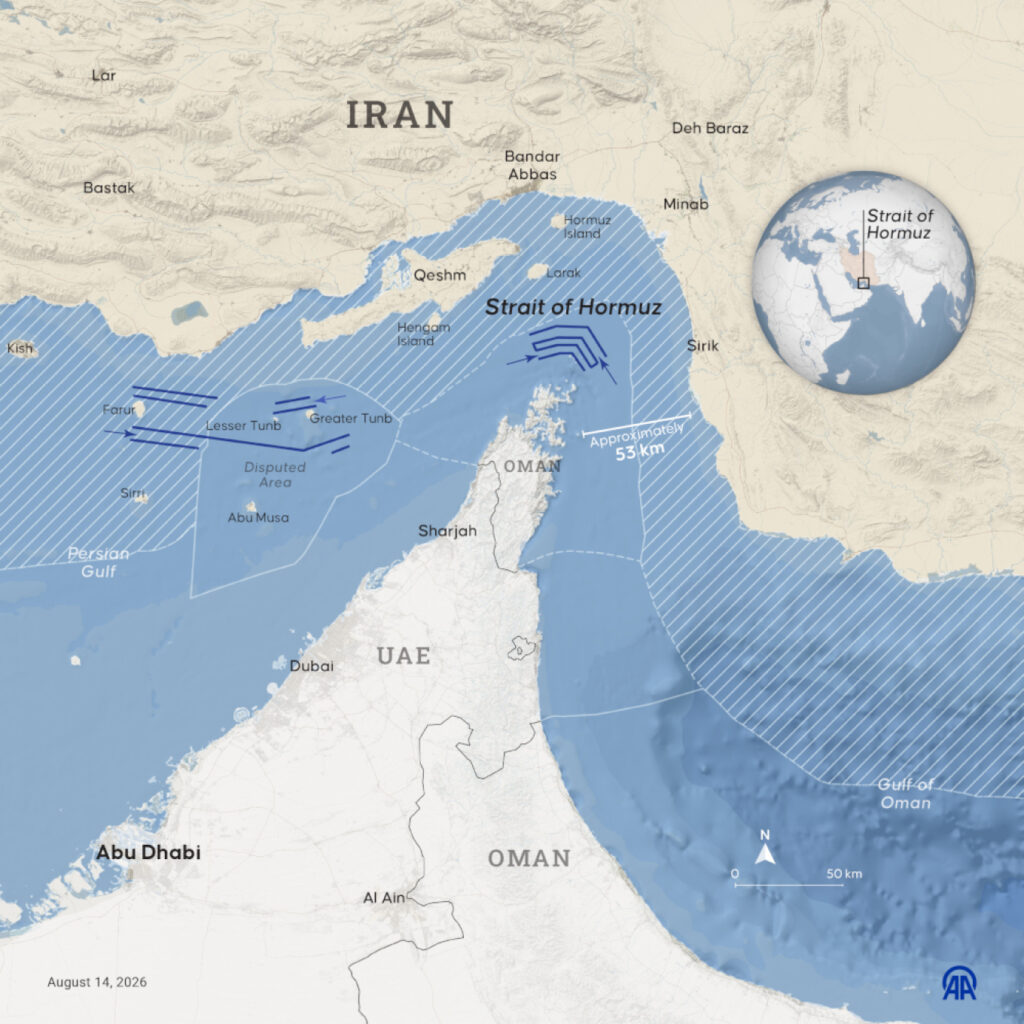
The solution is anything but risk-free. The Strait of Hormuz is only about 37 kilometres wide at its narrowest point, and a tanker can still be detected by radar or satellite even with its AIS switched off. Two vessels from the United Arab Emirates came under attack this week.
According to Kpler, despite the risk, about 80% of traffic through the Strait over the past two weeks has taken place without active transponders, with ships hugging the Omani coast as closely as possible and staying well clear of Iran.
Saudi Arabia bypasses Hormuz
Secret crossings are not the only trick Middle Eastern producers are using to keep their exports flowing.
Saudi Arabia has redirected about 5 million barrels a day through the East-West pipeline to the Red Sea port of Yanbu. Under normal circumstances, these volumes would leave from Persian Gulf ports and pass through Hormuz. Regional producers have managed to bypass the Strait for a further roughly 2 million barrels a day besides.
At the same time, production has risen elsewhere in the world. Brazil, Guyana and Venezuela have together added more than 1 million barrels a day to the global market, while the US is also producing hundreds of thousands of extra barrels a day.
On the other side of the equation, Washington has released 400 million barrels from its strategic reserves, sharply depleting the Strategic Petroleum Reserve. China is also drawing on large oil stocks while significantly cutting crude imports. Demand itself has fallen too, owing to higher prices.
The market, in other words, has proved far more flexible than even seasoned analysts expected at the start of the crisis.
Satellites spot ships that do not appear on the maps
The true scale of the operation is revealed by satellite imagery. Photographs taken on 14 August show rows of small dots, ships, moving in an arc along the coast of Oman and through the Strait.
At the same time, there were no corresponding AIS records. The ships had effectively “gone dark”.
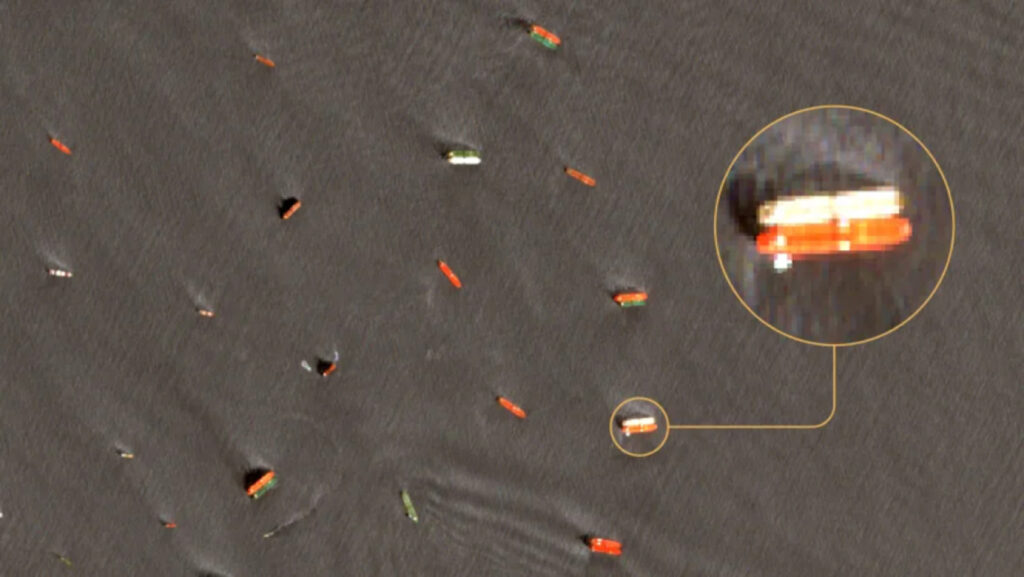
Satellite images from 7 August 2026 show vessels off the coast of the United Arab Emirates, shortly after one crossed the Strait with its AIS transponder switched off (EU Copernicus Sentinel-2 satellite)
Why this solution cannot last forever
The system is buying time, not solving the problem. Global oil stocks are estimated to have fallen by as much as 1.9 billion barrels during the war.
Even if the market eventually reaches equilibrium, these reserves will at some point need replenishing. Otherwise, they will fall to levels too low to act as a buffer against a fresh crisis.
In such a scenario, the main balancing mechanism would be far more painful: prices would have to rise enough to curb global consumption still further.
The problem has already begun to show up in refined fuels. Three of the world’s four major refining hubs are under serious strain. The war has damaged refineries in the Middle East and curbed the region’s exports of oil products.
At the same time, Russian refineries have been hit by Ukrainian drones, while Moscow, facing domestic fuel shortages, has restricted exports. China too is cutting exports of refined products to secure its own supply. As a result, much of the burden now falls on US refineries on the Gulf Coast, which cannot run at full capacity indefinitely.
Oil near $100 and pricier petrol, diesel and jet fuel
The pressure is already particularly intense in petrol, but above all in diesel and jet fuel, where available refining capacity is not enough to comfortably meet demand.
That is why their prices have risen far more than the price of crude alone would justify.
US President Donald Trump had for months managed to keep market expectations in check by talking up imminent diplomatic progress. American strategy, however, has now shifted towards sustained economic and naval pressure on Iran.
That shift has gradually pushed oil prices higher, now approaching $100 a barrel.
The battle for control of the Strait of Hormuz is thus continuing to keep oil, and even more so petrol, diesel and jet fuel, at elevated levels, fuelling inflation and squeezing consumers’ disposable income.
Even so, the fact that the global market has managed to create new routes, boost production elsewhere, draw on strategic reserves and carry out millions of barrels of “invisible” crossings through Hormuz has so far averted the worst case scenario. Without this coordinated, largely unseen operation, the biggest oil supply disruption the global market has faced could have pushed prices far higher.
Ask me anything
Explore related questions




