





For more than a decade, enterprise technology strategies revolved around one defining question:
How do we move to the cloud?
Cloud computing fundamentally changed the way organizations built software, managed infrastructure, and delivered digital services. It enabled businesses to scale applications on demand, reduce infrastructure costs, accelerate innovation, and respond more quickly to changing customer expectations. Cloud-first became the blueprint for digital transformation, allowing enterprises to modernize operations and become more agile in an increasingly competitive market.
But technology never stands still.
Today, Artificial Intelligence is changing the conversation once again. Organizations are no longer focused solely on where applications run—they’re increasingly asking whether their infrastructure is capable of supporting AI-driven operations.
The question has shifted from “Are we in the cloud?” to “Are we ready for AI?”
That distinction may seem subtle, but it represents one of the biggest strategic changes in enterprise technology since the rise of cloud computing itself.
AI Has Different Infrastructure Requirements
Traditional enterprise applications were designed to process transactions, execute business rules, and manage structured data efficiently.
Artificial Intelligence operates differently.
Instead of simply processing transactions, AI processes knowledge. Large Language Models (LLMs), intelligent assistants, recommendation engines, Retrieval-Augmented Generation (RAG), predictive analytics, and autonomous AI agents require continuous inference, rapid access to enterprise knowledge, and enormous computational power.
Unlike conventional software, AI systems must interpret context, understand natural language, retrieve information from multiple sources, and generate responses in real time. These capabilities create workloads that traditional enterprise infrastructure was never designed to handle.
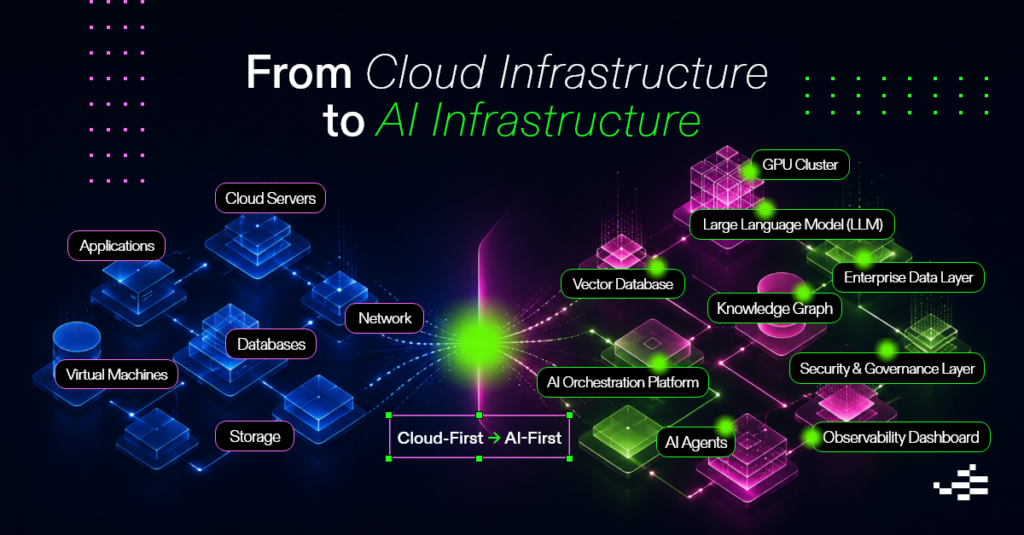
While cloud platforms remain the foundation of modern IT, many organizations are discovering that being cloud-ready doesn’t automatically make them AI-ready.
Supporting enterprise AI requires infrastructure specifically optimized for intelligent workloads, combining compute, networking, storage, and data services into a platform capable of delivering consistent AI performance at scale.
Infrastructure Is No Longer Just About Compute
When conversations turn to AI infrastructure, GPUs usually dominate the discussion—and for good reason.
High-performance GPUs have become essential for training machine learning models and running inference at enterprise scale. As AI adoption accelerates, demand for GPU resources continues to grow across every industry.
However, focusing exclusively on compute power overlooks a much larger picture.
Enterprise AI depends on an entire ecosystem working together. Reliable AI requires modern data architectures capable of semantic search, orchestration platforms that coordinate multiple models and business systems, governance frameworks that ensure trustworthy outputs, and observability platforms that continuously monitor performance, quality, and operational costs.
Without these foundational capabilities, organizations may succeed in launching AI applications but struggle to operate them efficiently, securely, or consistently.
The real challenge is no longer deploying an AI model. It’s creating an infrastructure that allows AI to become part of everyday business operations.
Data Has Become the Competitive Advantage
One of the biggest misconceptions surrounding enterprise AI is that success depends primarily on selecting the best language model.
In reality, the quality of enterprise AI depends far more on the quality of the organization’s data than on the model itself.
Most leading AI models have become remarkably capable. What differentiates enterprise outcomes is the information those models can access.
Modern AI systems retrieve knowledge based on meaning rather than keywords. This shift has accelerated investment in vector databases, knowledge graphs, semantic search technologies, and intelligent retrieval systems that enable AI to understand organizational knowledge instead of simply searching through documents.
Organizations that invest in AI-ready data foundations create more accurate, contextual, and reliable AI experiences for employees and customers alike.
Conversely, organizations with fragmented, outdated, or poorly governed data often discover that even the most advanced AI models produce inconsistent or unreliable results.
Data is no longer simply an operational asset.
It has become a strategic advantage.
Orchestration Is the Missing Layer
As AI becomes more deeply integrated into business processes, organizations are moving beyond standalone chatbots and isolated AI assistants.
Today’s enterprise AI solutions often involve multiple technologies working together. A single request may require retrieving information from internal knowledge bases, querying business applications, accessing APIs, invoking several AI models, validating responses against company policies, and returning an answer within seconds.
This level of complexity requires orchestration.
AI orchestration platforms coordinate these interactions, ensuring that models, enterprise systems, data sources, and workflows operate as a unified ecosystem. They also enable organizations to build AI agents capable of executing multi-step business processes instead of simply answering questions.
Without orchestration, AI remains a collection of disconnected tools.
With orchestration, it becomes an enterprise capability.
Governance Is Infrastructure
As AI becomes part of daily business operations, governance can no longer be treated as a separate initiative.
Security, identity management, access controls, compliance, auditability, and transparency must be embedded directly into the infrastructure from the beginning.
Organizations need confidence that AI systems only access authorized information, generate responses based on trusted sources, and operate within clearly defined policies.
This is particularly important as regulations surrounding AI continue to evolve and enterprises increasingly rely on AI for customer interactions, internal decision-making, and business automation.
Trustworthy AI isn’t something that can be added after deployment.
It’s designed into the architecture from day one.
Organizations that invest in governance early will find it significantly easier to scale AI responsibly as adoption grows.
Observability Makes AI Sustainable
Monitoring traditional infrastructure typically focuses on CPU usage, memory consumption, storage capacity, and application uptime.
AI introduces an entirely new set of operational metrics.
Organizations now need visibility into inference latency, retrieval quality, token consumption, model accuracy, hallucination rates, user satisfaction, and operational costs.
These insights help teams identify bottlenecks, optimize performance, control spending, and continuously improve AI systems over time.
Without observability, organizations have little understanding of how their AI systems behave in production.
With it, AI becomes measurable, manageable, and continuously improvable.
From AI Experimentation to AI-Ready Infrastructure
This shift from cloud-ready to AI-ready is also shaping the way Cloudevo approaches enterprise technology. With expertise spanning AI & Machine Learning, Data & Analytics, and Next-Gen Cloud Development & Architecture, Cloudevo helps organizations build the technological foundations required to move AI beyond experimentation and into real business operations.
The starting point is not simply choosing an AI model or adding another AI tool to the technology stack. It is about understanding whether the existing infrastructure, data architecture and cloud environment are ready to support intelligent workloads securely, reliably and at scale.
At Cloudevo, this means bringing together cloud architecture, data, AI, security and scalability as interconnected parts of the same strategy. From assessing existing environments and designing scalable cloud architectures to developing, deploying and continuously improving AI solutions, the focus is on creating systems that can evolve alongside the needs of the business.
A practical example of this approach can be seen in the technology infrastructure developed by Cloudevo for the English-language edition of Proto Thema. The solution uses an AI-powered workflow that combines content extraction, AI translation, automated CMS integration and human editorial review. Rather than using AI as a standalone tool, the technology is embedded into a broader operational workflow — demonstrating how AI can become part of a real, repeatable business process.
This is ultimately what AI readiness means in practice. It is not just about having access to powerful models or high-performance computing. It is about having the right infrastructure, data foundations, governance and processes in place to turn AI capabilities into reliable and measurable business value.
For Cloudevo, the next stage of cloud transformation is therefore not simply about moving more workloads to the cloud. It is about building the infrastructure that allows businesses to operate, scale and innovate with AI.
Ask me anything
Explore related questions




