





With an epic video showing David launching a stone from his sling, which transforms into a missile and destroys an incoming aerial threat, Israeli defense systems company Rafael marked its participation in the agreement signed on Monday in Israel for the “Achilles Shield.” The deal will launch the implementation of Greece’s multilayered air-defense, anti-drone, and anti-ballistic “shield.”
Rafael is the company behind the David’s Sling system — “David’s sling” — one of the systems already used by Israel as part of its broader air-defense architecture, alongside the Iron Dome.
According to Israel’s Ministry of Defense, the agreement, worth more than €3 billion, is the “largest defense export agreement in the history of Israel-Greece relations and one of the largest in the history of the State of Israel.” At the same time, it marks the first time Israel will supply another country with an “integrated defense system against a broad range of threats,” including ballistic missiles and drones.
As the Times of Israel notes, the agreement also comes amid growing tensions between Israel and Turkey, due to Ankara’s efforts to expand its influence in Syria. The newspaper notes that Turkey is a traditional rival of Greece, and that the weapons systems are expected to contribute significantly to Athens’ defense against its neighboring country.
“This project represents another milestone in the defense cooperation between Israel and Greece, a key strategic partner in the Eastern Mediterranean. Greece’s selection of Israeli technology as the backbone of its most ambitious air-defense enhancement program of the past decade reflects the depth of trust that has been built between the two countries,” the Israeli ministry said.
For his part, Israel’s Defense Minister Israel Katz said that the decision to deepen defense cooperation was made during his most recent visit to Greece.
🇮🇱🇬🇷 pic.twitter.com/jAkOY7JsP2
— Rafael Advanced Defense Systems (@RAFAELdefense) August 31, 2026
“Israel and Greece share common strategic interests and face common regional challenges. At a time when actors with hegemonic ambitions are seeking to expand their influence and undermine stability in the region, Israel and Greece will continue to deepen their defense and strategic cooperation and will act decisively to preserve stability and protect their security and shared interests,” Katz said, apparently referring to Turkey.
Israeli Prime Minister Benjamin Netanyahu, meanwhile, said: “The security agreement signed today with Greece, one of the largest in the country’s history, is a direct continuation of the alliance in the Eastern Mediterranean that we established a decade ago with Greece and Cyprus.”
Prime Minister Benjamin Netanyahu:
— Prime Minister of Israel (@IsraeliPM) August 31, 2026
"The security agreement signed today with Greece, one of the largest in the country's history, is a direct continuation of the Eastern Mediterranean alliance we forged a decade ago with Greece and Cyprus. It serves as further proof of the… pic.twitter.com/42AW0kymvr
He added that the agreement was “another demonstration of the enormous capabilities of Israel’s defense and technology industries” and “a move that expresses Israel’s strength, confidence in our defense exports, and the strengthening of regional alliances.”
The “Achilles Shield” makes headlines around the world, while Turkish media calls it a “huge sale”
Monday’s signing of the intergovernmental agreement between Greece’s Ministry of National Defense and the Israeli side for the development of the air-defense, anti-ballistic, and anti-drone shield — the “Achilles Shield” — featuring a unified and holistic command-and-control system, attracted international attention.
With the signing taking place in Tel Aviv, major news organizations around the world immediately reported the development, as Athens’ strategic move reshapes the balance in the Southeastern Mediterranean.
“Greece has also sought to strengthen its position in the eastern Mediterranean, close to several conflict zones in the Middle East,” Le Monde noted.
At the same time, Reuters, citing officials, described the agreement as part of a broader military modernization program.
For Deutsche Welle, Greece’s increased defense activity represents a significant development, noting that “by 2036, Greece plans to spend around €28 billion on broader military modernization.” This also includes purchases of fighter aircraft from the United States and warships from France and Italy.
The first
The fact that Athens is the first European Union member state to acquire such a multilayered defense infrastructure also attracted attention from the European press.
Politico noted that “Athens is going a step further than some other European buyers of Israeli air-defense systems,” while the Turkish press has described the deal as a “huge sale.”
Specifically, in an article published today under the headline “Huge sale from Israel to Athens! Agreements signed for the Achilles Shield,” Turkish newspaper Hürriyet described it as a “huge project” that, according to the paper, has “divided Greek media and public opinion.”
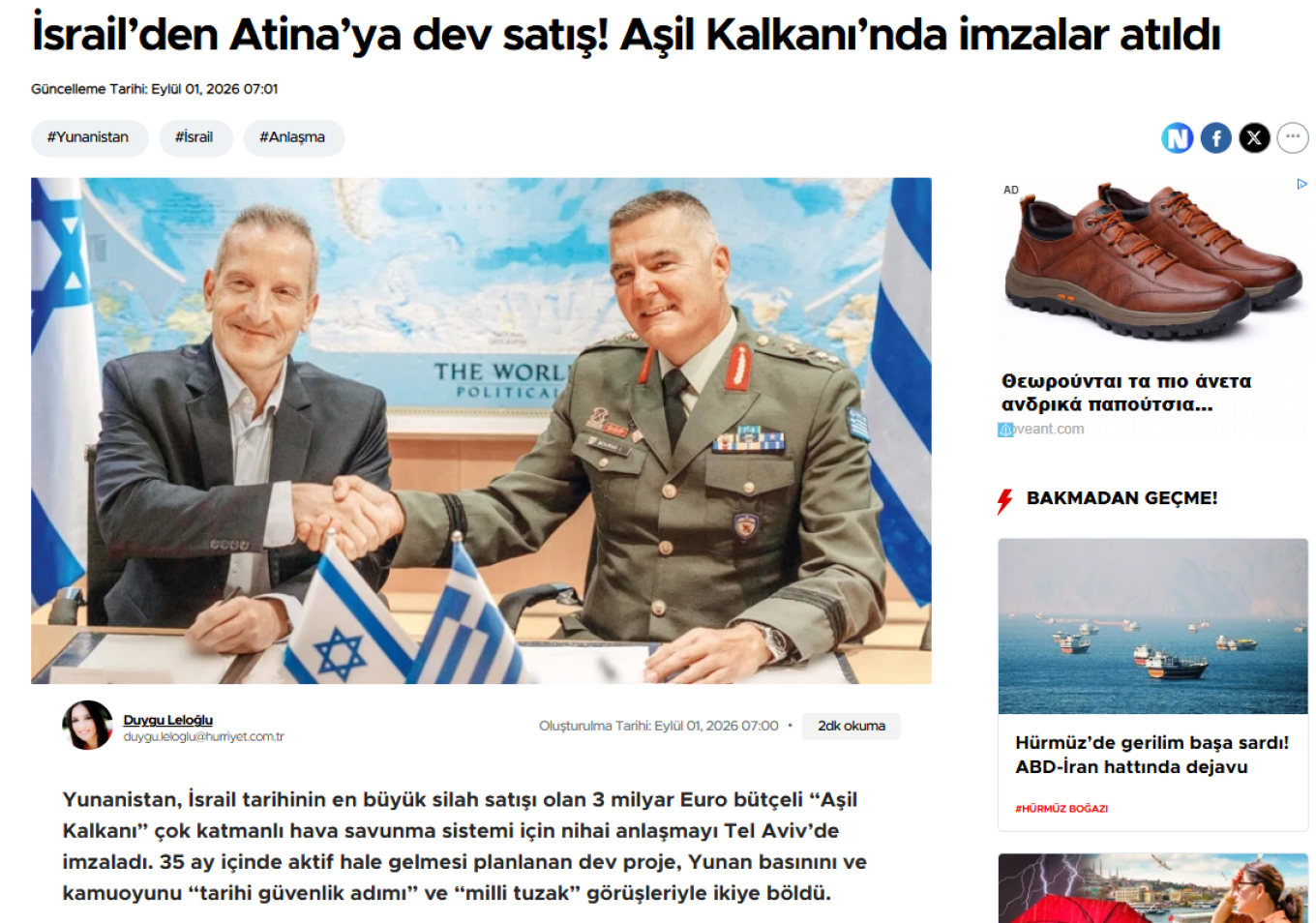
At the same time, the newspaper’s columnist Nilgün Tekfidan Gümüş argues:
“At a time when Turkey is making progress in its defense industry, becoming a global leader in UAV and UCAV technology, rapidly developing its missile capabilities, expanding the ‘Gökkubbe multilayered air-defense system’ using domestic and national resources, and increasing its geopolitical influence, Greece knocked on Israel’s door.
“Instead of cooperating with European companies on the project, Greece chose Israel, with which it is attempting to form an axis in the Eastern Mediterranean together with the Greek Cypriot administration.”
The timeline
Full deployment of the system is expected within 35 months from now, according to Proto Thema — meaning July 2029 — with the participation of 19 Greek companies.
Parts of the shield will, however, be completed progressively. In addition, the PULS missile system is expected to arrive within 18 months, further strengthening Greece’s defense capabilities.
The “Achilles Shield” includes David’s Sling, the system’s highest-tier air-defense layer; the Barak MX system at the intermediate level; and the SPYDER system, which, together with Hawk missiles, will cover medium ranges.
It also includes Drone Dome, under a separate €26 million agreement, designed to intercept small drones.
After detecting a drone, Drone Dome can disrupt the connection between the drone and its operator, as well as interfere with its GPS signal. The system has already demonstrated its capabilities, having been used to protect the G7 Summit in Cornwall in 2021.
The program’s total budget amounts to €3.035 billion.
Its implementation is also expected to involve extensive participation from Greece’s defense and technology sectors, with 19 Greek companies already participating in the relevant procedures.
Their share of the project exceeds 25%, amounting specifically to approximately €750 million.
At the same time, the agreement provides for the creation of a production base in Greece, with potential for future exports.
Ask me anything
Explore related questions




