





The Gallery Miranda opened in Hydra in the summer of 1976, when Miranda Sofianou-Paraskeva founded Art Gallery Miranda. At the time, the island was already a gathering place for many painters, writers and other artists from Athens and abroad, and she gave them a space in which to show their work. That space was located inside the family mansion itself.
Fifty years later, Gallery Miranda returns to Hydra with the exhibition “1976–2026.” Antonis Paraskevas is organizing it together with his mother, Miranda, and his siblings, Nikos and Phoebe. Works from the gallery’s historic period are presented alongside and in dialogue with works of postwar European art that were added to the collection later. We spoke with them about the gallery’s beginnings in their family home in Hydra and what it means to keep alive a relationship with art that you have inherited.
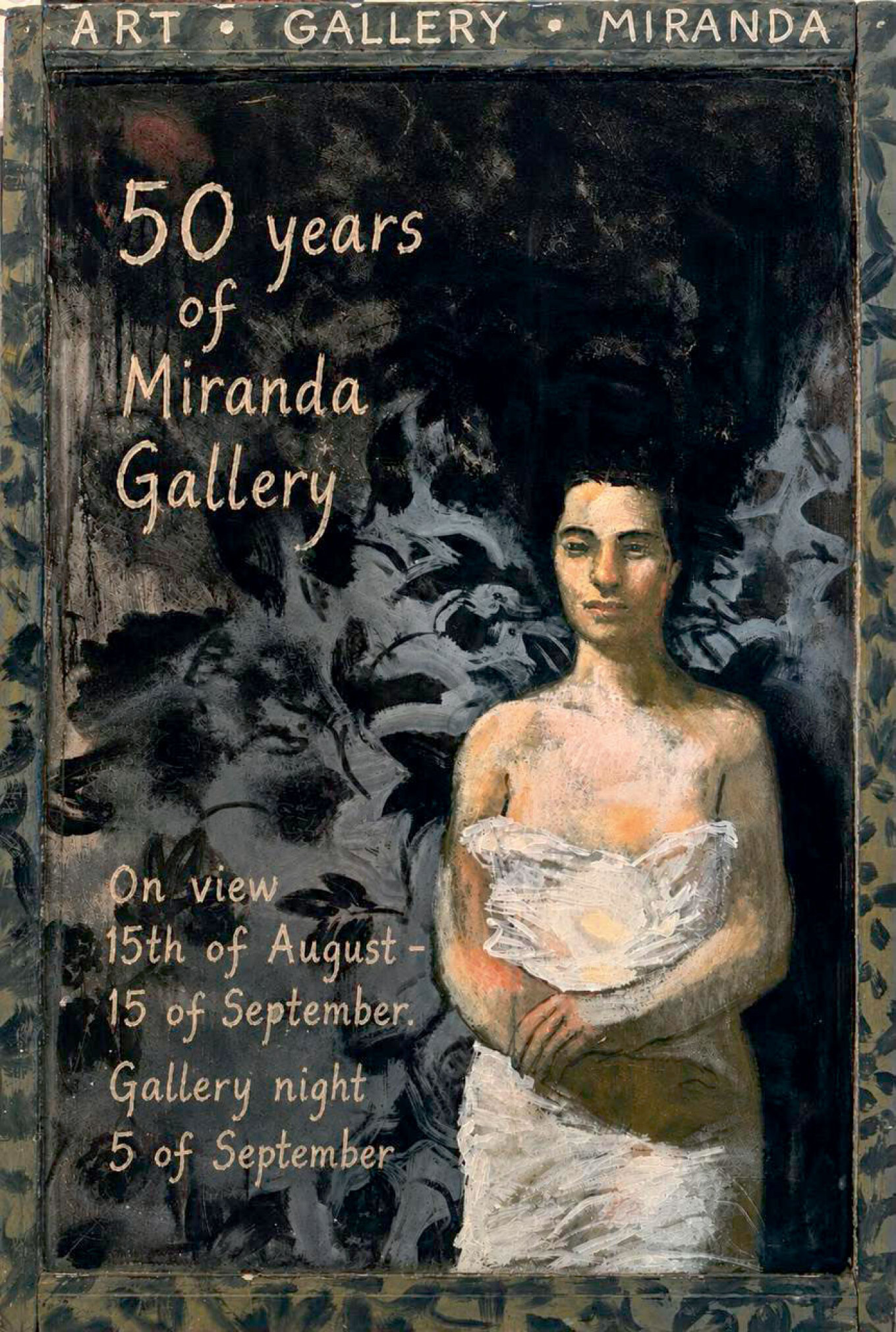
—What prompted your mother, Miranda, to open a contemporary art space in Hydra in 1976? What was the island’s artistic climate like at the time, and what did she want this space, located within your family mansion, to be?
Gallery Miranda began in 1976 very naturally, almost as an extension of the house itself and of our life in Hydra. My mother loved art very much, but she loved the people involved in art just as much. She had a particular way of bringing together painters and people with different ideas and backgrounds.
I don’t think she started out with a strict plan to create a “gallery” in the modern sense of the word. She wanted more to create a space where things that interested her could be presented and where people could meet.
At that time, Hydra was home to artists, writers and people coming from Athens and abroad, and there was a sense of freedom and inspiration that was different from today.
The gallery was located inside the family mansion. That gave it a particular character—you weren’t entering a conventional white exhibition space, but a home. I think that sense of intimacy also defined its character.
—The gallery always remained small-scale and personal. How did that shape the artists it hosted?
The gallery never tried to become large. Relationships with artists were personal, and often they came before the exhibition itself. Many of the most important representatives of Greek art passed through the gallery—not simply to show their work and leave, but to stay, talk and eat with us.
For us, as children, all of this seemed completely normal. Only much later did we realize how special it was.
I remember, for example, a story involving Dimitris Papaioannou. At the time, he had just graduated from the School of Fine Arts and was participating in a group exhibition with other young artists. He had painted a large sign for their exhibition himself, featuring a prominent nude female figure.
As usual, the sign was placed at the harbor so that people would know about the exhibition. It wasn’t long before the police appeared. It was August 15, the Feast of the Dormition of the Virgin Mary, and the procession was about to pass through the harbor. We were told that the image had caused considerable concern within the Church.
So we were asked to remove it immediately.
Dimitris found the simplest solution. He took a paintbrush, went down to the harbor and painted a white dress over the nude woman, effectively dressing her. The problem was solved, and the sign remained in place.
I really like this story because, in a way, it describes both the era and the gallery. There was spontaneity, humor and freedom. There was no great distance between art, the artist and everyday life. Everything happened together.
—You describe the anniversary exhibition “1976–2026” as a new dialogue rather than a retrospective. What will visitors see? How do the works from the gallery’s historic period interact with the postwar European art that was added to the collection later?
Visitors will encounter works by artists who became connected with the history of Gallery Miranda alongside works of postwar European art that entered the collection much later.
These represent different artistic journeys from different periods and countries. What interests us is what happens when these works find themselves in the same space today.
Suddenly, you may discover affinities that are not necessarily historical. They may have to do with material, gesture, geometry, the use of color, or simply a particular way of seeing things.
I am very interested in the idea that a collection is not something static. It changes together with the people who create it.
My mother made her choices then. Fifty years later, we inevitably have our own perspective. There is no reason for one to replace the other. What is interesting is for them to meet and enter into dialogue.
That is why 50 years seemed to us like a good moment not only to look back, but also to reopen this dialogue.
Above all, of course, it is a way of saying a big “thank you” to our mother for the inspiration and passion she passed on to us.
—The continuation. You are organizing the exhibition together with your siblings, Nikos and Phoebe. What does it mean to you to keep this relationship with art alive half a century later, and where do you see the gallery and collection going from here?
The fact that we are putting this exhibition together with Nikos and Phoebe is particularly meaningful to me. Because, in the end, we didn’t simply acquire a number of artworks. We inherited a relationship with art.
Each of us experienced it differently and has our own perspective. What unites us, however, is that Gallery Miranda is part of our family history. It is connected to our mother, to Hydra, but also to a large part of our childhood.
I wouldn’t want us to try to faithfully reproduce what the gallery was in the 1970s or ’80s. That era was unique and cannot be repeated.
But I would like us to preserve something of its spirit: the small scale, personal choice, curiosity and, above all, freedom.
I want the collection to engage in dialogue with its history without becoming trapped by it. We should be able to look at older works with fresh eyes, while also adding things that interest us today.
If we manage to preserve that curiosity and that freedom, I think we will have kept alive the most important part of Gallery Miranda.
Ask me anything
Explore related questions




