





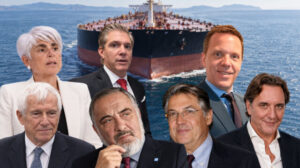
Greek shipowners are not only leading the market in vessel purchases and newbuilding orders. They are also carrying out a major cash-out in the secondhand market, taking advantage of valuations that, in some segments, have reached record levels.
Over the past rolling 12-month period, Greek interests sold 316 vessels, more than any other nationality: 164 bulk carriers, 117 tankers, 22 containerships and nine gas carriers. The gap with the next-largest sellers is substantial, with Chinese owners selling 156 vessels and Japanese owners 152.
Behind the numbers lies a clear strategy: liquidating older or overvalued tonnage, locking in capital gains and renewing fleets.
The trend is particularly pronounced in tankers. Data from Veson Nautical showed that the five largest Greek tanker sellers had completed transactions worth a combined $1.71 billion during 2026. Leading the list was Evalend Shipping, controlled by Kriton Lentoudis, with $451.49 million, followed by TOP Ships of Evangelos Pistiolis with $413.72 million. They were followed by TEN of Nikos Tsakos with $327.35 million, Atlas Maritime of Leon Patitsas with $307.36 million, and Dynacom Tankers of George Prokopiou with $213.1 million.
Dynacom’s case is particularly interesting, as Veson notes that the company is not traditionally considered a systematic seller. However, high offers from South Korea’s Sinokor for VLCCs created an opportunity that was difficult to ignore.
Tsakos Raises $100 Million and Invests in Newbuildings
The model is even clearer at Nikos Tsakos’s TEN. The company sold two 2006-built Suezmax vessels, a move that, according to the company, will add more than $100 million to its cash reserves.
At the same time, a programme for 26 newbuildings is underway, seven of which have already been delivered and chartered. TEN management itself has described the strategy as monetising the value of its “first-generation” vessels. Older tonnage is being sold at attractive prices and replaced with newer ships.
The strongest incentive to sell currently lies in the VLCC segment. Olympic Shipping and Management, affiliated with the Onassis Foundation, sold the 15-year-old Olympic Leopard to ADNOC Logistics & Services for approximately $115 million. The price is considered a historic record for a VLCC of that age and is only around 10% below the price of a newbuilding currently in China.
In the same wave, Delta Tankers, controlled by Diamantis Diamantidis, agreed to sell the 2015-built VLCCs Delta Amazon and Delta Apollonia for approximately $120 million each.
Another significant asset play was carried out by Hellenic Tankers of Andreas Hatzigiannis with the Stephanie. The VLCC was acquired in 2021 for approximately $41.5 million, while its sale this year was estimated at between $76 million and $79 million.
The broader Greek activity in large tankers also includes Thenamaris of Nicolas Martinos, which is simultaneously among the largest Greek tanker buyers in 2026. This illustrates just how quickly portfolios are being recycled today: the same group can be on one side of the market with one asset and on the other with a newer vessel or one with different specifications.
The Rotation Extends to Bulk Carriers
It is not only tankers. With Capesize freight rates strengthening significantly, higher valuations are also creating opportunities in dry bulk.
Navios Maritime Partners, controlled by Angeliki Frangou, sold the Navios Pollux, a 180,700-dwt Capesize built in 2009, for approximately $30.75 million, while Lavinia Bulkers of Panos Laskaridis sold the Erato.
These are two more examples of owners taking advantage of a strong market to liquidate older tonnage. Geopolitical disruptions, high freight rates and strong demand for prompt vessel availability have dramatically altered valuations.
For VLCCs, Veson had already valued a 10-year-old vessel at $117.33 million, almost two and a half times the long-term median of $48.68 million. Since then, the market has climbed even further, with 15-year-old VLCCs approaching $100 million.
For an owner who bought at a lower price, the dilemma is obvious: keep the vessel and continue collecting high freight rates, or lock in tens of millions of dollars in capital gains now.
Greek shipowners appear to be doing both, depending on the asset.
This is demonstrated by the other side of the transaction book. During the same period in which they sold 316 vessels, they acquired 229 secondhand ships, also more than any other nationality.
The Greek “sell-off,” therefore, is not an exit from shipping. It is a multi-billion-dollar rotation: selling older or highly valued tonnage, strengthening liquidity, and repositioning into younger secondhand vessels and newbuildings.
Ask me anything
Explore related questions




