





Ankara appears determined to continue escalating its response, with the aim of preventing Greece from reshaping its defence posture by strengthening the defence of the islands and, above all, equipping them with Israeli defence systems, using the familiar argument over the demilitarisation of the islands as its vehicle.
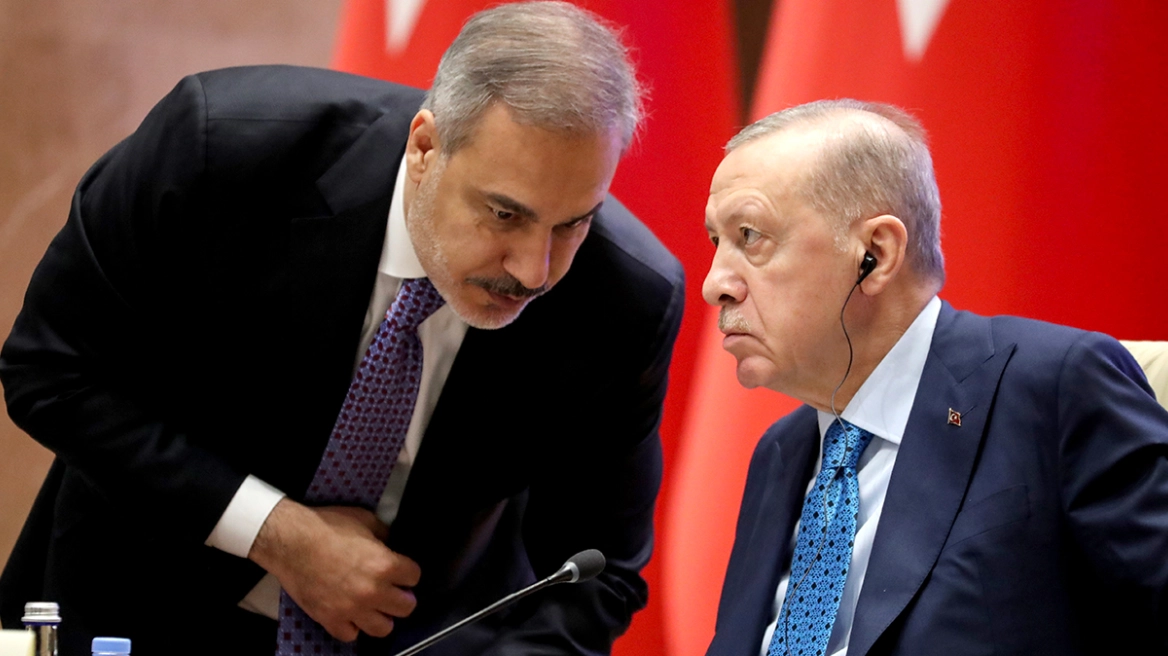
This is not the first time that Turkey, as Foreign Minister Hakan Fidan did the day before yesterday, has described Greece’s moves to strengthen the defence of the islands as a “threat to Turkey’s security” and as destabilising for the region.
As early as the 1980s, Turkey had presented Greece’s defence measures on the islands as a “threat to Turkey’s security”. More recently, in its letter to the UN on 14 July 2021 (A/75/961-S/2021/651), it had clearly set out its position: “…Greece’s continued, deliberate and persistent material violation of the demilitarisation provisions of the Lausanne and Paris Peace Treaties, which are essential to the achievement of their object and purpose, constitutes a serious threat to Turkey’s security. Equally important is the fact that, given their escalating nature, these violations have broader implications, as they constitute a threat to peace and security in the region.”
With this letter, Turkey had essentially taken a highly significant step in escalating the issue, as it linked the alleged obligation to demilitarise the islands to Greek sovereignty over them as a prerequisite.
The letter stated characteristically: “…In this context, I wish to underline the fact that Greece is violating fundamental provisions of the Treaties under which it acquired sovereignty over the islands. From a legal perspective, this means that Greece cannot, vis-à-vis Turkey, invoke the title to sovereignty deriving from those same Treaties for the purposes of delimiting maritime boundaries. This is because Greece, having failed to fulfil the obligations arising from the Treaties, cannot at the same time be considered to retain the rights it claims derive from them….”
For Turkey, under pressure from the Turkish media and also within the anti-Israel front that Recep Tayyip Erdoğan is seeking to build and lead, Athens’ decision not only to continue its strategic relationship with Israel but also to proceed with the procurement of advanced Israeli defence weapons is considered to cross “red lines”.
Turkey’s encirclement syndrome has always been dominant in state policy, but now this “threat” is coming from its major regional rival, Israel. Ankara considers that Greece’s procurement of Israeli anti-aircraft and anti-missile systems, and their much greater deployment on Greek islands, creates a breach in the “flanks” of the Turkish military posture along its western borders.
Turkey is now targeting Greece over the alleged obligation to demilitarise the islands, seeking precisely to create the conditions for undermining the transfer and deployment on the islands of the Israeli systems and the radars accompanying them.
In Ankara, officials believe that by invoking international agreements they will have external legitimacy for perhaps the first time, as on all other issues Turkey, with its revisionist policy, is in a difficult position because of its blatant violation of international treaties and international law.
Greece, of course, has repeatedly responded to these claims, including in its reply to the specific letter to the UN. The most important point, naturally, is that preparations to exercise lawful self-defence are an inalienable right under Article 51 of the UN Charter, particularly when there is a direct threat to Greek sovereignty, with Turkey still raising the issue of “grey zones” while simultaneously maintaining its casus belli.
By continually bringing the issue back to the fore, Ankara hopes that, through threats, it will be able to attract the attention of Americans and Europeans and, amid fears of a serious crisis, recreate the situation surrounding the S-300s, when it succeeded in preventing their transfer to Cyprus, resulting in them being deployed in Crete.
Ankara also wants to take advantage of the current circumstances, in which Benjamin Netanyahu’s Israel is extremely unpopular both in Europe and the United States, and thus be able to argue that Israel is working on scenarios against Turkey and leading to greater destabilisation in the region, even by using other countries such as Greece and Cyprus.
As a considerable period will still elapse before Greece begins receiving the Israeli systems, Turkey wants by every means to undermine Greece-Israel defence cooperation, because once their deployment in Greece begins, with some of them also being installed on the islands, any move on the ground would be extremely difficult and high-risk. Such a move would lead to Israel becoming involved and, naturally, would have no legitimacy at international level.
In the coming period, Turkey will continue to put the issue of demilitarisation and “grey zones” at the forefront, thereby obstructing any efforts to reach an understanding with Greece. The first major test for Greek-Turkish relations, however, will naturally be the resumption of surveys for the laying of the Crete-Cyprus electricity interconnection cable.
Ask me anything
Explore related questions




