





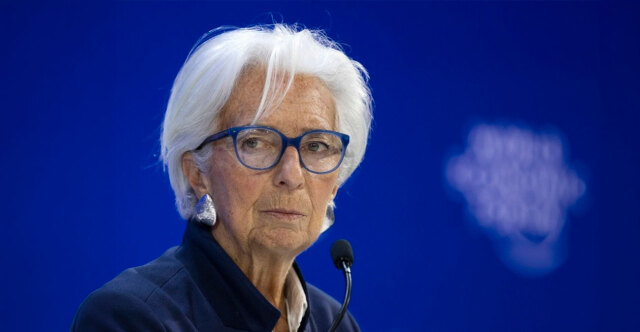
European Central Bank (ECB) President Christine Lagarde has stressed the need for Europe to abandon its reactive approach to crises and start addressing threats before they materialise, warning that the failure to take timely decisions is undermining the continent’s long-term economic prospects.
Speaking at the European Banking Congress in Frankfurt, Lagarde acknowledged that the European Union has demonstrated its ability to mobilise decisively when faced with immediate and major challenges, as it did during the pandemic and in response to the war in Ukraine.
However, she pointed out that Europe struggles more when it comes to addressing threats that develop gradually, as the absence of a visible and immediate crisis acts as a disincentive to taking action.
“When events convince us that the world has changed, we act,” she said.
“Our difficulties arise when a crisis unfolds slowly,” she added, describing one of the key problems with Europe’s decision-making process.
European procrastination and the cost of inaction
Since taking office in 2019, Christine Lagarde has repeatedly used the annual European Banking Congress in Frankfurt to advocate deeper European integration.
In 2025, she warned that Europe must overcome its persistent indecision over the measures needed to strengthen its economy, otherwise it risks being labelled “irresponsible”.
Her latest intervention follows the same line, but places greater emphasis on the need to address structural weaknesses before they become crises.
Although the 21-member Eurozone has demonstrated resilience in the face of economic pressures stemming from the war in Iran and US trade tariffs, Lagarde stressed that this resilience alone is not enough to secure the future competitiveness of the European economy.
Low productivity and weak growth
Among Europe’s main challenges are low productivity and limited long-term growth potential, two weaknesses that continue to weigh on the economic outlook.
Potential solutions include structural reforms and deeper integration of European capital markets, which would strengthen businesses’ access to financing.
The ECB president placed particular emphasis once again on the Capital Markets Union, warning that continued delays are carrying a real economic cost.
“Every year that passes without it, more of our savings are invested abroad and more of our growing companies seek financing elsewhere,” she stressed.
According to Lagarde, the problem is that the damage caused each year by the lack of progress is not significant enough to overcome resistance to change.
“Yet the loss in any individual year is not large enough to overcome resistance to change,” she noted.
Her intervention takes on added significance ahead of her reported planned early departure from the ECB in early February, which, according to the publication, would allow her to speak more freely on issues extending beyond the boundaries of monetary policy.
Ask me anything
Explore related questions




