






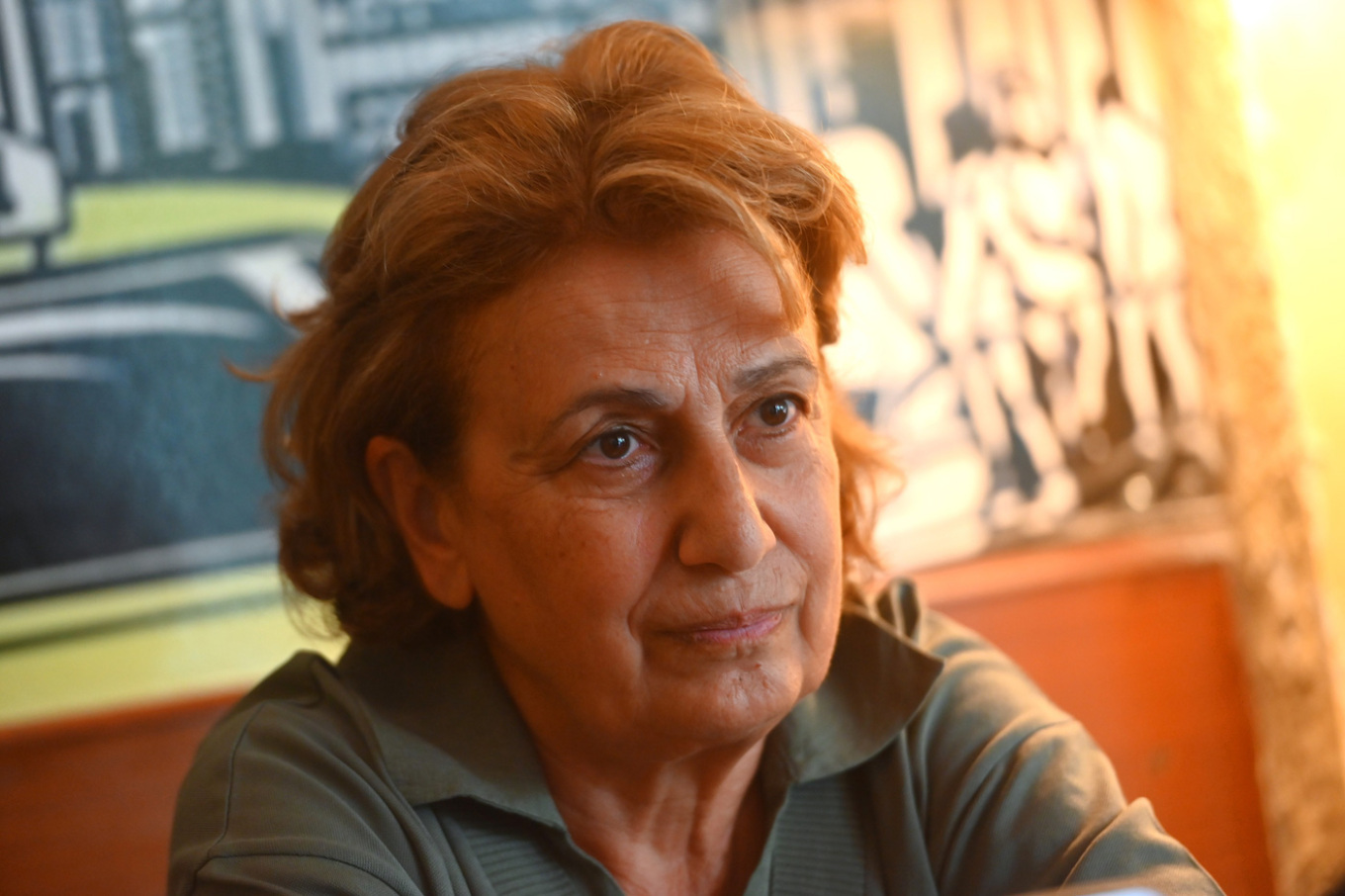
Enthralled. By the conversation I had – lucky me! – with Anastasia Kotanidou. What a person! What a doctor! What integrity! What consistency! What a career. As she told me: “I am now an emeritus professor. The director of the Intensive Care Unit at Evangelismos is Ms. Ioanna Dimopoulou.”
And what didn’t we discuss… We talked about everything, absolutely everything. About Giorgos Mazonakis: “He had no reason to undergo plasmapheresis.” About the obsession with anti-aging: “No one can remain young forever.” For example, “I can look at myself in the mirror and say that I am Claudia Schiffer, when in reality I am Georgia Vassiliadou.”
We discussed everything. You should read it.
Scene 1: Mazonakis and Plasmapheresis
DIMITRIS DANIKAS: What exactly is plasmapheresis?
ANASTASIA KOTANIDOU: We remove the plasma and replace it.
D.D.: What is plasma?
AN.K.: It is the liquid component of the blood.
D.D.: And why do we replace it?
AN.K.: Plasma contains certain antibodies. When we perform plasmapheresis, our aim is to remove these harmful antibodies. They may be autoantibodies or a toxic substance, as in dialysis. These procedures are also performed at Evangelismos.
D.D.: Why didn’t Mazonakis come to Evangelismos to have it done? Would you have done it for him?
AN.K.: Mazonakis had no reason to undergo plasmapheresis.
D.D.: Why did he go to have it done, then?
AN.K.: I don’t know why he went. There are people who believe that they can have things removed and remain young forever.
D.D.: So it is done for anti-aging purposes.
AN.K.: And there are also others who believe that they have certain toxic substances in their bodies and that they can remove them through plasmapheresis.
D.D.: So if I come to Evangelismos, you would determine whether I should undergo it or not? How is the procedure carried out?
AN.K.: Of course. Special tests are carried out, and through these tests we determine who should and who should not undergo plasmapheresis. If you remember, at the beginning of COVID, we collected plasma from patients who had very high levels of antibodies against COVID, as a therapeutic measure. To help severely ill patients, we gave them plasma from patients who had very high antibody levels. We did this before vaccines were developed.

Scene 2: From Gwyneth Paltrow to Orlando Bloom
D.D.: And how many doctors need to be involved in the procedure?
AN.K.: One doctor is enough. Along, of course, with nursing staff, who are specialized in patient care.
D.D.: What kind of doctor is that, a hematologist?
AN.K.: No, a doctor who is familiar with the plasmapheresis procedure; that is what is needed. There is no specialization in plasmapheresis. The doctors who can oversee plasmapheresis are doctors who have experience with it. For example, plasmapheresis is performed very frequently in the Intensive Care Unit. And all the doctors in the unit know very well how to deal with the side effects that plasmapheresis may cause.
D.D.: At what age is this usually done?
AN.K.: There is no age limit; you can be very young or very old.
D.D.: It depends on the illness.
AN.K.: Exactly.
D.D.: What illnesses are these?
AN.K.: The most common disease for which we perform plasmapheresis is myasthenia gravis. It is a neurological condition, and it is believed that by performing plasmapheresis we remove a significant amount of autoantibodies, allowing the patient to recover very quickly from the crisis.
D.D.: Is this done at Evangelismos?
AN.K.: Yes, and not only at Evangelismos.
D.D.: This is usually done for anti-aging purposes, right?
AN.K.: No, in hospitals it is done for medical reasons, not for anti-aging.
D.D.: Because I have read that many Hollywood actors do it, Gwyneth Paltrow, Sandra Bullock, Nicole Kidman, Orlando Bloom…
AN.K.: I have read these things too, but I don’t know exactly what these people are doing, and I don’t know exactly what procedure they are undergoing. And the doctor who performed plasmapheresis on Mazonakis said that she performed plasmapheresis – I don’t know whether she performed plasmapheresis while saying that she was removing 200 ml of blood. Plasmapheresis is a continuous procedure; you cannot remove a little blood and then stop. It is a machine with a pump that operates continuously. The blood passes through, the plasma is removed, and a replacement fluid or replacement plasma is introduced. Blood is not introduced. Replacement fluid or pure plasma is introduced.
Scene 3: Side Effects
D.D.: How do all these “clinics” get permission to operate?
AN.K.: From what is circulating on the Internet, it appears that there are another two or three. Look, the Ministry of Health has now decided to take very strict measures and establish a special committee that will deal with all these rejuvenation centers, as we might call them.
D.D.: But this is happening now, always after the fact.
AN.K.: Usually in our country, things happen after the fact; they don’t happen beforehand.
D.D.: Isn’t the Athens Medical Association, Mr. Patoulis, for example, also responsible?
AN.K.: Normally, the 2019 law says that they are inspected by the Medical Association. Now, what inspections were or were not carried out, I cannot know. I cannot judge that myself, nor is it my job.
D.D.: What would you say to someone who wants to remain young forever?
AN.K.: No one can remain young forever. You have to exercise, maintain your weight and live a healthy lifestyle – not drink, not smoke, get enough sleep. Well, if you follow these things, you remain young for a very long period of time.
D.D.: Do you know of such cases? Have they ever come to Evangelismos?
AN.K.: No, but there have been cases involving other kinds of side effects from such clinics. Not from this particular one, but people have come in with very significant reductions in electrolytes. Electrolytes are an important component of our blood. Plasmapheresis can reduce electrolyte levels, calcium levels and the proteins we have in our blood. All of these can have very serious consequences afterward.
Scene 4: The CPR Method
D.D.: You don’t do anti-aging, but it is very widespread nowadays, isn’t it?
AN.K.: Yes, very much so. It is a trend that has emerged over roughly the past decade. There are, of course, specialized clinics abroad that deal with these anti-aging treatments. A great many people go there.
D.D.: Are they good?
AN.K.: I have not been to any, so I don’t know. I have heard that people who go there have a good time, even though they pay astronomical amounts at some clinics. Another very important point for medical and nursing staff is that all doctors, nurses and allied health professionals must be able to perform cardiopulmonary resuscitation at any time. If cardiopulmonary resuscitation is performed correctly from the first minute, the patient has a chance – not an insignificant one, 8% to 35% – of recovering. Another thing we need to do as a state is to see where we have lost our sense of proportion and why we have not trained everyone to be able to perform cardiopulmonary resuscitation. Children should learn it from primary school, from kindergarten.
D.D.: Even these doctors did not know how to do it. What kind of doctors were they?
AN.K.: The system abroad prohibits you from maintaining your license to practice medicine if you are not competent in cardiopulmonary resuscitation. Hospitals abroad require all staff to repeat the resuscitation course every three years. Without it, the person does not receive their salary; that is how strict things are. Here, the Minister of Labor, Ms. Kerameus, published a law requiring all businesses with more than 50 employees to receive training from certified bodies in performing cardiopulmonary resuscitation. The problem is that in Greece we still do not know who the certified bodies are. We are in the process of determining this.
D.D.: Yes, but it was not a pathology clinic; they were doing something else. What kind of inspection was carried out? People have serious doubts.
AN.K.: Yes, but people go to these clinics and pay incredible amounts of money.
D.D.: Not ordinary people. Some celebrities go, not ordinary people.
AN.K.: Ordinary people go too.
D.D.: Ordinary people paying €15,000 for treatment?
AN.K.: Unfortunately, there are many people who, when faced with a very serious problem, can turn to people who are fraudsters because they question what a serious doctor has told them.
D.D.: It is the same with cancer. And they go to these people. Why do they go there?
AN.K.: Because hope dies last.
Scene 5: The Signs and the Internet Doctors
D.D.: Their list of celebrity clients is enormous; it is not just Mazonakis.
AN.K.: I know. First of all, in our country, as you know very well, there are huge signs displaying the names of doctors, physiotherapists and I don’t know who else, which is prohibited by law. I am not allowed to put up a two-meter sign outside and say, “gynecologist, specialized in such-and-such.”
D.D.: Holistic Medicine, etc.
AN.K.: Has anyone dealt with this until now? No one. Various governments have come and gone, and no one has tackled this simple issue of advertising through signs. The second major problem is advertising on the Internet. There is no service that sits down and checks what is being written on the Internet from all sides. Advertising through the Internet is also prohibited by law.
D.D.: So medicine has become a business. Human life, people’s health, becoming young again – this dictatorship of youth, of fashion.
AN.K.: It is not the only one advertising other forms of medicine outside conventional medicine. There are many who advertise other specialties.
D.D.: Which do not exist in medicine; they are invented.
AN.K.: Most of them are invented.

Scene 6: “Hydrotherapy Is Extremely Dangerous”
D.D.: Apart from living a healthy lifestyle, what should someone do?
AN.K.: Someone who wants to remain young forever must think about the consequences of what they are about to do in order to remain young forever. They must also choose carefully the people who will perform these procedures on them.
D.D.: Have you heard what they say about enemas, that you should have one once a week?
AN.K.: No, I haven’t heard that. I have heard about hydrotherapy, which is performed at some clinics. Using a colonoscope, they wash the inside of the intestine. It is an extremely dangerous procedure, very invasive, and can have incredible consequences. Many celebrities do it, though.
D.D.: So what exactly is done?
AN.K.: Through a colonoscope, they introduce a very large amount of water into the intestine and wash out the intestine of toxic substances. This can cause changes in the intestinal flora. The intestine contains bacteria and fungi that are important for its normal functioning. It can later cause problems with bowel movements. But the most serious thing it can cause is a severe infection. Because the water enters under very high pressure, some bacteria may penetrate the intestinal wall and enter the bloodstream. We may also have micro-tears in the intestine from this procedure. People who have diverticula in particular are very prone to complications from this type of treatment.
D.D.: The anti-aging we were talking about earlier.
AN.K.: And who has assessed this? Many times, we ourselves are also under illusions. We think we have a tremendous result without that result being measurable. I can look at myself in the mirror and say that I am Claudia Schiffer, when in reality I am Georgia Vassiliadou.
Scene 7: Lack of Nursing Staff
D.D.: At Evangelismos now, what is the situation like compared with the past?
AN.K.: A great deal of work is being carried out at the moment. I hope that in two or three years Evangelismos will have been sufficiently renovated. But many other things are needed as well. And the fundamental thing that is needed is nursing staff. There is a huge shortage of nursing staff.
D.D.: When you say nursing staff, how many more are needed?
AN.K.: There is a major problem: on paper, it appears that we have an adequate number of nurses because the hospitals’ organizational structures are old. They have not changed since 2012. Today’s needs are different; we need at least 30%-35% more nursing staff than we currently have.
D.D.: Why aren’t they being hired? Are salaries perhaps low?
AN.K.: Salaries are low, but there are also not enough nurses. Then there are positions that are much less demanding than working in a hospital. The Intensive Care Unit needs a great many nurses. At the moment, Evangelismos, through a major donation from the Niarchos and Thanasis Martinos Foundations, is preparing another 32 intensive care beds, which is highly questionable as to whether they will become operational because we do not have enough nursing staff.
D.D.: How much does a nurse earn approximately today?
AN.K.: Approximately €1,200-€1,300 gross, plus some shifts they work.
D.D.: So roughly €1,500.
AN.K.: Gross, though. Net, it would be €1,000-€1,200.
D.D.: And a newly appointed doctor?
AN.K.: Approximately €1,200-€1,300 net, plus on-call duties. Which are paid very little. At one point, the hourly rate for on-call duties was €3-€4. I pay the woman who works at my home €11 an hour, while the doctor is paid €3-€4 an hour.
[Kotanidou to Danikas: Mazonakis Did Not Need Plasmapheresis, ‘Alternative Medicine’ Carries Risks]
Scene 8: Exams After Graduation
D.D.: Can a doctor remain in Greece under these conditions?
AN.K.: Unfortunately, there are many young doctors who leave the country. At the moment, the Central Health Council has made a proposal that students, when they graduate and want to enter some highly sought-after and good specialties, should have the opportunity to take examinations so that they can enter without having to wait in a huge queue.
D.D.: What exams?
AN.K.: Exams covering the entire medical curriculum.
D.D.: After they have received their degree.
AN.K.: They will have received their degree, but they will take a kind of nationwide entrance examination again. That is the aim of these exams, to keep the best students in Greece.
D.D.: How many years have you been in medicine?
AN.K.: I have been in medicine for many, many years. I graduated in ’82; I have been in medicine for 44 years.
D.D.: And financially? Don’t tell me your salary, generally speaking. You are not satisfied, I imagine.
AN.K.: I reached the rank of full professor. The salary of a full professor is €2,000.
D.D.: If that is possible, a full professor of medicine earning €2,000! Isn’t that ridiculous? Couldn’t this be causing the whole problem with envelopes? When you earn so little and save lives, isn’t it logical to ask for something more?
AN.K.: Medicine is a vocation; you are forbidden from asking for money. You chose to remain in the public system. If you want to make money, you go into the private sector and there you can ask for whatever you want. Since you chose to work in the public system, you are forbidden from asking for money.
Now, with the new legislation, I can choose a doctor again through the private sector from the public system. In other words, this has been implemented by the Ministry of Health, and doctors in the National Health System have the possibility of also practicing privately – but all of this must be declared to the tax authorities, not through envelopes again.
Scene 9: “12 Hours a Day and on Weekends”
D.D.: So if I am a cardiologist in the National Health System, can I have a second job?
AN.K.: You can, of course. You can have your own practice and also go to a private clinic to provide services. In your free time, after your working hours have ended.
D.D.: This is an additional source of income. What is the difference in salaries between the public and private sectors?
AN.K.: Usually, in private hospitals, doctors are paid based on the clientele they have. They are not paid a fixed salary. Few doctors have a salary in the private sector. Usually, they are the lower-ranking doctors. Higher-ranking doctors in the private sector receive income from their patients. For a young doctor, the difference will not be very large. But for a doctor who has established themselves and is a well-known name, the difference will be very large, I imagine.
D.D.: Are you in charge of the Intensive Care Units?
AN.K.: I am now an emeritus professor. The director of the Intensive Care Unit at Evangelismos is Ms. Ioanna Dimopoulou. I have a three-year extension at the Intensive Care Unit from the University as an emeritus professor.
D.D.: Many hours?
AN.K.: As many hours as necessary. Depending on the day, depending on the needs of the clinic, depending on the needs of a patient. There are no specific hours.
D.D.: Could it be 10-12 hours a day?
AN.K.: It could. And weekends, if necessary.
D.D.: Do you use AI at Evangelismos?
AN.K.: AI has very extensive applications in certain specialties, for example in radiology. The new machines have certain built-in AI systems that can even produce a diagnosis, which the doctor may later need to check. The same applies to machines that produce electrocardiograms. There, too, the machine reads the electrocardiogram and gives you the diagnosis, but it still requires review by the doctor.
Scene 10: Side Effects from the COVID Vaccine
D.D.: How many people does Evangelismos currently serve? Everyone together – staff, patients and visitors? Is it around 6,000?
AN.K.: Evangelismos has the capacity for 900-1,000 cases and is always full; it never has vacant beds. Consider that the medical and nursing staff, administrative staff and allied health personnel total 1,500-2,000 people. And surely the relatives are not going to be just one or two per patient?
D.D.: What would you ultimately say about the Mazonakis case, as you read it and assessed it?
AN.K.: It is very sad that a young person was lost. Secondly, I would say that we should not believe everything we see, because not everything that glitters is gold.
D.D.: But we believe it. Why?
AN.K.: Because that is human nature. We like to believe things that are a little shiny. Do you remember when COVID first emerged, all those people came out and said that the more patients we killed with COVID, the more they paid us, the doctors, extra? Things were so absurd… Yet there was a percentage of the public who believed these things. Even today, there are people who believe it.
D.D.: They say that vaccines caused side effects. Has this been established?
AN.K.: No, there is no such finding. It is like the chicken-and-egg question, which came first. First of all, all these people who experienced some side effects had also had COVID. Why do they say that the vaccine caused their side effects and not COVID itself?

Epilogue: The Goal of Evaluation
D.D.: Has the National Health System improved?
AN.K.: The National Health System was established many years ago. And along the way, some corrections were needed. The corrections we make to the Health System take a long time to be implemented. At the moment, efforts are being made to correct many things. For example, to begin a relevant evaluation of everyone working in the Health System. Once this exists, people will also be able to see much more easily which doctor to turn to.
D.D.: What would you say to Georgiadis?
AN.K.: What I would tell him is that he should give each director a specific budget. Each director should be able to assess this budget, be given the ability to select all the staff and, at the end of the year, the director should report to the Minister of Health or whoever on the results.
D.D.: What else would you tell him?
AN.K.: To give scientific societies the opportunity to organize the educational activities they run better. If we do these two things, we will have changed everything completely. In the end, someone should also evaluate me. Whether the things I did during the year were correct. Because I could gather my group of five people and distribute money.
D.D.: Isn’t there a problem there?
AN.K.: There is no problem, because in the end I will have measurable points, namely how many patients I saw, what the outcome of their treatment was, whether I used too much money on medicines, etc., that made no sense…
As I left, after our warm, friendly embrace, I told her. And I write it here, and I mean it: I would trust Anastasia Kotanidou, I sincerely mean it!
Ask me anything
Explore related questions




