





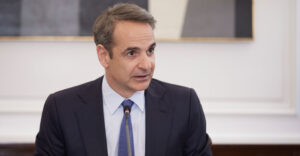
The prime minister’s Sunday review
Prime Minister Kyriakos Mitsotakis, in his Sunday message, refers to the measures to be announced before 15 October, when the sale of heating oil begins. He says the government will review the situation every fortnight, so that society is supported to the limits of what the economy can bear. He also addresses the severe weather that has hit Crete, and New Democracy’s 52nd anniversary.
The key points of the prime minister’s post follow.
On energy
“We are in a difficult situation. What matters above all is that we do not let a global crisis turn into a national impasse for Greek households. We know we cannot solve the problem by magic, but we are trying to give genuine relief.”
Message to Europe on measures
“I insist, however, that this energy turmoil is a European problem and cannot be tackled merely with advice to curb consumption. Common, bold solutions are urgently needed. That is precisely why Greece is asking Europe for greater fiscal flexibility.”
“Europe’s rules and infrastructure were built in other, calmer times, when energy was cheap. The facts have now changed radically and we must adapt to reality.”
“That is our real achievement: we have thrown off the belief that ‘nothing ever changes here’. The challenge now is no longer whether we can make it, but whether we will have the courage never to lower the bar again.”
On Crete
“My thoughts are with our fellow citizens who have been tested by the storm, who saw their properties flooded and their daily lives turned upside down.”
“On Monday, a government delegation will travel to the island to coordinate the recording of damage and the recovery procedures. I thank those working in the field. The first priority is human life, and immediately after that, support for those affected.”
On New Democracy’s anniversary
“We are proud of our ideas, our values and the path we began on this day, 4 October 1974. Its founding declaration, signed by Konstantinos Karamanlis, calls on us to serve the nation, ‘beyond and above the old, misleading labels of left, right and centre’.”
The prime minister’s full post
Good morning! October is already here, and autumn is making its presence felt, unfortunately with particular intensity in Crete. My thoughts are with our fellow citizens who have been tested by the storm, who saw their properties flooded and their daily lives turned upside down. The Ministry of Climate Crisis and Civil Protection mobilised the response mechanism as a precaution, placing Crete on heightened alert, convening meetings of the Risk Assessment Committee and coordinating all the bodies involved. Warnings were issued via 112, and movement in dangerous areas was restricted. After the heavy rain, our forces carried out rescues and other interventions, while the Region and the municipalities are working to restore access to the affected areas. On Monday, a government delegation will travel to the island to coordinate the recording of damage and the recovery procedures. I thank those working in the field. The first priority is human life, and immediately after that, support for those affected.
Among this week’s key developments, I pick up the thread on the measures to support society against the new energy pressures. The prolonged standoff around the Strait of Hormuz keeps generating fresh pressures, and I have no wish whatsoever to dodge the issue. We are in a difficult situation. What matters above all is that we do not let a global crisis turn into a national impasse for Greek households. We know we cannot solve the problem by magic, but we are trying to give genuine relief. That is why, for the next 15 days, we are increasing the pump subsidy on road diesel from 10 to 15 cents, which, together with the refineries’ discount, will ultimately reach 20 cents.
At the same time, shortly before 15 October, we will announce our measures for heating oil, with the clear aim of keeping the price below €1.75 a litre, and we will also proceed with an across-the-board increase in the heating allowance, as I have already said. We will monitor the situation every fortnight, acting within the limits of our capabilities to support society.
I insist, however, that this energy turmoil is a European problem and cannot be tackled merely with advice to curb consumption. Common, bold solutions are urgently needed. That is precisely why Greece is asking Europe for greater fiscal flexibility. We propose that we be able to use the additional VAT revenue generated by high prices, so that it can be channelled directly into targeted support for households and businesses, without these temporary measures counting towards the strict expenditure ceilings. Europe’s rules and infrastructure were built in other, calmer times, when energy was cheap. The facts have now changed radically and we must adapt to reality. I have already sent a letter on the matter to the President of the European Commission and the President of the Eurogroup, asking that we take this necessary step.
In this pressing climate, we are also increasing the number of instalments for repaying overdue debts to the tax authority and social security funds from 72 to 120, with a minimum instalment of €30 and the interest rate remaining low, at the level of the 24-instalment arrangement. At the same time, we are tightening the terms for servicers, protecting the compliant debtor from auction or seizure. If a company breaches an agreed arrangement, the action will be annulled, a fine of up to €500,000 will be imposed and the citizen will be credited with five instalments of the original agreement. There will be a 15% cap on the down payment, instead of leaving it to the creditor’s discretion. And if a citizen does not receive a full picture of their debt within 45 days, interest will be frozen. Our aim is to create a safety net, as already exists with the out-of-court mechanism for primary residences, so that citizens can have a genuine second chance.
I now turn to a major cycle that closed this week: we submitted the final two disbursement requests to the EU, completing the required milestones on time, as on every previous occasion. This means we will absorb the entire Recovery Fund allocation of €36 billion, close to 16% of GDP, the largest European support in proportion to the size of our economy (indeed, the European Commission itself acknowledged that Greece stood out in its use of the Recovery Fund among the 27 member states). To put it another way, in half the time of an ESPA programme, we managed to absorb almost twice the money. How did we do it, and what did we achieve? Through an organised plan, “Greece 2.0”, based on the proposals of the Pissarides report, we managed to rebuild the economy after the heavy blow of the decade-long crisis. Real GDP rose by 11 points, more than 550,000 new jobs were created and investment soared by 60%, exceeding our initial estimates.
I want us to dwell on some other figures, which show how much the use of the Recovery Fund has already changed the lives of all Greeks:
Nine million citizens use the gov.gr platform.
Seven million citizens have had free preventive check-ups, with more than 300,000 referred promptly for further treatment.
5.2 million citizens have already registered with their free personal doctor, and 165,000 children have their own free personal paediatrician.
2.5 million employees are protected by the digital work card, and more than 7.5 million instances of overtime have been recorded and paid.
1.2 million insured people use the digital health record.
410,000 pupils use the free digital tutoring service (which, I might add, began operating for the 2026-2027 school year).
More than 180,000 households have benefited from the energy-saving programmes and from the replacement of heating systems and solar water heaters.
25,500 residents of mountainous and island areas have been examined by the mobile health units.
More than 23,000 households have acquired their own first home thanks to the “Spiti mou” programmes 1 and 2.
20,000 of our fellow citizens have had operations in the free afternoon surgery sessions.
1,812 people with disabilities have gained their own personal assistant.
Land registry data is now posted for 99% of the country.
Alongside the reforms that have improved the functioning of the state and citizens’ everyday lives come major infrastructure projects. Without, of course, diminishing the importance of all these projects and reforms, I firmly believe that the greatest “dowry” Greece 2.0 leaves us is not only the €36 billion, but proof that the Greek state can. It can plan, it can deliver, it can confront the inertia of the past and move forward. That is our real achievement: we have thrown off the belief that “nothing ever changes here”. The challenge now is no longer whether we can make it, but whether we will have the courage never to lower the bar again.
And precisely because we have proved that we can, it matters that we answer the next question: what happens after the Recovery Fund? The answer is that the next phase does not start from zero, nor does it rest on wishful thinking. The National Development Programme already exists, and will mobilise investment of €23 billion, which is €13 billion more than in the previous programming period. There are also resources of more than €8 billion from the Social Climate Fund, the Modernisation Fund and the Decarbonisation Fund, while a further €19 billion remains from the 2021-2027 ESPA programme. Ahead of us lies the new major European negotiation, for resources of more than €49 billion. And it is of particular significance that this negotiation is very likely to unfold during the Greek Presidency of the Council of the European Union, in the second half of 2027. That is why preparing for the Presidency is not a routine process, but one of the 12 horizontal priorities of the government’s programme that we presented at the recent Cabinet meeting. The issue is not only how much money the country will have at its disposal. It is where it will go and what results it will deliver. Our central aims up to 2030 are clear: sustainable growth and higher incomes, stronger defence and international presence, a more effective state and faster justice, better education and health services, safer transport, affordable energy and protection of the natural environment.
In labour market news, unemployment fell to 7.4% last August, the second-lowest rate ever recorded in our country, while August was the third month this year with unemployment below 8%.
It is worth noting that improvement is recorded across all sub-categories: among men, unemployment stood at 4.9%, down from 6.9% last August, among women at 10.3%, from 11.1%, while there is also a significant improvement in youth unemployment, with the rate falling to 15.6% from 21.8%. This progress does not come by itself, but through targeted policies that focus where there is still room for improvement. I will give two examples. For women, who still face more obstacles in the labour market, we are extending the programme subsidising businesses to hire 10,000 unemployed women, with an emphasis on mothers of minor children, and boosting it with 5,000 additional full-time jobs. For our young people, we are strengthening vocational education and training, linking it more closely to the real needs of businesses through branches of the Public Employment Service inside companies, and we are supporting those aged 18 to 29 with entrepreneurship programmes, so that they can make their own professional start. We are continuing, so that this progress reaches even more of our fellow citizens.
The next news item of the week I would like to mention is the creation of the National Model Centre for Dementia. We are talking about one of the most serious, most complex and fastest-growing public health problems worldwide. In our country, around 214,000 people already live with a diagnosis of dementia, while the emotional and physical burden on their families is often enormous. The new Centre will offer free holistic care to people with early-stage dementia, including memory assessment, day care, home care and telemedicine. At the same time, it will support and train carers, including informal ones, who often shoulder this burden without adequate guidance. It will also play a role in prevention, education and research. The project is being implemented thanks to a €4.49 million donation from the National Bank of Greece and the charitable foundations of “Initiative ’21”, in cooperation with the Ministry of Health. It is an initiative that concerns health, but also the dignity of patients, their families and all those who fight this difficult battle every day.
Now to matters from the regions. Greece’s power transmission operator, IPTO, has put into operation the upgraded high-voltage interconnections between Zakynthos and Kefalonia and between Kefalonia and Lefkada, replacing lines that had been in service for decades. This means a safer and more resilient electricity supply for the Ionian Islands, particularly in the summer months, when tourist traffic significantly increases demand for power. The next electrical interconnection will be that of Corfu with the mainland system, via Igoumenitsa, within 2027.
In Katerini, a new undergraduate programme in Maritime and Combined Transport Management is being created by the International Hellenic University, adding another educational option outside the major university centres.
In the Peloponnese, we are providing €3.5 million for the participation of people with disabilities and citizens over 65 who face the risk of poverty or social exclusion in sporting, cultural and recreational activities.
In Boeotia, the new Emergency Department of Thebes Hospital and the renovated Health Centres of Distomo and Aliartos were inaugurated.
In Kos and Syros, the South Aegean Region is allocating €2.8 million from European funds for two new Day Centres for Comprehensive Mental Health Care, one for people with dementia and Alzheimer’s in Kos, and one for people with autism and neurodevelopmental disorders in Syros.
In Megalopoli, a €3.5 million project for the bioclimatic upgrade of part of the road network is being included, within the broader framework of the Just Development Transition.
In Corfu, after months of effort, funding of €21.1 million has been secured so that the contract can be signed for the project “Water Supply of Corfu Town from the Chrysida EAN”. This is an intervention that tackles a long-standing and very real problem for residents and visitors alike.
And I close with yesterday, a day that was special for our Orthodox cultural heritage. Together with my friend, the Prime Minister of Bulgaria, we watched the signing of the protocol for the return to Greece of religious relics that had been taken to Sofia in 1917, during the First World War, and the handover to Bulgaria of the remains of Tsar Samuel, which were found in 1965 in the Basilica of Saint Achillios in Florina. As for the Greek treasures, they comprise 48 relics from the Holy Monasteries of Panagia Eikosifoinissa and of the Honourable Forerunner in Serres, as well as from the Holy Metropolis of Serres and Nigrita. They will be exhibited at the Museum of Byzantine Culture until 5 November and will then return to their “home”. This is the first step, and certainly not the last, towards the return of all our relics, as part of the active cultural diplomacy we have pursued in recent years with tangible results.
Before I leave you, however, I would like to make a special mention of today, the anniversary of the founding of New Democracy, which we celebrate tomorrow, Monday, at 6pm, at the old OSY depot. We are proud of our ideas, our values and the path we began on this day, 4 October 1974. Its founding declaration, signed by Karamanlis, calls on us to serve the nation, “beyond and above the old, misleading labels of left, right and centre”.
We renew our appointment for next Sunday. Have a good rest of your day!
Ask me anything
Explore related questions




