





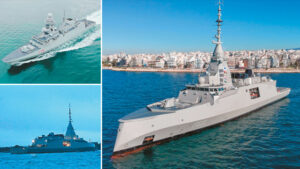
The FDI frigate “Kimon” is expected to participate in the celebrations for the national anniversary of October 28 in Thessaloniki, signaling the new era of the Fleet, which has only just begun. With FDI and Bergamini-class frigates, drones and new weapons, the country’s projection of power at sea has moved to another level, at a time when two more state-of-the-art warships are already on their way.
The purpose of “Kimon’s” participation in the celebrations is none other than to familiarize the general public with what has been described as the “crown jewel” of the Greek fleet, as well as to attract the younger generation, so that they can see firsthand the opportunities that come with serving in the Hellenic Navy.
After all, the current picture of the Navy is a far cry from the situation it was in a year ago, with the turning point coming on December 18, 2025, when the Greek flag was raised on the frigate “Kimon” in Lorient, France.
This was not simply the delivery of yet another warship, but a glimpse of the future, since the Navy of the next era has begun to become visible—and will become even more so immediately after the completion of the military parade in Greece’s second-largest city for October 28.
Specifically, two days later, on October 30, 2026, the delivery of the second FDI, the frigate “Nearchos,” is scheduled, while in mid-December the Greek flag is expected to be raised on “Formion” as well—developments that demonstrate the speed with which the Greek Fleet has acquired three new-generation frigates.
At the same time, their acquisition is not limited to replacing older units, since the FDI frigates mark the beginning of a deeper change in the way the Hellenic Navy plans to operate over the coming decades. More powerful strike units, advanced sensors and weapons, increased networking and the ability to integrate new technologies more rapidly are elements of this transition—and at the same time only the beginning, since the new naval “doctrine” extends all the way to… AI.
Agreement with Italy
At the same time, the two FREMM Bergamini-class frigates are being added to the new backbone of surface units, a piece that was added to the larger picture of the new Hellenic Navy only last month. It is worth noting that on September 8 in Rome, in the presence of National Defense Minister Nikos Dendias and his Italian counterpart Guido Crosetto, the Implementing Arrangement activating the acquisition program for the “Carlo Bergamini” and “Virginio Fasan” was signed, with the relevant preparations already underway.
The transfer of the two ships is scheduled for the first half of 2028 and 2029 respectively, but in the planning of the Hellenic Navy General Staff, the Bergaminis are not viewed as an isolated program. On the contrary, they are incorporated into the broader restructuring of the surface fleet, together with the FDI frigates and the modernization of the four MEKO 200HN “Hydra”-class frigates.
This is because the acquisition of the new ships does not diminish the importance of older Fleet units, as the MEKO frigates are expected to serve as a bridge between the current and next generation of units, remaining combat-capable and operationally relevant alongside the newer ships.
A new composition of surface forces is thus gradually taking shape, with ships from different generations but with clearly enhanced capabilities in combat sensors, air defense and network-centric operations.
Developments are also taking place… beneath the surface of the sea, as four Type 214 submarines, the Hellenic Navy’s “silent” submarines, together with the upgraded Type 209 “Oceanos,” are entering a new cycle of maintenance and support. At the same time, the delivery and integration of modern SeaHake heavy torpedoes gives Greek submarines a weapon worthy of their advanced capabilities.
Beyond the changes to the major units, the installation of SPIKE NLOS systems on gunboats and SPIKE ER systems on the Mark V boats of the Underwater Demolition Command adds precision-strike capabilities to platforms with different operational roles.
Drones and robotics
The clearest picture of the future of the Hellenic Navy is, in any case, reflected in unmanned and autonomous systems. Part of the Camcopter S-100 fleet has already been delivered, opening up new capabilities in surveillance, reconnaissance and intelligence gathering. The creation of an organized structure for unmanned systems at Fleet Headquarters points in the same direction.
These systems are gradually ceasing to be treated as supplementary capabilities and are being incorporated more substantially into operational planning. This new approach was also signaled by Prime Minister Kyriakos Mitsotakis’s visit to Hellenic Navy facilities, prompted by cooperation with the Massachusetts Institute of Technology in the field of maritime robotics and autonomous systems.
For the Greek side, the objective is not simply the acquisition of new equipment, but the transfer of know-how, structures and human resources capable of understanding, integrating and operationally exploiting these technologies. The Hellenic Navy is now seeking this human capital, while allowing the public to capture images of the Thessaloniki waterfront during the military parade from the deck of “Kimon.”
EU alarm over a “black winter,” Russia and the Houthis
Brussels is now sending warning messages to member states regarding the level of defense preparedness, at a time when gray clouds are gathering over the Old Continent. The “frozen” conflict in Ukraine and operations in Iran are not the EU’s only headaches, as the escalation of Houthi aggression is also turning Brussels’ attention toward the Red Sea.
It was in this direction that, at the beginning of the week—and for the first time so urgently—the EU’s High Representative for Foreign Affairs, Kaja Kallas, issued a simultaneous warning about Operation “Aspides” in the Red Sea and about new sabotage attempts by Russia. Specifically, arriving at the latest meeting of EU defense ministers in Brussels, Ms. Kallas said that member states must contribute more to the mission, namely “Aspides.”
The urgency of addressing the problem in the Red Sea, where the European operation is underway, has also begun to be highlighted by a number of European officials, with Belgian Defense Minister Theo Francken speaking of a “black winter in Europe” because of the escalation of Russian interference in EU member states in the form of a hybrid threat.
Greek leadership
Against this backdrop, National Defense Minister Nikos Dendias raised the issue of expanding European participation in Operation “Aspides,” warning that the threats to the EU do not emanate only from the European North.
“It is therefore time for the EU to fully understand that the challenges do not come only from the North, but also from the South, and to provide the necessary resources required to implement the 360-degree policy that we have been advocating for many years,” he stressed during the meeting of defense ministers, finding receptive ears on the Italian side.
It is worth noting that the European EUNAVFOR Aspides (“Shield”) operation officially began on February 19, 2024, with Athens being the first to recognize, and in full measure, the operational and geopolitical opportunity. The moves, however, were immediate, and the frigate “Hydra” (F-452) sailed from Salamis Naval Base on February 26, 2024.
Three years later, the country’s international presence—both in the Red Sea as part of Operation “Aspides” and in the European “Irini” operation for Libya, in the Eastern Mediterranean and around Cyprus, as well as in NATO’s Standing Naval Forces—has created a strategic advantage for the Hellenic Navy. An advantage that became clear last June, when Greece assumed command of Standing NATO Maritime Group 2.
The first five steps
At the same time, the increased alert levels in Brussels have begun to mobilize European forces in the area of the defense industry as well, with the EU Council approving on September 28 the first “five European Defence Projects of Common Interest (EDPCIs) to strengthen Europe’s defense readiness and industrial capacity,” focusing on the development of critical capabilities in unmanned aerial vehicles (drones) and counter-drone systems, maritime and seabed defense, space, air and missile defense, as well as the protection of Europe’s eastern flank.
Specifically:
- DronE and Counter-Drone European Resolve (DECODER)
- Integrated Maritime and Seabed Defence (IMSD)
- SPACE
- EU Federated Integrated Air and Missile Defence, including Early Warning (EU-FIAMD)
- Eastern Flank Watch (EFW)
For the Greek side, however, beyond the European “Aspides” operation, interest is focused on the fourth of the approved projects, concerning the EU’s federated integrated Air and Missile Defence—a parameter that is acquiring an institutional dimension for the first time.
Given that Athens has already signed the €3.1 billion contract for the implementation of the “Achilles Shield,” the possible incorporation of part of the project into a future European shield is an issue of serious interest to the Greek Defense Ministry, as it would serve as a deterrent against potential threats.
Ask me anything
Explore related questions




