





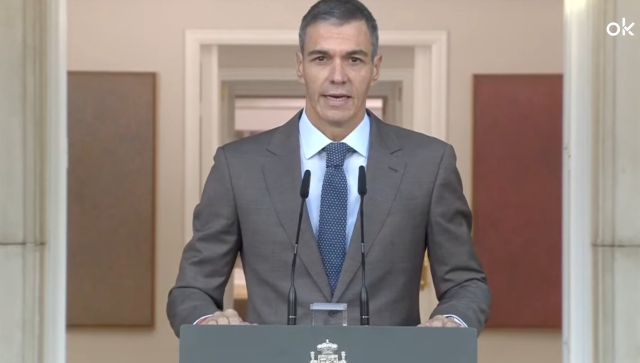
Pedro Sánchez announced on Monday morning that snap elections would be held on 29 November, in an address from the Palace of La Moncloa. Following a weekend of extensive consultations with members of his government, leaders of his party and partners from other parties, Sánchez decided to dissolve Parliament nine months before the end of its term, which he had initially intended to complete.
The trigger for the calling of the election was Parliament’s rejection last Friday of two housing decrees drafted by the government in response to the social mobilisation that followed the eviction of 87-year-old Maricarmen Abascal in Madrid.
The Junts party rejected both decrees, joining forces with the PP and Vox, despite the government having negotiated part of their content with the Catalan separatists. The rejection sparked demonstrations across the country, bringing thousands of citizens onto the streets over the weekend to demand solutions to the housing crisis.
Sánchez acknowledged that the government had “made mistakes” and had failed to implement everything it had set out to achieve.
He nevertheless called on citizens to choose whether they wanted to “join the wave of the far right that causes regression wherever it governs” or offer Spain a “broader progressive majority” and ensure that the country “remains a bastion of integrity and social justice”, a “global model for peace, feminism and prosperity”.
The Spanish prime minister also referred to his government’s economic and social achievements, such as progress in renewable energy, social rights and the reduction of inequalities.
He recalled that he had been forced to deal with unprecedented crises, including wars and geopolitical upheaval, and that he had “fought against tyrants, techno-oligarchs and regimes that committed genocide”.
He also criticised the fact that he had had to face the “worst possible opposition”, namely the PP and Vox parties, which have even challenged his legitimacy.
What preceded the address and what happens next
Sánchez informed the king of his decision a few hours before his address, as the Spanish monarch was due to begin an official visit to Finland on Monday. At the same time, an emergency meeting of the Council of Ministers is expected to take place shortly in order to approve the decree calling the election and dissolving the Cortes Generales, the Spanish Parliament. The relevant text will be published on Tuesday in the Official State Gazette so that, after the 54-day period stipulated by law has elapsed, the election can be held on Sunday, 29 November.
The Spanish prime minister has been consulting with ministers, government officials, party figures and other stakeholders since Thursday evening, seeking their assessment of the situation following the Junts decision to reject his proposals on the housing crisis. In recent days, both within the PSOE and the government, despite reservations over what would be the best option, the view had begun to prevail that the time had come to go to the polls.
The mobilisation in the streets, which intensified after the right-wing parties rejected the government’s proposals, created a window of opportunity for the Socialists. At the same time, given the uncertain situation being shaped by factors such as the judicial calendar, the crisis in Ceuta and rising prices, the assessment was that it would be preferable to call an election now rather than postpone the decision for a few months, with the risk of further political costs accumulating.
The decision took shape gradually over the past few days. There was no formal “war council” or emergency crisis meeting. Instead, Sánchez arrived at his decision through a series of discussions, telephone calls and exchanges of views, listening more than he spoke. Until late on Sunday evening, moreover, the prime minister had not announced his decision or, at least, only a handful of people knew about it.
This is the third time Sánchez has gone through a similar period of deliberation. The first was in April 2024, when an investigation into his wife, Begoña Gómez, became known, and the second in June 2025, when he considered the possibility of snap elections and resignation following the launch of a tax evasion investigation into former Zapatero aide Santos Cerdán.
Ask me anything
Explore related questions




