





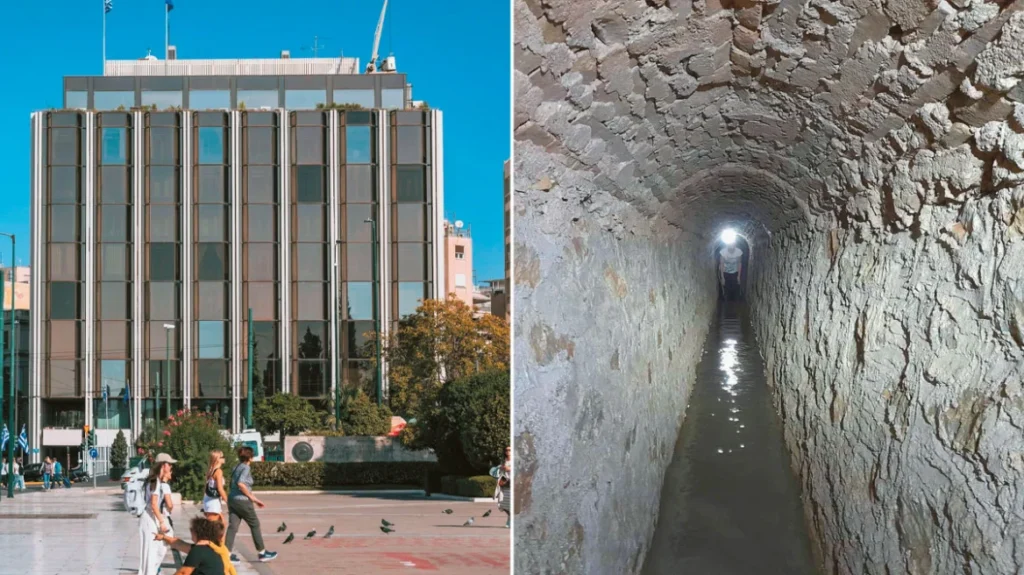
An ancient secret hidden beneath our feet may hold the answer to why the basement floors of the Ministry of Foreign Affairs in Syntagma were flooded.
The water may well be flowing underground through Athens every day, as it has for 2,500 years, via the Peisistratian Aqueduct. Its flow may have temporarily changed or its water level may have risen.
The “culprit,” then, does not appear to have been the tunnel-boring machine, but an ancient structure that transports more than a thousand cubic meters of water every day into the heart of Athens, with some of that water accumulating just 200 meters from the Ministry of Foreign Affairs building.
It all began in late September, when employees at one of the country’s most heavily guarded public buildings received an unusual instruction: turn off their computers and leave.
The basement floors of the Ministry of Foreign Affairs building, at the intersection of Vasilissis Sofias Avenue and Panepistimiou Street, had filled with water. The building was evacuated, a team of specialists from the National Technical University of Athens (NTUA) arrived that same evening, and inspections began.
By late October, the main suspect was the construction work on Metro Line 4, which just a few months earlier had caused cracks in dozens of homes in Kypseli. Athens Mayor Haris Doukas demanded explanations, Elliniko Metro categorically denied responsibility, and the question remained unanswered: Where had so much water come from?
Experts familiar with the area’s underground geology are pointing in a direction few had considered. Right next to the building, beneath the National Garden, an ancient underground network continues to feed the local aquifer.
Sources at the Ministry of Foreign Affairs, however, told Proto Thema that pumps are operating in the building’s basement to remove the water, and that the conclusion of the Athens Water Supply and Sewerage Company (EYDAP) on the causes of the water ingress is still awaited.
“Titanic”
The flooded building is not the ministry’s main headquarters, but the imposing structure that formerly housed the Astir Hotel, at the corner of Vasilissis Sofias Avenue and Panepistimiou Street.
It was built between 1973 and 1978 and operated for years as a luxury hotel. Today, it houses the Ministry of Foreign Affairs departments responsible for relations with the European Union.
Its basement contains meeting rooms, as well as the gym that was established during George Papandreou’s tenure as foreign minister. That is precisely where the water appeared.
As the space came to resemble the Titanic, scientists from the National Technical University of Athens took over the investigation. No findings have been made public, leaving room for speculation.
Some attributed the flooding to a change in the water table caused by metro construction work. The theory sounded plausible. Just last February, the “Athena” tunnel-boring machine had reached the “Evangelismos” shaft, completing the excavation of the tunnel from Katechaki.
Earlier in the year, the road surface near the “Evangelismos” station had subsided. The most serious precedent, however, was in Kypseli. There, since the summer, cracks and subsidence had appeared in approximately 200 apartments.
Given this history, any disturbance in a basement in central Athens was bound to raise questions about the metro.
“It wasn’t us”
In a letter to the company, Athens Mayor Haris Doukas directly linked the incident to the metro works, stating that it was “estimated to have resulted from the construction works on Metro Line 4,” and requesting “full and immediate information” about the findings of the technical inspections.
The response came swiftly. In the early hours of October 28, Elliniko Metro issued a statement setting out three points.
First, the company had received no request to inspect any building in the area. None of its engineers had carried out an inspection of a building on Vasilissis Sofias Avenue.
Second, excavation of the tunnel from Katechaki to “Evangelismos” had been completed the previous February. The only works currently taking place in the area were concreting work at the “Kolonaki” station and a small excavation at the ventilation shaft.
Third, and most importantly, the piezometers installed to record underground water pressure and levels had not detected anything unusual. The incident, the company said, “is not connected to the construction project for Metro Line 4.”
Government sources backed Elliniko Metro’s account. The Ministry of Foreign Affairs, however, has not issued an official announcement or published any findings concerning the origin of the water.
According to Elliniko Metro, the ministry has not even submitted a request for an inspection to the company.
If the tunnel-boring machine is not to blame, then what is?
The ancient river
The answer may lie in a structure built in the 6th century BC, when Athens was ruled by Peisistratus and his sons.
It was their project: the first major water supply system of the ancient city, so well constructed that it has never entirely ceased operating. It was simply… forgotten by most people, while continuing to carry water beneath the feet of millions of Athenians.
“Today, the National Garden is watered every day with a supply of 1,000–1,300 cubic meters of underground water every 24 hours from the ancient Peisistratian Aqueduct,” Panagiotis Defteraios tells Proto Thema.
Defteraios is a civil engineer and geotechnical engineer, an experienced speleologist, and a PhD holder from the National Technical University of Athens, whose research focuses on ancient underground aqueducts.
And how much water is that? A daily flow of 1,300 cubic meters is equivalent to half the volume of an Olympic-sized swimming pool. Every day, without interruption, through a network that was excavated 25 centuries ago.
Where does this water come from?
“The aqueduct begins at the foothills of Mount Hymettus, near the Monastery of Saint John the Theologian, and continues parallel to the Ilissos River toward Agios Thomas in Goudi, passing through the area of the former Military City,” Defteraios explains.
Its route is not speculation. “Its underground course has been confirmed by Ziller in 1877, by Tambakis, who served for many years as director of the National Garden, and by more recent technical projects, such as the metro.”
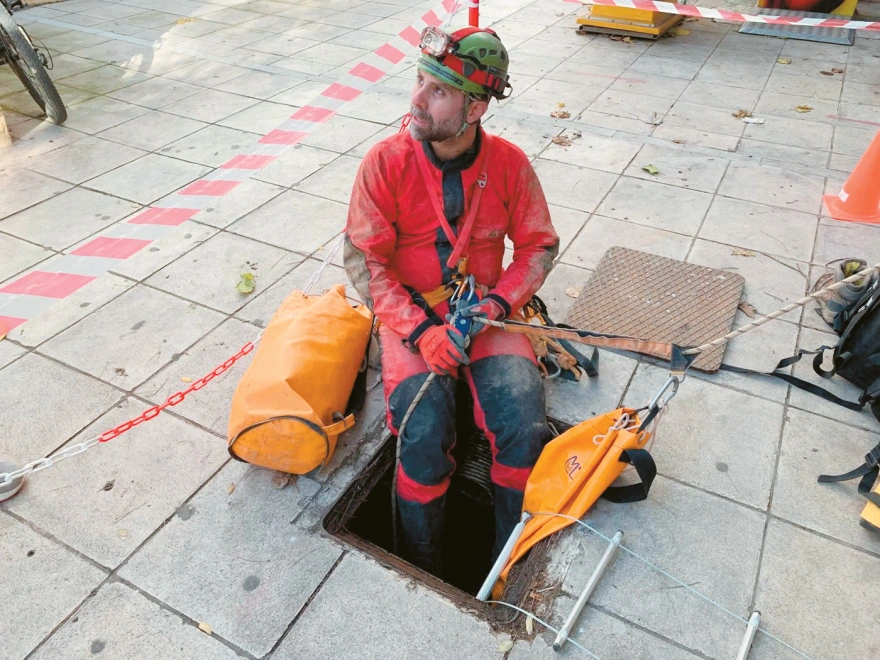
Defteraios’s scientific team descended into the ancient network and measured it.
“The quantities of water inside the ancient underground passage, part of which constitutes an improvement to the original Peisistratian system—possibly dating to the 4th century BC—were measured by our team in 2022–2023,” he says.
It runs beneath Papadiamantopoulou Street
The entrance to the active section of the ancient structure is located at a spot passed by thousands of Athenians every day, without them suspecting what lies beneath.
“Access is through Agios Thomas Square in Goudi. The underground passage that we have established exists there, with an accessible length of 350 meters, lies at a depth of 10–12 meters beneath the square and runs toward the city center, underneath Papadiamantopoulou Street.”
The ancient section running from Goudi toward the National Garden has not been operational for centuries. The water, however, found other routes.
“Since the Ottoman period, a more recent channel, known as Tsakmaki, carried the water from the blocked Peisistratian Aqueduct, which emerged at Agios Thomas, toward the city,” Defteraios explains.
The water ended up in a Roman reservoir on Mourouzi Street, next to the National Garden, together with water from the then-blocked Hadrianic Aqueduct, which arrived from Ampelokipoi.
In modern Athens, the water acquired a single destination.
“From 1875 onward, the water from the Peisistratian Aqueduct was allocated exclusively to the National Garden,” he notes. “In 1920, the Ottoman-era channel was replaced by metal pipes, which to this day carry the water to the lake at the Vasilissis Sofias entrance, from where it is distributed through channels to irrigate the Garden.”
That lake is on the same street as the building that was flooded. The distance is not great, and experts do not rule out the possibility that the water originated from this underground reservoir.
But why now?
The answer is that, despite its age, the underground system remains dynamic.
“A particularly telling example occurred in 2003, when the construction of Polis Park, opposite the Children’s Hospital, resulted in huge quantities of water flooding the excavations for months, while the National Garden dried up,” Defteraios recounts.
“The water returned to the underground tunnel and the Garden when the construction works progressed and sealed the underground leak.”
Unexplored branches
That incident serves as a guide today. It demonstrates that the water from the Peisistratian Aqueduct is not a static quantity. When it finds a new route, it follows it. It is cut off from one destination and appears, uninvited, somewhere else.
Back then, the water that disappeared from the Garden’s lakes ended up in the excavation pits of a construction site.
The water’s journey does not end at the Garden’s lakes.
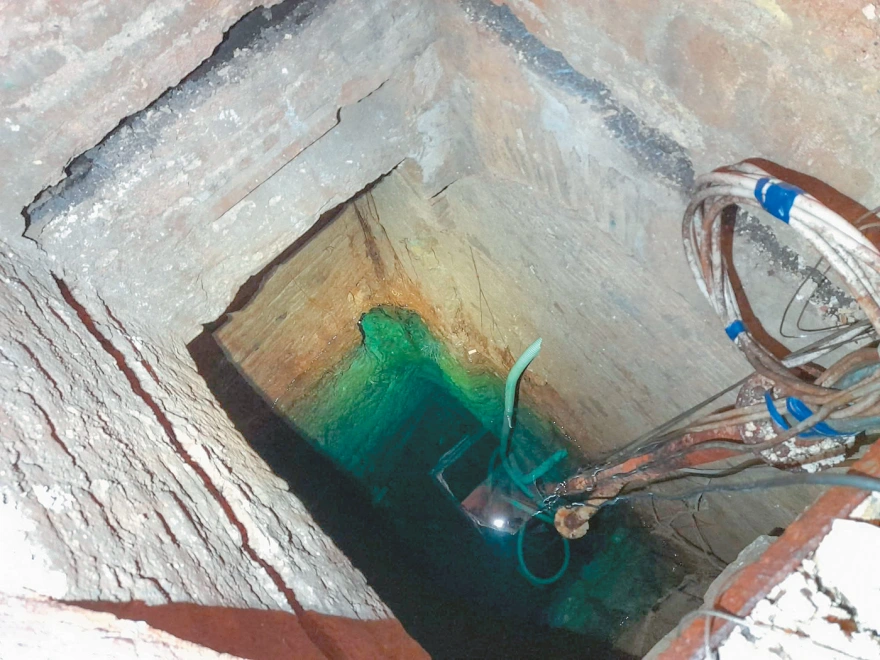
“Once the irrigation cycle is complete, the water returns through a well to the unexplored underground network of the ancient aqueduct, which has branches toward Plaka, Monastiraki, Kerameikos, and other areas,” Defteraios explains.
This is where another revelation emerges, challenging a widely held belief among Athenians.
“The running water we see in the opening at Monastiraki Square does not come from the Eridanos River on Lycabettus Hill; it comes from the Peisistratian Aqueduct,” he says.
And the most important point for the case involving the ministry is that this water does not remain confined to the underground passages.
“Locally, therefore, a groundwater aquifer is being continuously replenished beneath the National Garden by all this water, which irrigates the plants every day and seeps into the area’s subsoil.”
“The same water can also be detected as an underground water level in another well in the National Garden, which is also used for irrigation, as well as in the well inside the catacomb of the Russian Orthodox Church, which belongs to the same ancient underground network.”
The Russian Orthodox Church on Filellinon Street is just a few steps away from Syntagma Square.
An underground lake 200 meters away
Distance is the factor that makes the ancient aqueduct theory impossible to ignore.
“The Ministry of Foreign Affairs building is within a radius of 200–500 meters of the points we have identified,” Defteraios says.
He is nevertheless careful to avoid jumping to conclusions.
“This does not necessarily mean that the building was flooded by water from the aqueduct. However, we know that this water spreads underground throughout the area.”
The scenario described by experts familiar with the underground geology is straightforward.
An underground system carrying up to 1,300 cubic meters of water a day does not need a major change to cause a problem. A temporary alteration in its flow, a blockage, or a localized rise in the water level could be enough to force the water out at the most vulnerable point in the neighborhood.
Other experts who have commented on the issue also appear to agree.
Geotechnical engineer Kostas Sachpazis, a professor at the School of Engineering of the University of Western Macedonia, explained that Athens’s underground geology is complex. The behavior of water can change from one city block to the next.
In his view, the water level does not need to rise significantly for a basement to flood. A small increase in pressure may be enough.
NTUA Professor Emeritus Panagiotis Karydis noted that the impact of underground construction projects on the water table is a multifactorial issue. It depends on the depth of excavation, the characteristics of the soil, and the depth of buildings’ foundations.
The common conclusion among all the experts is that the cause can only be established through measurements: identifying the point where the water entered, comparing water-level data from before and after the incident and, according to Sachpazis, conducting a chemical analysis of the water, which could “give away” its origin.
Officially, no answer has been provided. And there may well be no further developments in the matter, since the water will be removed using pumps.
Until then, the Peisistratian Aqueduct will continue doing what it has been doing for 2,500 years: flowing down from Mount Hymettus, watering the National Garden, and disappearing into the darkness beneath the center of Athens…
Ask me anything
Explore related questions




