





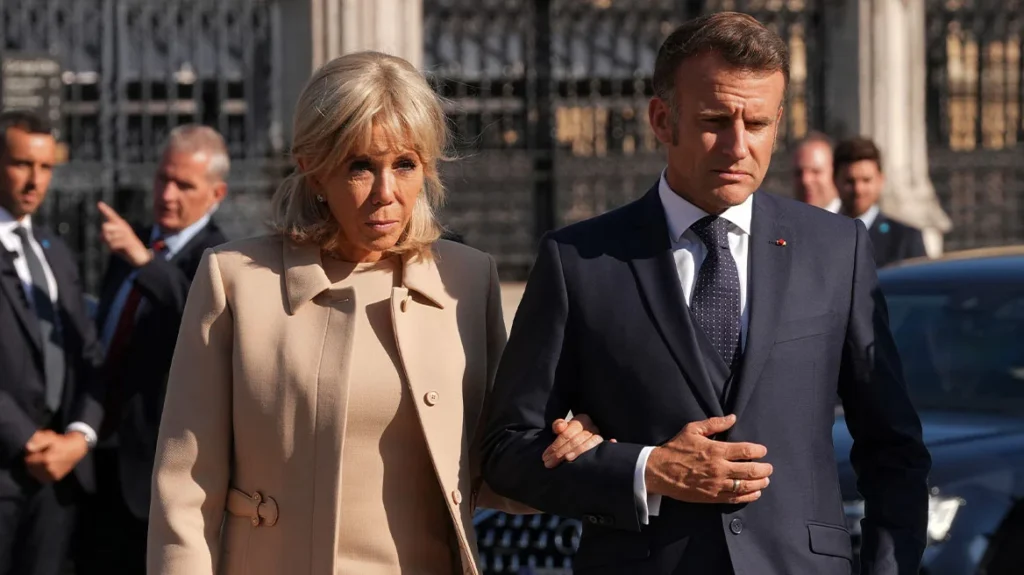
A new biography of French President Emmanuel Macron paints a different picture of the man, focusing on his childhood, his relationship with his grandmother and his marriage to Brigitte. Macron himself admits that he still feels like a child and never really experienced adolescence, while his wife believes that his grandmother’s influence continues to shape his personality to such an extent that he needs psychoanalysis.
The book, written by veteran political journalist Catherine Nay, who spoke to Macron, Brigitte and friends from his childhood, portrays an exceptionally intelligent but isolated man who struggles to accept criticism and question his own decisions. “I am still a child. I was never a teenager. I don’t like teenagers. I don’t understand them. My wife understands them,” the 48-year-old French president confided to his biographer, according to The Times of London.
According to the book, Macron’s early years were shaped by two powerful female figures: his grandmother, Manette, and, later, Brigitte, who is 24 years his senior. Manette, a retired headteacher, is portrayed as an authoritarian woman who sought to mould her grandson into her own personal “masterpiece”. According to Nay, she effectively kept him isolated in his studies and was furious when, at the age of 14, he began dating a girl. The young Macron managed to regain her favour only after promising her: “I will never look at girls again.”
The author notes that France’s future president had a much closer relationship with his grandmother than with his parents.
Brigitte Macron herself acknowledges Manette’s decisive influence over her husband. “Emmanuel has not yet buried his grandmother. He has not even replaced her. He should undergo psychoanalysis,” she told the author.
The book also revisits the unusual story of the presidential couple’s relationship, which began when Macron was just 15 and Brigitte was 39. She was his drama teacher, married and the mother of three children, while the young Emmanuel was a classmate of one of her children. According to Nay, Macron was the one who took the initiative in pursuing the relationship. His feelings for his teacher are described in the book as the “seduction of an adult”, and he is said to have suggested that they write a play together in order to secure time they could spend alone.
Brigitte later confided to a friend that she had asked Macron whether he wanted to have children of his own. “No, I want you to look after me alone,” he reportedly replied.
Isolation, self-confidence and an inability to admit his mistakes
The biography portrays the young Macron as an exceptionally intelligent child who nevertheless remained isolated from his peers, had very few friends and never learned to accept criticism. In the author’s assessment, this isolation has continued into his adult life, with the French president becoming increasingly detached from those around him and spending much of his daily life at the Élysée Palace.
Nay argues that Macron has developed a conviction that his decisions are always right. The self-confidence that propelled him to the French presidency at the age of just 39, making him the country’s youngest leader since Napoleon, has, in her view, turned into an inability to engage in self-criticism.
“Introspection has no place in his intellectual world. Even when he apologises, he comes back later to explain that he was right,” the author recently told French radio station France Inter.
She links this trait to his decision to call snap parliamentary elections in 2024, which left his government without a parliamentary majority and plunged France into prolonged political instability.
Ask me anything
Explore related questions




