





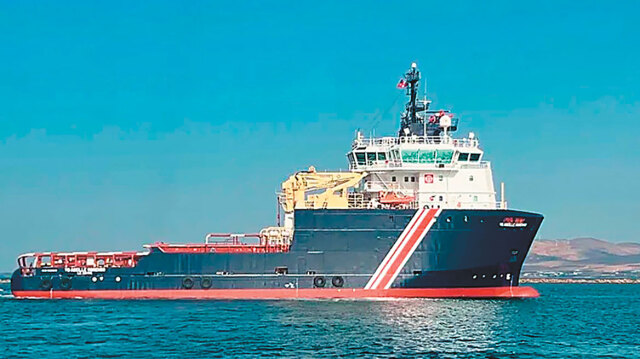
With the French research vessel Abeille Marengo operating since Thursday in international waters southeast of Karpathos, conducting surveys for the laying of the Great Sea Interconnector (GSI) cable under the Greek NAVTEX issued on 6 November, a dispute that has left a significant mark on Greek-Turkish relations over the past two years appears, for the time being, to have been brought to a close.
For Greece, the objective was clear from the outset: to prevent Turkey from turning the entire Eastern Mediterranean into a prohibited area for interconnection projects and from using such projects as leverage to impose faits accomplis and advance its claims under the “Blue Homeland” doctrine. This is particularly important at a time when the Eastern Mediterranean is becoming increasingly critical for connectivity projects, while the ambitious India-Middle East-Europe Economic Corridor (IMEC), which is also expected to pass through the region, remains pending for reasons unrelated to the crises in Iran and Gaza.
The deadlock created in July 2024, following the incident off Kasos, had cast a long shadow over Greek-Turkish relations and prevented the resumption of surveys for the GSI project. This summer, however, the French company Meridiam became involved in the project following an initiative by Greece’s Independent Power Transmission Operator (IPTO) and with the support of French President Emmanuel Macron himself. This brought Paris directly into the equation and, by all indications, proved instrumental in breaking the impasse.
French intervention with Ankara, acting as an informal intermediary, facilitated the establishment of a “practical arrangement” allowing the surveys to resume in a manner that safeguarded Greece’s rights and jurisdiction while also offering Turkey a face-saving solution. This was particularly important given the pressure exerted by the Turkish opposition and Ankara’s determination to demonstrate that it is defending its “Blue Homeland” doctrine and the Turkey-Libya maritime memorandum in practice.
Two days after the resumption of surveys, the French-brokered arrangement appears to be working. Turkey’s largely symbolic reaction consisted of the Turkish frigate TCG Gökova reading out the text of an unlawful Turkish NAVTEX (TURNHOS N/W: 1127/26), issued on 10 November, over the radio. The Greek frigate Limnos responded by reading out the Greek NAVTEX (NAVWARN 1411/26), under which the research vessel is conducting its operations.
Why the two sides communicated by radio
The Turkish response provided further evidence that no request for authorisation of the surveys had been submitted to Turkey. Had such a request been made, there would have been no reason for the Turkish frigate to read out the unlawful Turkish NAVTEX over the radio. Notably, the Turkish notice did not refer to “permission” but only to “consent” for the surveys to take place. This exchange occurred as the Abeille Marengo had entered international waters within Greece’s delimited Exclusive Economic Zone (EEZ) southeast of Karpathos, in an area overlapping with the claims contained in the Turkey-Libya maritime memorandum.
The message conveyed by Turkey through its initial, relatively restrained response does not suggest an escalation in the coming days while the Abeille Marengo remains within the Greek continental shelf. Nevertheless, there is some concern about how Ankara might react when the vessel reaches the boundaries of the Cypriot EEZ. In the past, research vessels operating in that area have faced harassment, partly because of Turkey’s purported determination to protect the “rights” of the breakaway entity in northern Cyprus. Those vessels, however, were conducting scientific marine and seismic surveys rather than surveys for cable laying, which fall into a different category under the Law of the Sea.
The domestic political debate has focused primarily on the precise contents of the French note verbale sent to Ankara, which appears to have unlocked the “practical arrangement” enabling the French research vessel Abeille Marengo to begin its surveys without obstruction.
Because the French note verbale constitutes diplomatic correspondence between France and Turkey, it is not in the possession of the Greek government or the Ministry of Foreign Affairs, although its contents have been communicated to the ministry. Even if the Greek Foreign Ministry possessed the document, it would not be entitled to make it public, since doing so would violate established rules of diplomatic practice and provoke a diplomatic incident, primarily with France.
According to information available, the French note verbale stated, among other things:
- “… We hereby inform you that the vessel ‘Abeille Marengo’ will conduct surveys during the specified period in the area extending from point … to point …”
- “… This notification does not constitute a statement of position and does not prejudge maritime jurisdictions or delimitations.”
- “… Furthermore, the vessel’s surveys fall within the freedoms of the seas concerning the surveying and laying of cables, under the Law of the Sea.”
The French diplomatic note
It is not known whether the understanding reached between Paris and Ankara included other concessions that the French side may have offered, independently of the specific project. Such concessions could concern France’s position on Turkish requests involving the European Union or French investments in Turkey. What had been made clear to the Turkish government, however, was that any repetition of the Kasos incident, involving obstruction of the surveys, would also have consequences for Franco-Turkish relations. At the present juncture, such a development would be particularly damaging for Turkey, which is making every effort to secure access to European programmes such as SAFE and Made in Europe, as well as to advance the revision of its Customs Union with the EU.
According to a senior source familiar with the consultations with Paris, the sole purpose of the note verbale was, as explicitly stated in the document, to provide “notification”, not to submit a request for approval or authorisation of the surveys.
The fact that applications for authorisation were submitted to Greece and Cyprus, while Turkey received only a “notification”, is also reflected, according to the same source, in the Greek NAVTEX of 6 November, which includes the reference numbers of the decisions approving the applications. By contrast, the unlawful Turkish NAVTEX of 10 November uses the term “consent”.
According to legal experts consulted by the Greek Ministry of Foreign Affairs, this notification from the French side, which should also have been received by Egypt as a coastal state of the Eastern Mediterranean, does not under any circumstances constitute evidence of recognition of maritime jurisdiction rights. Moreover, according to a senior source familiar with the consultations, the wording of the French note verbale prevents it from being invoked in future proceedings before an international court or tribunal as an argument for establishing rights over maritime zones.
France, moreover, has a clear position on the Turkey-Libya maritime memorandum, which it has expressed both bilaterally and through the common position adopted by all 27 EU member states. Two weeks ago, the EU reaffirmed its rejection of the memorandum following its ratification by the Libyan Parliament. According to information from a diplomatic source, Ankara stated in its reply to France on 10 November, among other things, that it was granting its consent for the vessel’s surveys over what it claims to be the Turkish continental shelf.
Once communications between Paris and Ankara had been completed, the green light was given for the research vessel to depart. The Abeille Marengo had remained in the port of Heraklion for two weeks.
Greek Prime Minister Kyriakos Mitsotakis and Cypriot President Nikos Christodoulides smiling in Dublin following the start of surveys for the laying of the cable.
The diplomatic negotiations behind the scenes
Intensive diplomatic activity had preceded these developments, with Greek Foreign Minister Giorgos Gerapetritis maintaining constant contact with his Cypriot counterpart, Constantinos Kombos, as they coordinated discussions with the French Foreign Ministry. At least two telephone conversations took place between Gerapetritis and Turkish Foreign Minister Hakan Fidan. There was also verbal communication from the US embassies in Nicosia and Ankara regarding Washington’s position, according to which no party can raise an “objection” to projects of this kind. At the same time, the Greek Ministry of National Defence had activated its operational plan to deal with any possible confrontation once the surveys began, mobilising Hellenic Navy surface vessels, albeit at a distance, as well as drones to monitor the area.
The latest developments, which ultimately enabled the resumption of surveys for the GSI, highlight the delicate limits within which Greek-Turkish relations operate and will continue to evolve. The “practical arrangement” reached over the GSI does not, of course, automatically usher in a period of “calm waters”, nor does it resolve the major outstanding issues in Greek-Turkish relations, foremost among them the delimitation of maritime zones.
It may, however, prevent potential flashpoints from escalating into major crises, possibly even bringing the two countries to the brink of a military confrontation over projects such as cable-laying surveys. Under the United Nations Convention on the Law of the Sea (UNCLOS), such activities fall within the freedoms of the seas and do not even require permission from the coastal state.
Israel and Turkey
The question now concerns future surveys for cable-laying projects as the Eastern Mediterranean emerges as a major connectivity hub. Could the same “practical arrangement” applied in the GSI case be achieved if a project were of Greek interest and implemented by a Greek business consortium, or if it involved a country that was less cooperative and lacked France’s ability to exert influence over Ankara? Another question is whether Turkey, drawing lessons from the events of the past ten days and the way the GSI survey dispute unfolded, will revise its approach, choosing either to undermine future projects that it believes exclude it from regional plans or to seek to establish in practice its maritime jurisdiction claims in the area covered by the Turkey-Libya memorandum.
Turkey’s position and its response to the GSI form part of Ankara’s broader strategy to secure a dominant regional role, an ambition that extends beyond maritime zones alone.
A report published in October by the National Intelligence Academy (Millî İstihbarat Akademisi), an institution affiliated with Turkey’s National Intelligence Organisation (MIT), entitled “Anatomy of Israeli Expansionism”, illustrates the perception now prevailing in Ankara. According to this view, Greece and Cyprus constitute a threat because they contribute to Israel’s efforts to confront Turkey strategically, with the aim of “encircling” and consequently weakening it.
The report states:
“Israel aims to compete with Turkey across a broad region extending from the Eastern Mediterranean to the Balkans and from the Red Sea to the Horn of Africa, including energy pipelines and connectivity corridors. The defence agreement signed with Greece or the recognition of Somaliland represent updated manifestations of this objective. Israel’s efforts to build alliances and its diplomatic initiatives aimed at encircling and excluding Turkey must be monitored with particular attention.”
According to the MIT report:
“The Eastern Mediterranean constitutes one of the most institutionalised arenas of this competition. The security, energy and political relations that Israel is developing with Greece and the ‘Greek Cypriot Administration of Southern Cyprus’ (GCASC) are evolving into a strategy of encircling Turkey. …
“Israel’s efforts to integrate its relations with Greece and the ‘GCASC’, alongside actors such as the United Arab Emirates and India, into broader security and connectivity networks also acquire particular importance in this context.
“Consequently, Israel seeks to encircle Turkey and its close allies and to make the formation of alliances with Turkey costly.”
Meanwhile, Turkish Minister of Energy and Natural Resources Alparslan Bayraktar, speaking at an event at the Istanbul Financial Centre last week, revealed Turkey’s intentions and its opposition to energy connectivity projects in the Eastern Mediterranean, such as the GSI, as well as to projects involving the exploitation of natural resources in the EEZs of Cyprus and other countries in the region.
The objective, naturally, is to ensure that Turkey is not bypassed and instead becomes the energy hub for the entire region, simultaneously acquiring full control over energy flows and, through that control, the ability to hold the Republic of Cyprus hostage.
Bayraktar defended the importance of the unlawful underwater pipeline connecting Turkey with the occupied territories of northern Cyprus, which has been the subject of a complaint to the United Nations by the Republic of Cyprus, arguing that it could provide cheap and clean energy to the entire island. He also floated the idea that this pipeline could be used to export natural gas through reverse flow, drawing on any discoveries made by Cyprus, Turkey itself or another country in the Eastern Mediterranean.
The Turkish minister effectively accused Cyprus and Greece of having blocked this project within the European Network of Transmission System Operators for Electricity (ENTSO-E).
Ask me anything
Explore related questions




