





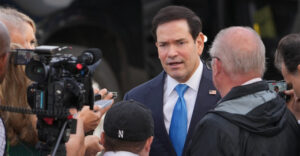
Marco Rubio’s visit to Athens is taking place with particular symbolism but also substantial content, as the U.S. Secretary of State has chosen Greece for one of his relatively infrequent trips abroad, at a time when American diplomacy has its attention focused on a series of open and pressing fronts.
Formally, the visit is linked to the 6th round of the Greece–U.S. Strategic Dialogue, but the range of issues that will be on the table extends far beyond its framework. Energy, defense, regional security, connectivity, investment and technology, as well as an examination of geopolitical developments, make up an agenda that reflects the depth of the relationship between Athens and Washington.
Of particular significance is also the fact that Rubio’s visit to Athens is not accompanied by a corresponding visit to Ankara. For decades, U.S. diplomacy followed the practice of parallel visits to Greece and Turkey in order to maintain the balances in the region. This choice, therefore, is another element that will be assessed in Athens as an indication of the particular weight and autonomy that the Greek-American relationship is now acquiring.
The Strategic Dialogue is taking place in an environment in which the Eastern Mediterranean is becoming increasingly connected with broader U.S. priorities in energy and security. Rubio himself had played a leading role, as early as 2019, in promoting U.S. policy for the region, together with then-Senator Bob Menendez, through legislation on security and energy cooperation in the Eastern Mediterranean. This approach elevated U.S. cooperation with Greece, Cyprus and Israel to a strategic level.
In Athens, the U.S. Secretary of State will discuss not only bilateral relations, but also a series of regional developments and crises in which Greece’s role as an important ally is highlighted. The situation in the Middle East, the war in Ukraine, the situation in the Eastern Mediterranean and the energy balances in Southeastern Europe, as well as the role played by Greece, while maintaining excellent relations with both Israel and the Arab world, will be part of the discussions with Kyriakos Mitsotakis and George Gerapetritis.
Energy, F-35s and the 3+1 format
In the field of energy, the Vertical Corridor is expected to occupy a central position. The Greek side is seeking to strengthen the country’s role as a gateway for the transportation of U.S. LNG to the Balkans and Eastern Europe, while the planned drilling and exploration activities by ExxonMobil and Chevron in the Greek EEZ are also at the center of attention. U.S. support for Chevron’s activities, which also include exploration in the blocks south of Crete, takes on additional significance because of the reactions expressed by the Libyan side, with reference to the illegality of the Turkish-Libyan Memorandum.
Similarly, in defense, the discussion is expected to focus on further strengthening the Greek Air Force. The upgrade of the F-16s to the Viper standard and the procurement of F-35s are already key pillars of defense cooperation, while Athens is considering the acquisition of additional weapons and support equipment from the United States.
The same applies to regional cooperation. The Greece–Cyprus–Israel 3+1 format with the United States remains an important coordination tool, while particular importance is being attached to energy and digital connectivity projects. Washington has invested political capital in this architecture of the Eastern Mediterranean, while Athens seeks to ensure that these projects move forward despite the reactions and challenges raised by Turkey.
The schedule of meetings
Marco Rubio arrives in Athens in the evening from Iceland, and his official program begins tomorrow with a meeting with Foreign Minister George Gerapetritis at the Ministry of Foreign Affairs, where, following their joint statements, they will also officially launch the 6th Strategic Dialogue.
Mr. Rubio will inaugurate the new wing of the U.S. Embassy building and will then deliver a speech at the Pnyx, while in the afternoon he will meet with Prime Minister Kyriakos Mitsotakis, who will have returned from Croatia. The visit will conclude with a dinner hosted in his honor, attended by the prime minister and the foreign minister.
At the same time, from noon onward, the proceedings of the 6th Round of the Strategic Dialogue will be held with the participation of the ministers and deputy ministers responsible for the relevant areas. Within this framework, three agreements will also be signed: a Renewal of the Memorandum of Cooperation concerning the Imposition of Import Restrictions on Categories of Archaeological and Ethnological Material up to the 15th century AD; a Letter of Intent between Greece and the United States for the establishment of cooperation between the Hellenic Armed Forces and the Florida National Guard; and a Memorandum of Understanding (MoU) for the mutual recognition of Certificates of Competency for Seafarers, in accordance with the 1978 STCW International Convention, with the aim of facilitating employment and strengthening bilateral cooperation in the field of maritime education.
For Athens, what is at stake from Rubio’s visit is not only confirmation of the good level of bilateral relations, but also the next steps in the Strategic Partnership, with specific energy, defense and investment projects, and above all an indication of the depth of the strategic alliance relationship in a region such as the Eastern Mediterranean, where U.S. interests in security, energy and geopolitical influence converge with those of Greece.
Ask me anything
Explore related questions




