





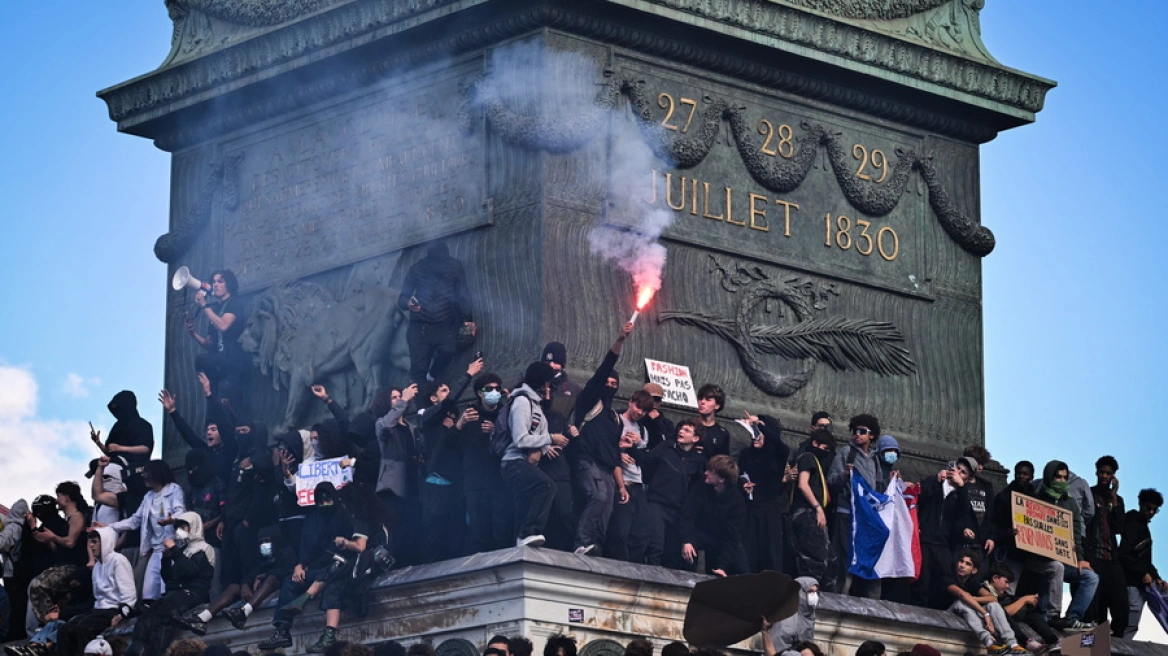
It began with localized school blockades and escalated into mass riots of 2nd and 3rd generation immigrants backed by the country’s left on a national scale.
What begun as student’s demonstrations and anger among young people in France has intensified in just a few weeks, has evolved in chaos with high school students pushed aside by non-student rioters. The students were determined to put their concerns at the top of the political agenda, six months before the country’s presidential election.
Deteriorating school buildings, overloaded curricula, teachers who are not replaced when absent, pressure surrounding access to higher education. Since mid-September, the riots has spread from one school to another, eventually encompassing students across the country. But all this has taken a different turn as schools are being burned down in a total reverse of the initial objective of the student’s demonstrations.
The protest movement began at a number of schools on the outskirts of Paris, but gradually spread, turning local demands into a nationwide movement before deteriorating into chaos.
The significant escalation was supported by the left with the perpetrators being children of immigrants. Attacks on school principals and arson attacks on school buildings. Demonstrations intensified, and clashes with law enforcement became more frequent. More than 200 educational institutions were blockaded, while over 1,000 were experiencing operational disruptions.
After ten days of protests, French Education Minister Édouard Geffray agreed to meet with high school student unions and committed to an action plan aimed at speeding up the replacement of absent teachers, reviewing the school curriculum and addressing “school democracy.” A few days earlier, he had announced the creation of a platform where students could express their demands. Higher Education Minister Philippe Baptiste met with student organizations. But the students no longer controlled their own demonstrations.
French President Emmanuel Macron appeared to be losing patience. According to a source close to him, Macron blames the education minister for underestimating the protest movement, failing to anticipate its spread and not making an appearance during its first ten days. In reality, Macron himself has failed to understand that the riots are no longer about education; they are a “bras de fer” between the left-wing parties along with immigrants on one side and the French government and people on the other.
Jean-Luc Mélenchon, leader of the France Unbowed party and a presidential candidate, instead of trying to bring down the energy of the riots in order to avoid the possible death of someone, did the opposite fueling the fire in an attempt to gain political points in light of the coming elections. Socialist Party leader Olivier Faure spoke of “a generation rising up” as well. A 15-year-old had his hand amputated after being struck by a stun grenade in the city of Lens. In Tours, a 16-year-old lost his hearing in one ear, with the prosecutor’s office referring to injuries “consistent” with being hit by a rubber-bullet launcher.
Lecornu reacted sharply to allegations of police violence. Referring to claims of “political orders for police repression,” he said on Wednesday that they were a “lie” that “tarnishes the police,” describing the incidents as “accidents” that can happen.
Late on Thursday night, the French prime minister pledged that the government would present “concrete, immediate and fully funded responses” to the protests by the end of October, although he provided no further details. “The anger of young people does not come out of nowhere. No one can remain indifferent to the concerns they are expressing,” he added.
It remains to be seen whether he will persuade the organizations and unions that have called for a new day of strikes and demonstrations on Tuesday, October 13.
“Until the €10 billion is put on the table, we will continue mobilizing,” insisted Sabrine Harbas, a representative of the Student Union.
Many high school students, however, say they are determined to continue protesting. “It’s kind of like a game between the government and us—let’s see who backs down first,” said 16-year-old Lucine unaware of the real game that is being played at his expense.
Ask me anything
Explore related questions




