





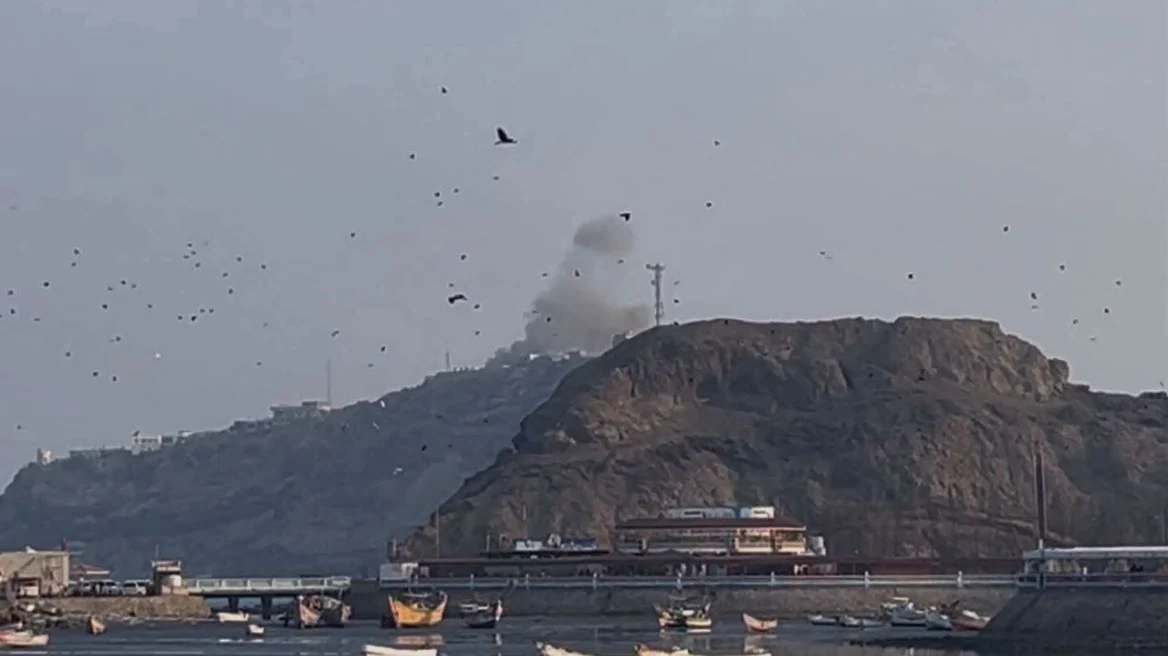
At least five people were killed and 16 injured in a missile and drone attack launched on Thursday by the Iran-backed Houthi rebels against Al-Maashiq Presidential Palace in Aden, Yemen, which houses the country’s internationally recognized government.
According to Yemen’s Health Ministry, two members of Prime Minister Shaya al-Zindani’s personal security detail were among those killed, while 16 people were injured.
The Houthis claimed responsibility for the attack, saying their target was a Saudi Arabian military operations center that, according to their account, was operating within the government compound.
Yemen’s Health Minister, Qasim Mohammed Buhaibeh, said the victims included security personnel and civilian employees working at the compound, which serves as a key workplace for senior government officials, including the prime minister.
A statement released by the government’s Information Ministry clarified that the prime minister and members of the Cabinet were safe following the attack.
The strike is one of the most significant attacks against Yemen’s government since early October, when the military operation known as “Yemen’s Dawn” began as part of the country’s years-long conflict with the Houthis.
Houthis: “Any Saudi Military Presence Is a Legitimate Target”
In a statement, the Houthis said the attack was part of their strategy of striking Saudi military forces regardless of their location.
“The bombing of the headquarters of the Saudi enemy’s war operations in Aden is part of our declared strategy of targeting Saudi military concentrations wherever they are and considering any military presence of the Saudi enemy a legitimate target for our forces,” they said.
Yemen’s government did not immediately provide further details about the types of missiles used or the extent of the damage to the presidential compound.
In a separate statement, Yemen’s Cabinet confirmed that the attack had been carried out with missiles and drones, emphasizing that it would not affect the government’s operations or the continuation of military operations against the Houthis.
“Yemen’s future will not remain hostage to a militia that turns its weapons against its own people, threatens the security of its neighbors, and relies on violence to compensate for the Yemeni people’s rejection of its coup-based agenda,” the statement said.
Warnings of Attacks on Saudi Airports
The attack on the presidential palace took place less than an hour after the Houthis renewed their warnings that Saudi Arabia’s airspace and airports were not safe.
The rebels claimed they retained the ability to respond with comparable strikes to ongoing Saudi military operations in Yemen.
According to the Houthis, Saudi Arabia carried out 65 air and missile strikes in various parts of Yemen over the previous 24 hours, targeting the capital, Sanaa, and several other provinces.
The Health Ministry cited by the rebels reported that Saudi air and missile strikes had killed 120 people and injured another 307 between September 3 and October 15. According to the same claims, women and children accounted for approximately 60% of the casualties.
Yemen’s Army Announces the Killing of a Senior Houthi Commander
On the same day, Yemen’s army announced that it had killed one of the Houthis’ most important military commanders, known as “Abu al-Fadl al-Khadrami.”
According to the statement, the commander was responsible for the organization’s ballistic missile and drone operations and ranked among its most senior military leaders.
Yemen’s army also claimed that al-Khadrami had received specialized military training in Iran.
Saudi Arabia: Houthis Possess Advanced Weapons and Threaten International Shipping
The Saudi-led military coalition warned that recent Houthi attacks, including strikes targeting King Khalid International Airport in Riyadh, demonstrated the growing threat posed by the organization to Saudi Arabia, regional security, and international maritime trade routes.
Coalition spokesperson Major General Turki al-Maliki said the Houthis had acquired advanced military technologies with assistance from regional actors.
He claimed that they had developed into “the first terrorist organization to possess ballistic missiles, attack drones, suicide drones, and explosive-laden speedboats.”
The coalition announced that military operations would continue with the aim of weakening the Houthis’ military capabilities and neutralizing sources of support for their war effort, while respecting international humanitarian law, as it stated.
Missiles and Drones Intercepted over Saudi Arabia
Houthi attacks against Saudi Arabia have escalated in recent days.
On Thursday, the Riyadh-led coalition announced that it had intercepted and destroyed multiple aerial threats in different parts of the country. These included a drone over the city of Khamis Mushait in southwestern Saudi Arabia, a cruise missile in the western region of Medina, and another unmanned aircraft in the Eastern Province.
The escalation is raising growing concerns about the security of energy supplies, international commercial shipping, and fuel prices, as the Houthis increasingly target airports, oil facilities, and maritime transport.
Trump: Houthis Are Trying to Drive Up Oil Prices Ahead of US Elections
Earlier this week, US President Donald Trump accused the Houthis of deliberately trying to drive up oil prices, while suggesting that Iran was behind the renewed escalation in attacks.
In a post on his Truth Social platform, Trump wrote:
“The Houthis are behaving very badly. They had been quiet for a long time, but now they have reappeared, probably at Iran’s direction, attacking Saudi Arabia and deliberately trying to drive up oil prices, probably ahead of the US elections.”
Ask me anything
Explore related questions




