





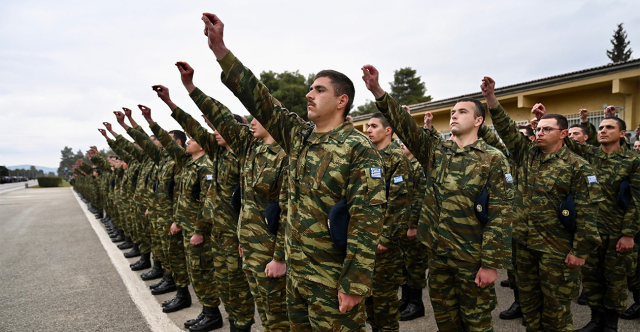
Applications for enlistment in Greece’s fourth intake of 2026 have exceeded even the most optimistic forecasts, as structural changes introduced by legislation passed by the Ministry of National Defence last January have dramatically altered the landscape of military service in the country.
By tightening the rules on deferments, putting an end to the ‘industry’ of medical certificates and opening the way for 18-year-olds to enlist, the reforms have brought the number of conscripts expected to report to recruit training centres from 9 November to more than 10,000.
Conscripts assigned to the fourth intake of 2026 must report to their local Recruit Training Centres (Kέντρα Εκπαίδευσης Νεοσυλλέκτων, or KEN) from 9 November until the end of that week. However, the unexpectedly high demand has put existing facilities under pressure, with capacity threatened by the influx.
In response to this unprecedented situation, the Ministry of National Defence has significantly increased the number of training centres to accommodate almost all those who submitted applications by 31 July 2026.
Where the new training centres will be located
According to reliable information, the network of Recruit Training Centres operating for the fourth intake will include:
- Avlonas
- Tripoli
- Lamia
- Messolonghi
- Kalamata
- Thebes
- Poros
- Sparta and reception points in the regional unit of Evros
The number of recruits has also surged because of the introduction of early enlistment. For the first time, 18-year-old men have been given the opportunity to complete their military service at such a young age.
Record numbers opting for early enlistment
The early-enlistment scheme has reportedly driven the sharp rise in recruit numbers. Following the relevant legislative changes, 18-year-old men can now choose to serve before beginning their university studies.
Figures available to the Ministry of National Defence appear to point to a ‘wave of early enlistment’, with a large number of first-year university students reportedly choosing to complete their military service before starting their degree courses.
Those who cancelled their deferments only last September — after the statutory deadline of 31 July 2026 — will instead be assigned to the January 2027 intake.
Meanwhile, the Ministry of National Defence is also planning radical changes to the way new recruit training centres are organised. Defence Minister Nikos Dendias has announced that they will follow the model used by training centres for reservists.
During a visit last summer to the 1st Reserve Retraining Centre in Avlonas, Dendias said: ‘The Armed Forces will replicate the model of these reserve training centres as a template, a “blueprint”, as the Anglo-Saxons would say, across all recruit training centres.’
He added: ‘This will be funded through an existing private donation from the Public Power Corporation, and I hope we will have completed this comprehensive transformation of recruit training centres by the end of 2026.’
According to the defence minister, the strategic objective is to provide ‘meaningful military service that gives young people useful skills and certifications’, leaving behind the idea of service as a ‘chore’.
Military service and innovation
New opportunities are also opening up for young scientists, who may be able to fulfil their compulsory military service at the Hellenic Centre for Defence Innovation (ELKAK), provided they meet the academic criteria.
Under the new legislative framework, eligible conscripts holding a PhD in a field related to technological disciplines can complete their military service at ELKAK, benefiting from the provisions that allow them to serve as Probationary Reserve Officers in the Army or Air Force, or as Auxiliary Officers in the Navy.
They can take up these roles immediately after completing basic training. Their period of compulsory service will be the same as that required of regular conscripts, and after completing six months of military service they will be awarded the rank of Reserve Second Lieutenant or the corresponding rank in their respective branch.
Eligible fields include:
- Information technology
- Mechanical engineering and aeronautical engineering
- Electrical engineering and computer engineering
- Chemical engineering
- Emerging technologies and artificial intelligence
- Economics and business administration
- Biology, molecular biology and genetics
- Automation engineering
Photo: EUROKINISSI
Ask me anything
Explore related questions




