





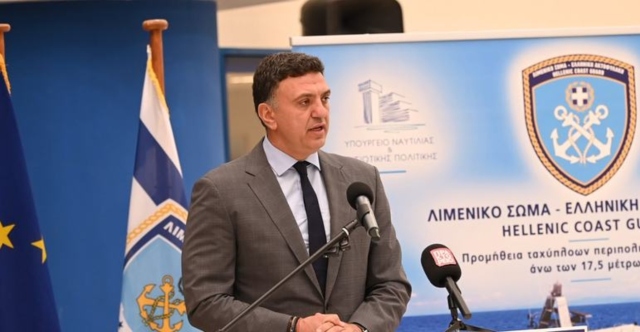
Shipping and Island Policy Minister Vassilis Kikilias today signed a €23.8 million contract for the procurement of seven new high-speed patrol boats for the Hellenic Coast Guard, at a special ceremony held at the Ministry of Maritime Affairs and Island Policy.
The new vessels will strengthen the Coast Guard’s operational capabilities in patrolling Greek waters, protecting the country’s maritime borders, monitoring fishing activities, combating illegal activity and conducting search-and-rescue operations.
The contract covers seven MAGNAR 1950-class vessels, each measuring 21.29 metres in length, to be built in Greece by VIKING LIFE-SAVING EQUIPMENT HELLAS, the company awarded the contract. It also includes an option to procure up to seven additional vessels of the same type in the future.
In his address, Kikilias referred to the growing demands facing the Hellenic Coast Guard at a challenging time, stressing the need to continuously equip its personnel with modern resources.
“We are living in difficult times, amid geopolitical instability. The responsibilities facing our ministry and the Hellenic Coast Guard are significantly increasing, and the procurement of seven new high-speed patrol boats represents another decisive step in our efforts to support the men and women of the Coast Guard, enabling them to fulfil their patriotic duty with the most modern equipment available. We want to make their work easier as they face the challenges of today and tomorrow,” the minister said.
He called on all parties involved to adhere strictly to the timetable, with the vessels scheduled to be delivered successively over a period of six to 12 months from now.
Boosting Greece’s shipbuilding industry
Referring to the fact that the new patrol boats will be built in Greece, Kikilias stressed the importance of strengthening the country’s shipbuilding industry.
“From the moment I took office as Minister of Maritime Affairs and Island Policy, I stressed that operational capability and the ability to strengthen ourselves on a permanent basis, eventually achieving self-sufficiency, are essential. Our ability to manufacture vessels, and therefore to maintain strong shipyards and a strong shipbuilding industry, is both a necessary and sufficient condition for this effort. It is now becoming clear that Greek shipyards and companies operating in this sector are growing stronger,” he said.
Kikilias also praised Hellenic Coast Guard personnel, drawing on his own experience visiting Greek islands and joining patrols aboard Coast Guard vessels.
“During my visits to our islands, large and small, I have had the opportunity to travel aboard many different types of Hellenic Coast Guard vessels and see first-hand — something I recognise with great pride — the ability, professionalism and patriotism of our personnel, our coastguards,” he said.
Modernising the Hellenic Coast Guard
Addressing the broader plan to modernise the Hellenic Coast Guard and its operational priorities, the minister said the government was pursuing a range of initiatives to equip the service with the technology needed to meet contemporary challenges.
“It is extremely important for us, as we work to create and build a modern, strong Hellenic Coast Guard, that alongside launching procurement procedures for artificial intelligence, the new Operations and Communications Centre (KEPICH), the National Integrated Maritime Surveillance System (ESOTHE), the Vessel Traffic Monitoring System (VTMS), drones, sensors and everything else required in the modern era to support our personnel, we also have the equipment we need,” he said.
“We must be able to police our borders effectively, operate with confidence and uphold our doctrine. We are a country that must be able to put into practice whatever it announces.”
Concluding his remarks to Coast Guard personnel, Kikilias urged them to act confidently while remaining conscious of their responsibilities and the challenges they face.
“I want you to act with confidence, but also with an awareness of your duty and the difficulties involved. I want you to respect the public and society, our islanders, our people and our seas, because the sea demands respect and caution. Our priorities are clear: above all, the safety and protection of human life, as well as our maritime borders. We must be ready, organised and operating at the highest possible level,” he said.
The new patrol boats will be capable of reaching speeds of at least 50 knots and travelling distances of at least 320 nautical miles. Each will have a six-member crew, a total carrying capacity of at least 30 people, modern navigation and communications systems, and equipment suitable for search-and-rescue operations.
VIKING: Vessels to be built entirely in Greece
Ioannis Georgiadis, representing the contractor, said the signing marked an important day for VIKING Greece, the Ministry of Maritime Affairs and Island Policy, and the Greek shipbuilding and industrial sectors.
“Today is a particularly important day for VIKING Greece, the Ministry of Maritime Affairs and Island Policy, and Greek shipbuilding and industrial activity. With the signing of the contract to build seven modern MAGNAR-class high-speed patrol boats, with an option for seven more, a project of strategic importance for the country and the Hellenic Coast Guard is getting under way,” he said.
He thanked Kikilias, the ministry’s leadership and staff, and the Hellenic Coast Guard for placing their trust in the company, adding that this confidence brought with it considerable responsibility.
“We are committed to delivering vessels with advanced operational capabilities that will substantially strengthen the Hellenic Coast Guard’s mission to protect maritime borders, human life at sea and national security,” Georgiadis said.
He highlighted the fact that the vessels would be built entirely in Greece, at the company’s facilities in Thebes.
“This represents an investment in Greek industry, Greek expertise and Greek workers. The programme will create jobs, develop new skills and strengthen our country’s productive base,” he said.
VIKING, he added, is an international organisation with a strong presence in Greece spanning several decades. Its aim is to combine international experience and the highest quality standards with Greek manufacturing and innovation.
“Today’s project is perhaps the best example of this philosophy. I would like to reiterate our commitment to working professionally, consistently and with dedication to deliver a result that meets the expectations of the state and the Hellenic Coast Guard personnel who will operate these vessels every day. Thank you for your trust. We look forward to seeing the first Greek-built MAGNAR boats operating in Greek waters soon,” he said.
The procurement is funded through the Public Investment Development Programme under the co-funded Fisheries, Aquaculture and the Sea Programme 2021–2027.
The contract also provides for a four-year warranty or 6,000 operating hours for the main engines, whichever comes first. Covered maintenance and repair work will be carried out without additional cost to the Hellenic Coast Guard.
Ask me anything
Explore related questions




