





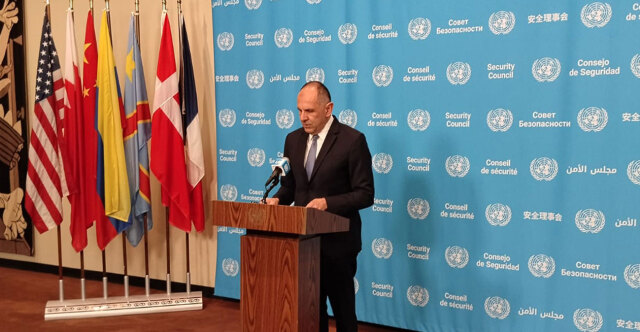
Greece, the European Union and four other countries have voiced their strong opposition at the United Nations to the ratification of the Turkey-Libya maritime memorandum by Libya’s House of Representatives.
Greek Foreign Minister George Gerapetritis said the decision raised serious concerns for regional security and the international legal order.
In a joint statement delivered on behalf of Egypt, Cyprus, Bahrain, the United Arab Emirates (UAE), the European Union and Greece, Gerapetritis described the memorandum as contrary to international law, stressing that its ratification neither changes its legal status nor can it prejudice the rights of third states.
Athens also reiterated its commitment to dialogue with Libya on the delimitation of maritime zones, based on international law and the principles of good neighbourly relations.
Gerapetritis’s full statement
“I make this statement on behalf of Egypt, Cyprus, Bahrain, the United Arab Emirates, the European Union, and my own country, Greece.
The recent decision by the House of Representatives of Libya to ratify the so-called ‘Memorandum of Understanding between Turkey and Libya on the Delimitation of Maritime Jurisdiction Areas in the Mediterranean’, signed in 2019, raises serious concerns about regional security and stability.
It also highlights a broader challenge for the international legal order: the need to ensure that arbitrary bilateral agreements do not undermine established rules of international law or prejudice the rights of third states.
International law, and in particular the United Nations Convention on the Law of the Sea (UNCLOS), as well as customary international law, provide the legal framework for the delimitation of maritime zones. These rules are fundamental to ensuring predictability, legal certainty and peaceful relations between states.
Accepting bilateral agreements that disregard the applicable rules and principles of international law would set a dangerous precedent, undermining the international legal order and the principles underpinning the peaceful settlement of disputes.
The purported Turkey-Libya memorandum runs counter to these fundamental principles. It disregards geographical reality and the maritime rights of all coastal states concerned, including the rights of islands under the United Nations Convention on the Law of the Sea.
The subsequent decision by Libya’s House of Representatives does not alter this legal reality. The memorandum remains null and void, has no legal standing, is contrary to international law and cannot constitute a lawful basis for the delimitation of maritime zones or produce legal effects for third states.
We remain committed to the reunification of Libya’s institutions and to the prospect of a united and prosperous Libya. A stable Libya that actively participates in regional cooperation is essential for peace and security throughout the Mediterranean.
Libya’s political transition and its relations with neighbouring countries must be governed by respect for international law and good neighbourly relations.
As member states of the United Nations, we have consistently supported the peaceful settlement of disputes through dialogue and in accordance with international law.
In this spirit, Greece has held bilateral talks with Libya on the delimitation of maritime zones, in good faith and in accordance with international law, and expresses its readiness to continue these efforts.
Respect for international law is an essential prerequisite for regional stability and for maintaining a rules-based international order.”
Ask me anything
Explore related questions




