





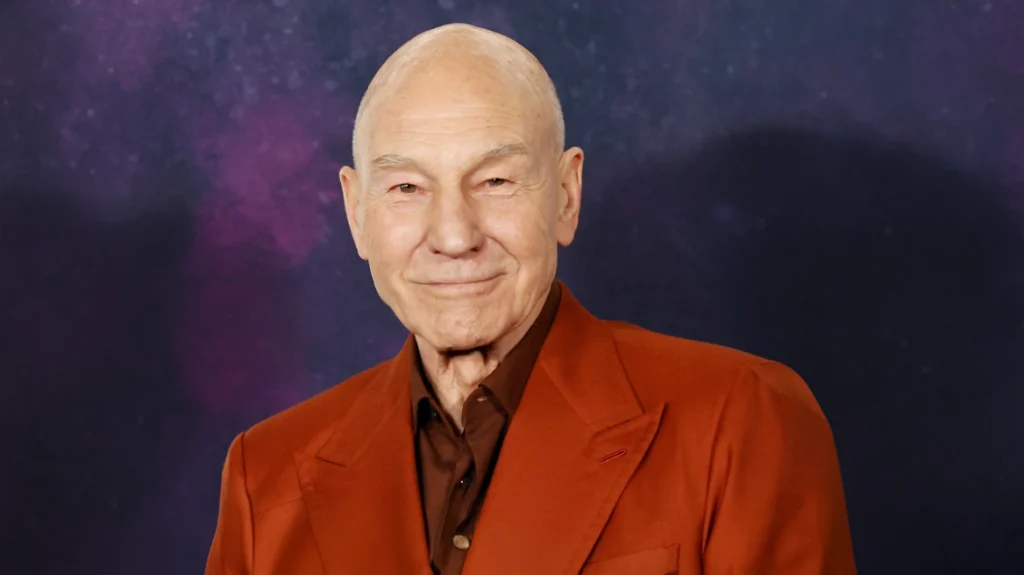
Patrick Stewart, the iconic star of Star Trek: The Next Generation and the X-Men films, has died at the age of 86.
According to initial reports, he died on Wednesday, October 28, at his home in Los Angeles, after battling Alzheimer’s disease.
The news was confirmed by his representative in a statement: “It is with great sadness that we announce the death of Sir Patrick Stewart yesterday at his home in Los Angeles, under the loving care of his beloved wife, Sunny, following a brief and moving journey with Alzheimer’s disease,” the statement read.
“He was surrounded by the warm embrace of family and friends, with live music, prayer, tears, laughter and the kind of profound emotion that only he could inspire after a lifetime devoted to all of us. We will forever hold in our hearts the peaceful calm and contemplative expression on his face, a lasting reminder of his grace,” the statement added.
Patrick Stewart was born on July 13, 1940, in Mirfield, in the West Riding of Yorkshire, England. With a career spanning more than six decades, he established himself as one of Britain’s most distinguished actors, with a particularly strong presence in theatre, television and film.
He became widely known as Captain Jean-Luc Picard in Star Trek: The Next Generation, and later gained a new generation of fans as Professor Charles Xavier in the X-Men film series. At the same time, he built an impressive theatrical career, particularly through his work with the Royal Shakespeare Company, and distinguished himself as a voice actor and narrator.
Patrick Stewart was the son of Gladys Barrowclough, who worked as a weaver and textile mill worker, and Alfred Stewart, a sergeant major in the British Army. His father had previously worked as a general laborer and postman.
His childhood was marked by domestic violence perpetrated by his father against his mother. The experience profoundly affected him and, many years later, led him to become an active campaigner against violence against women. In 2006, he appeared in an Amnesty International video in which he spoke openly about what he had experienced as a child. He also supported the establishment of a scholarship at the University of Huddersfield for postgraduate studies in domestic violence.
His relationship with acting began during his school years. He credited much of his subsequent career to one of his teachers, Cecil Dormand, who gave him a copy of a Shakespeare play and encouraged him to perform it in front of the class.
At just 15, he left school and began becoming more actively involved in local theatre. He also worked as a newspaper reporter and obituary writer, but a year later he was forced to choose between journalism and acting. He ultimately chose the latter.
In 1966, he joined the Royal Shakespeare Company, where he remained until 1982 and became one of its leading members. In the years that followed, he appeared in more than 60 of the company’s productions, performing major roles from the Shakespearean repertoire.
Meanwhile, he began appearing on television. He made his television debut in Coronation Street in 1967, followed by roles in a number of productions, including I, Claudius, Tinker Tailor Soldier Spy and North and South.
His film appearances included John Boorman’s Excalibur in 1981, David Lynch’s Dune in 1984 and Tobe Hooper’s Lifeforce in 1985.
His major international breakthrough came in 1987, when Stewart moved to Hollywood to star in Star Trek: The Next Generation, taking on the role of Captain Jean-Luc Picard.
When he agreed to join the series, he knew almost nothing about Star Trek or its enormous cultural significance in the United States. In fact, he believed the show would have a short run and that he would subsequently return to the theatre.
Reality turned out to be very different. Star Trek: The Next Generation aired from 1987 to 1994, and Picard became one of the most recognizable characters of Stewart’s career. He reprised the role in the feature films Star Trek Generations (1994), Star Trek: First Contact (1996), Star Trek: Insurrection (1998) and Star Trek: Nemesis (2002).
The series brought him worldwide fame and significant accolades, including a Screen Actors Guild Award in 1995 for his performance in a drama series.
Years later, when asked which work he considered the most important of his career, he chose Star Trek: The Next Generation, explaining that it “changed everything” for him.
His success as Jean-Luc Picard led to his becoming closely associated with that type of role, but one of the most significant departures from it was his participation in the X-Men film series.
There, he portrayed Professor Charles Xavier, a character who, as has often been noted, shares several traits with Picard: a composed, commanding and charismatic man with a deep voice. Stewart also lent his voice to the character in X-Men video games.
At the same time, he continued appearing in film and television productions. Among other roles, he starred as Captain Ahab in the 1998 adaptation of Moby Dick and as Ebenezer Scrooge in the 1999 television adaptation of A Christmas Carol. He also appeared in Frasier and the British comedy series Extras, where his performance earned him an Emmy Award for Outstanding Guest Actor in a Comedy Series.
Despite his enormous success in television and film, theatre always remained particularly important to him. After Star Trek began, he realized how much he missed the stage and continued seeking opportunities to perform in theatrical productions.
One especially notable production was Charles Dickens’s A Christmas Carol, in which he performed all 40 characters in the story. The production opened on Broadway in 1991 and earned him a Drama Desk Award for his performance. Other major theatrical roles followed, including Prospero in The Tempest, as well as performances in Othello, Macbeth and Hamlet.
In 2008, he played Claudius in Hamlet, alongside David Tennant, winning the Laurence Olivier Award for Best Actor in a Supporting Role. A year later, he worked with Ian McKellen in a production of Waiting for Godot, a collaboration that became a significant milestone in his long theatrical career.
Stewart’s deep, commanding voice became another of his defining characteristics. In addition to his performances in films and television series, he worked extensively as a voice actor and narrator.
He narrated literary works, documentaries and television productions, and lent his voice to animated films such as The Prince of Egypt, Chicken Little and The Pagemaster. He also appeared in productions including The Simpsons, Family Guy and American Dad!, in which he voiced Avery Bullock.
His voice was also heard in video games, including titles from the Star Trek and X-Men franchises, as well as games such as The Elder Scrolls IV: Oblivion, for which he received a Spike TV Video Game Award.
His Personal Life
Patrick Stewart had two children, Daniel and Sophie Alexandra, from his first marriage to Sheila Falconer. The couple divorced in 1990. In 2000, he married Wendy Neuss, but they separated three years later.
In 2004, after living in Los Angeles for several years, he returned to England. As he explained at the time, he was feeling homesick and wanted to return to the theatre.
That same year, he became chancellor of the University of Huddersfield, and in 2008 he was appointed a professor of performing arts. In 2001, he was appointed an Officer of the Order of the British Empire (OBE), and in 2010 he was knighted for his services to drama.
Alongside his artistic career, he was actively involved in social issues. His childhood experiences led him to support campaigns against domestic violence and become a patron of an organization supporting abused women.
Stewart also had a special connection with the town of Huddersfield and with football. He was a lifelong supporter of the local football club and served as president of the town’s academy, which aims to develop young talent.
With more than six decades on stage and screen, Patrick Stewart achieved something rare: combining a distinguished career in classical theatre with the worldwide popularity of a television and film star. From Shakespeare to Star Trek and X-Men, his career was defined by a constant pursuit of challenging roles and a presence that transcended any single genre or medium.
Ask me anything
Explore related questions




