





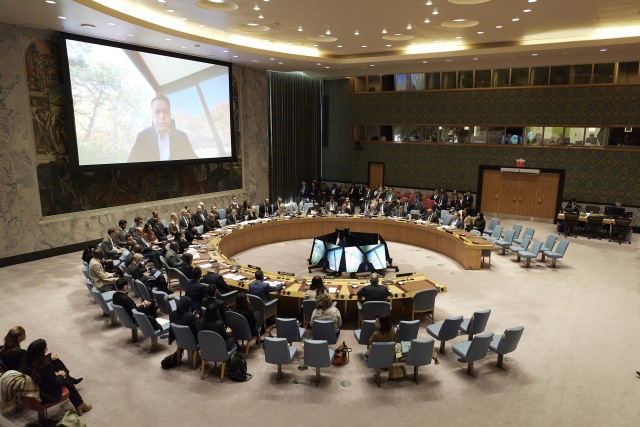
The United Nations Security Council has approved a one-year extension of the mandate of the United Nations Support Mission in Libya (UNSMIL), until 31 October 2027, with Greece and Russia abstaining from the vote.
The mission’s main tasks, as set out in Resolution 2542 of 2020, include facilitating an inclusive, Libyan-led political process, supporting the implementation of the ceasefire, promoting the rule of law and protecting human rights.
The vote followed difficult negotiations, with disagreements over both the political process in Libya and references to maritime security and international law. The United Kingdom, which was responsible for drafting the resolution, made four revisions, while the silence procedure was interrupted three times.
A particular concern for Greece was the wording concerning Libyan actors’ obligations under international law, including the law of the sea.
The issue came to the forefront of the Security Council following the ratification of the 2019 Turkey-Libya maritime delimitation memorandum, which Greece considers illegal, by the House of Representatives in eastern Libya on 20 October.
According to the Athens-Macedonian News Agency (AMNA), following a Greek request supported by the Council’s other European members, the preamble initially included a reference to respect for the principles of good neighbourly relations and regional cooperation. It also called on all actors in Libya to comply with their obligations under international law, including international law of the sea.
However, according to the record of the negotiations, the three African members — the Democratic Republic of the Congo, Liberia and Somalia — along with China expressed reservations. The African members argued that the wording went beyond UNSMIL’s mandate and the scope of a technical renewal. The reference was progressively weakened, prompting Greece to break the silence procedure during the fourth revision.
In a joint statement on 26 October, Bahrain, Cyprus, Egypt, Greece, the United Arab Emirates and the European Union had reiterated that the Turkey-Libya memorandum violated international law and infringed on the maritime rights of other coastal states, including those with islands. They had also stressed that the memorandum remained null and void and could not produce legal effects for third states.
On the political front, disagreements centred on the extent to which the resolution should support the 30 August agreement, reached under the “4+4” mechanism, on the electoral framework and the restructuring of the administration of the High National Elections Commission.
The final draft resolution welcomes the commitment to unifying Libya’s institutions, establishing a unified executive authority and holding presidential and parliamentary elections within 24 months.
China and Russia reportedly stressed during the negotiations that the agreement was not a constitutional document and had not secured the support of all Libyan parties, calling for an inclusive political process. Meanwhile, the African members expressed concern that establishing a unified executive authority could become a precondition for holding elections.
Ask me anything
Explore related questions




