





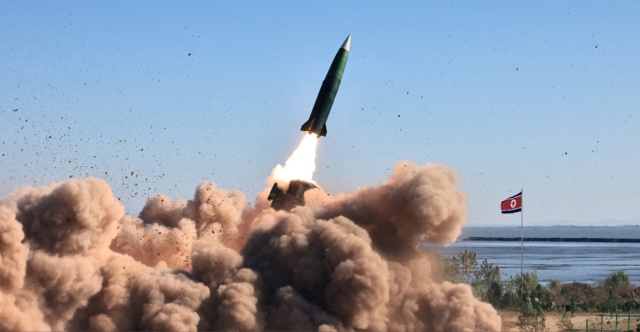
North Korea has conducted a new weapons test to assess the effectiveness of a warhead containing cluster munitions designed for tactical ballistic missiles. According to state news agency KCNA, the test took place on Saturday (31 October) and demonstrated, Pyongyang claims, that the weapon can destroy an area of 120 to 130 hectares. North Korea plans to bring four different types of such warheads into operational service by the end of the year.
KCNA reported on Sunday (1 November) that research institutes under North Korea’s Missile Administration carried out the test to assess the new warhead’s operational suitability and destructive power.
The weapon uses cluster munitions: a warhead releases large numbers of smaller explosive submunitions over a target area, allowing multiple locations across a wide area to be struck.
What Pyongyang claims about the new weapon’s destructive power
According to the North Korean news agency, the test showed that the “Type 2 standard” cluster-munition warhead can destroy an area of 12 to 13 hectares at its maximum strike density, equivalent to 120 to 130 stremmas (12–13 hectares).
The claim about the weapon’s destructive capability comes from North Korean authorities and has not been independently verified.
The test was overseen by General Kim Jong-sik, a member of the Central Military Commission of the ruling Workers’ Party of Korea and a first vice department director of the party’s Central Committee.
An official from North Korea’s Missile Administration said cluster-munition warheads are divided into four different categories according to their operational roles, but did not disclose further technical details.
He said that by the end of 2026, the country’s military units would be able to select and deploy all types of these warheads according to operational requirements and the characteristics of their targets.
Previous tests and a show of military strength
The latest test is part of Pyongyang’s efforts to develop and improve its missile systems, following a series of launches and displays of new military technologies in recent months.
Last April, North Korea announced that it had tested cluster munitions mounted on a Hwasong-11 Ra tactical ballistic missile. The test was attended by the country’s leader, Kim Jong Un, and his daughter, Kim Ju Ae.
That test aimed to assess both the power of a cluster-munition warhead and that of a warhead containing fragmentation mines.
In recent weeks, Pyongyang has also conducted a series of missile tests and held a military technology exhibition showcasing various types of unmanned aerial vehicles (drones).
Analysts believe these activities may be linked to North Korea’s broader efforts to modernise its armed forces.
The experience gained by North Korean military personnel through their participation in the war in Ukraine alongside Russia has also been highlighted in this context.
North Korea launches 10 missiles during Merz’s visit to South Korea
The announcement of the latest test comes days after North Korea launched around 10 ballistic missiles on Thursday (29 October).
The missiles were fired from areas in the eastern part of the country towards the sea, in another demonstration of Pyongyang’s military capabilities.
The launches took place on the same day German Chancellor Friedrich Merz was visiting South Korea for talks with the country’s political leadership.
The successive launches and development of new cluster-munition warheads add to North Korea’s military weapons programme, as Pyongyang seeks, according to its own announcements, to expand the operational capabilities of its missile forces.
Ask me anything
Explore related questions




