





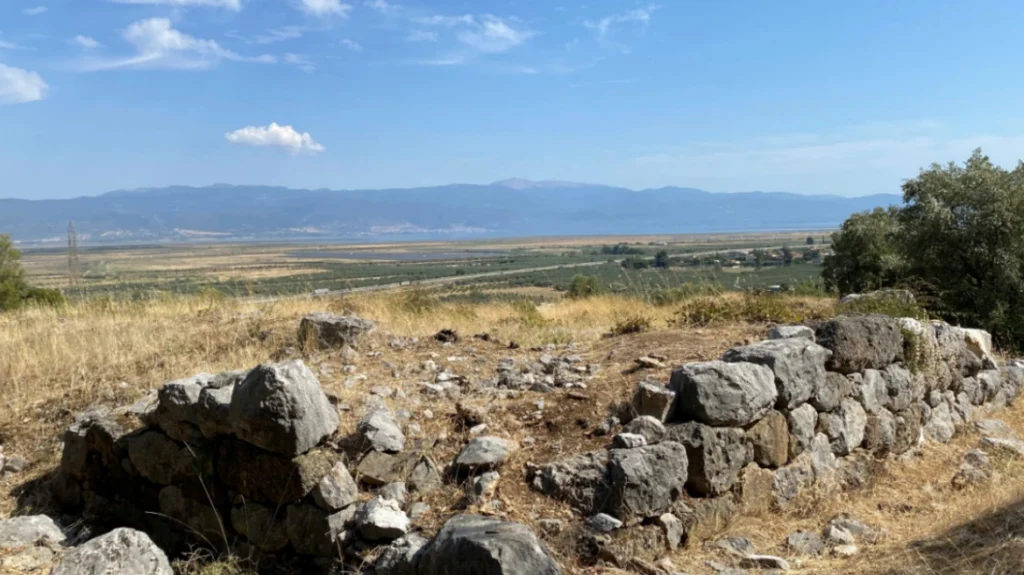
The Phocian Wall, where the final phase of the battle between the Greeks and the Persians at Thermopylae took place, is being restored and brought to prominence by the Ministry of Culture as part of its broader plan to unify all the monuments in the area.
The designated archaeological site of Thermopylae includes the three passes mentioned by Herodotus in his account of the battle between the Greeks and Persians in 480 BC (the Western, Middle and Eastern Passes). The Middle Pass, where the hot springs from which the area takes its name are located, is also home to the site’s most important fortification, the so-called Phocian Wall, which Herodotus refers to as the “Phocian Wall.”
The wall is located southwest of Kolonos Hill. It is a fortification built in the 6th century BC by the Phocians to repel incursions by the Thessalians during the Sacred Wars. When the Greek city-states decided to confront the Persian invasion in 480 BC, this old wall was hastily repaired and used by the Spartans and their allies as the main defensive stronghold at Thermopylae. The Spartan camp was set up behind it. The final phase of the battle unfolded in the area around Kolonos Hill in 480 BC.
The landscape of the area has changed radically from antiquity to the present day. In ancient times, the land passage at Thermopylae, which served as the main route connecting southern Greece with Thessaly, ran—as Herodotus recounts—through three successive narrow passes over a distance of 9 km, between the area’s steep mountain ridges, since the sea covered almost all the land that is now occupied by the plain.
Systematic archaeological research in the area was organised in 1939 by Spyridon Marinatos. The discovery on Kolonos Hill of numerous iron and bronze spearheads and arrowheads dating to the 5th century BC, many of which are of eastern types, played a decisive role in documenting the historical topography of the area and identifying it as the battlefield of Thermopylae.
“Thermopylae is a place of unique historical and symbolic significance, inextricably linked to one of the most important battles of antiquity. The Phocian Wall, near the elevation of Kolonos, where the final phase of the battle unfolded, is important evidence of the ancient fortifications at Thermopylae. Today, however, it remains difficult to identify and inaccessible to visitors.
“The restoration and consolidation of the wall, with respect for its authenticity and international principles of restoration, contributes not only to the preservation of the monument but also to making the area more legible and comprehensible to visitors. The archaeological research carried out before the interventions significantly enriched scientific knowledge about the wall’s layout, its phases of use and its function, while the planned works will ensure the protection and long-term preservation of its authentic features,” said Minister of Culture Lina Mendoni, adding:
“The restoration of the Phocian Wall is part of the broader plan to unify and highlight the monuments of Thermopylae and connect the various points of interest through a network of routes and walking trails, rest areas, viewpoints and information points. The battlefield, the elevation of Kolonos and the Phocian Wall will be connected with the modern Leonidas Monument and the Thermopylae Historical Information Centre, creating a unified, organised and accessible archaeological site worthy of the historical and global significance of Thermopylae.”
The Phocian Wall extends for approximately 100 metres, with a markedly zigzagging layout adapted to the contours of the hilltop. The surviving remains of the wall and tower are preserved mainly at a low level.
As part of the first phase of the project, archaeological excavations and extensive vegetation clearance were carried out, revealing the actual outline of the fortification and improving access to and visibility of the monument. Archaeological trenches along the wall and the western tower were used to investigate their foundations and construction, while extensive deposits of fallen stones were uncovered, separated and documented in preparation for the restoration work.
Internal masonry walls, large storage jars and layers of burnt material were identified in the western tower, indicating complex and successive uses. At the same time, a significant quantity of movable archaeological finds was collected, including a bronze coin from the Hellenistic period (323–319 BC), which will contribute to research into the dating and later use of the fortification.
According to the approved studies, the masonry walls are to be repositioned and restored using the available original building material, which will be put back in its original locations or in new positions supported by documented evidence. The re-erection of scattered stones and the restoration of the structure’s geometry are also planned. The proposed interventions aim to protect the authentic remains, ensure the stability of the monument and restore the legibility of its form and construction.
Ask me anything
Explore related questions




