





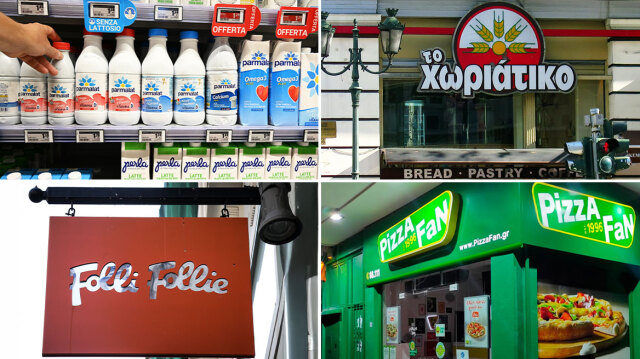
The latest controversies surrounding Greek pizza chain Pizza Fan and bakery business To Horiatiko have brought renewed attention to financial misconduct in the food industry, a sector in which some of the world’s best-known brands have been caught up in major fraud investigations.
The Greek cases have raised questions about alleged tax evasion, money laundering and the financial practices of businesses with extensive networks of outlets and employees. Although the full extent of the allegations remains to be established, the investigations have prompted comparisons with some of the most notorious corporate scandals internationally.
From Italy’s Parmalat and Britain’s Patisserie Valerie to China’s Luckin Coffee and the American Mafia’s involvement in pizza restaurants, the history of the global food industry contains striking examples of how sophisticated financial schemes can remain undetected for years.
Beyond the financial losses, such scandals can have devastating consequences for employees, investors and suppliers. They also raise a fundamental question: how can large-scale irregularities continue for so long without being identified by auditors, regulators or other authorities?
Parmalat: The €14bn scandal that became Europe’s Enron
One of the most spectacular corporate collapses in European history involved Parmalat, the Italian dairy giant whose accounting scandal erupted in December 2003.
Founded in 1961 by Calisto Tanzi, Parmalat had grown into one of Europe’s largest dairy producers, with operations extending far beyond Italy.
Behind its international success, however, investigators uncovered a sophisticated system of falsified accounts, fictitious transactions and offshore companies that had allegedly been used for more than 15 years.
The scale of the deception was extraordinary. The company’s financial problems eventually revealed a hole of approximately €14bn, earning Parmalat the nickname “Europe’s Enron”.
The crisis began when the company, despite claiming to hold substantial cash reserves, was unable to repay a €150m bond.
Executives initially maintained that the money was tied up in an investment fund in the Cayman Islands, one of the world’s best-known offshore financial centres.
The explanation immediately raised suspicions among financial institutions and regulators. Standard & Poor’s downgraded the company’s credit rating to junk status, while Italian authorities demanded further clarification.
In an attempt to reassure markets, Parmalat produced what appeared to be a Bank of America document confirming that its subsidiary Bonlat held €3.95bn in an account in the Cayman Islands.
There was one major problem: the document was forged.
Bank of America denied the existence of the purported account, triggering a chain of events that led to the company’s collapse.
Following his arrest, Tanzi admitted that Parmalat had falsified its accounts for more than 15 years and diverted corporate funds into family-controlled businesses.
Investigators also discovered fictitious milk sales, fabricated invoices used to obtain bank loans and a complex network of offshore companies.
Tanzi and several executives subsequently received prison sentences, while the scandal also implicated figures associated with the company’s auditing arrangements.
Parmalat eventually survived through a major restructuring. In 2011, it was acquired by French dairy group Lactalis.
The Pizza Connection: How the Mafia turned restaurants into a billion-dollar drug operation
Perhaps the most extraordinary example of organised crime infiltrating the food industry emerged in the United States during the 1980s.
The investigation became known as “The Pizza Connection”, exposing an international heroin trafficking and money-laundering network involving the Sicilian Mafia and its American associates.
At the centre of the operation was an extensive network of apparently independent pizzerias operating in New York and numerous smaller American cities.
These restaurants served ordinary customers, but investigators found that parts of the network were also being used to facilitate criminal activity.
Working with associates of the Sicilian Cosa Nostra, the organisation imported heroin into the United States through sophisticated international supply routes.
Drugs originating in Southeast Asia travelled through Italy before reaching America, sometimes concealed in food shipments, including tomato sauce containers and pizza ingredients.
The legitimate importation of food products helped provide cover for the trafficking operation.
Authorities estimated that the network was responsible for heroin transactions worth approximately $1.6bn.
At a time when cash payments dominated restaurant transactions, the pizzerias also offered opportunities to disguise criminal proceeds as legitimate business revenue.
Money generated through drug trafficking could be mixed with restaurant takings, concealed in secret locations or transferred into overseas bank accounts, including accounts in Switzerland.
After a lengthy investigation involving the FBI and American prosecutors, the organisation’s activities were exposed.
The broader Mafia investigations of the period included the undercover work of FBI agent Joseph Pistone, better known as Donnie Brasco, whose experiences later inspired the Hollywood film of the same name.
The Pizza Connection prosecution was led by the office of Rudolph Giuliani, then the US Attorney for the Southern District of New York and later mayor of New York City.
The landmark trial began in 1985 and concluded in 1987 after approximately 17 months.
Several leading members of the criminal network received lengthy prison sentences, making the case one of the most significant prosecutions of international organised crime in the United States.
Patisserie Valerie: The £94m accounting scandal that destroyed a British institution
The collapse of Patisserie Valerie demonstrated how even a beloved British high-street brand could be brought to the brink of extinction by accounting irregularities.
The company traced its origins to 1926, when a Belgian entrepreneur known as Madame Valerie opened its first shop in London’s Soho.
Over the following decades, the business became famous for its colourful cakes, pastries and café culture, expanding into prominent locations including Oxford Street and Edgware Road.
By the time its financial troubles emerged, Patisserie Valerie operated more than 170 outlets, employed approximately 2,700 people and generated annual sales of around £100m.
The company had floated on the stock market in 2014 and initially appeared to be a successful example of British retail expansion.
But in 2018, serious accounting irregularities emerged.
Investigations uncovered a discrepancy of approximately £94m in the company’s financial position, involving allegedly falsified accounting entries, questionable cheques and other financial practices.
Earlier that year, when shares were trading near record highs, senior company figures had sold substantial holdings.
In February 2018, the chief executive, finance director and a board member sold shares worth nearly £6m. Further disposals by board members, worth approximately £7.2m, followed in June.
Months later, the company acknowledged the discovery of accounting irregularities, suspended its finance director and requested a halt to trading in its shares.
It also emerged that the business owed approximately £1.4m to the UK tax authorities.
The consequences were swift.
A company once valued at roughly £450m on the stock market suffered a dramatic collapse and entered administration.
Around 70 branches closed, leaving approximately 900 employees without jobs.
The investigations also uncovered allegations of financial misappropriation involving sums exceeding £10m.
The scandal subsequently triggered criminal proceedings involving former executives and scrutiny of the company’s external auditors.
A major accounting and advisory firm was fined approximately £2.3m in connection with shortcomings in its auditing work between 2015 and 2017.
Although the original business collapsed, the Patisserie Valerie brand survived following restructuring and acquisition, eventually coming under the ownership of Causeway Capital.
Luckin Coffee: The Chinese chain that survived a $310m sales fraud
The story of Luckin Coffee provides a very different ending to a major corporate scandal.
Founded in China, the coffee chain expanded at extraordinary speed, positioning itself as a direct competitor to Starbucks.
Its rapid growth attracted international investors, and the company became one of the most closely watched Chinese businesses listed on the American stock market.
But in 2020, the impressive financial performance presented to investors unravelled.
Investigations revealed that the company had fabricated approximately $310m in sales during 2019.
The scheme involved fictitious transactions and entities used to create the appearance of stronger revenues and faster expansion than the business had actually achieved.
The revelation devastated investor confidence.
Luckin Coffee’s shares plunged by approximately 80%, and the company was subsequently delisted from the Nasdaq.
It also agreed to pay a $180m penalty to resolve proceedings brought by US securities regulators.
Unlike many companies caught in major accounting scandals, however, Luckin Coffee did not disappear.
Instead, it underwent restructuring and continued expanding aggressively in its domestic market.
The company eventually overtook Starbucks in China in terms of store numbers and reported revenues, demonstrating that commercial demand for a brand can survive even a devastating financial scandal.
In 2025, approximately five years after the fraud was exposed, Luckin Coffee also entered the American market, opening its first outlets in New York.
U.S. Foodservice: Hundreds of millions in inflated profits
Another major accounting scandal emerged in 2003 at U.S. Foodservice, a large American food distribution company acquired three years earlier by Dutch retail group Royal Ahold.
Investigations found that U.S. Foodservice had overstated its earnings by approximately $700m to $800m.
The revelations triggered a severe crisis for both the American subsidiary and its Dutch parent company.
Royal Ahold faced investor lawsuits, regulatory scrutiny and extensive financial restructuring.
In 2005, the Dutch group reached a settlement worth approximately $1.1bn in shareholder litigation.
Another settlement, amounting to around $297m, followed in 2014.
Several executives associated with the accounting scandal were also prosecuted and received prison sentences.
The case became a prominent example of how weaknesses in corporate governance and financial oversight could affect multinational food businesses operating across different jurisdictions.
Subway and McDonald’s: Fraud hidden inside everyday business operations
Not every scandal in the food industry has involved the manipulation of corporate accounts.
In some cases, criminal schemes have exploited weaknesses in internal systems or promotional campaigns.
In 2021, an American financial analyst working for Subway exploited security weaknesses to create fraudulent digital gift cards.
The cards were subsequently sold or converted into money through online channels, generating losses estimated at more than $11m.
A similarly unusual case involved McDonald’s and its hugely popular Monopoly promotional game.
The competition offered customers opportunities to win prizes worth up to $1m by collecting promotional game pieces.
But an individual responsible for security at an external company involved in producing the promotional materials systematically stole high-value winning pieces.
These were then distributed through a criminal network connected to organised crime figures.
The operation compromised the competition for years and involved prizes worth approximately $25m.
The scandal became one of the most notorious examples of promotional fraud in American corporate history.
Folli Follie: The Greek scandal that went unnoticed for years
Greece has its own internationally significant example of accounting fraud.
For decades, Folli Follie, the fashion and accessories company controlled by the Koutsolioutsos family, was regarded as one of the country’s most successful international businesses.
With a strong presence in overseas markets, the company appeared to represent the global ambitions of Greek entrepreneurship.
That image collapsed in May 2018, when the investment firm Quintessential Capital Management, led by Gabriel Grego, published a report challenging the company’s reported financial performance.
The revelations triggered investigations that exposed extensive irregularities in its accounting statements and the presentation of its international business activities.
The Folli Follie affair became one of Greece’s most prominent corporate fraud scandals, raising serious concerns about the effectiveness of auditing practices and regulatory oversight.
Its importance extended beyond the company itself, damaging confidence in corporate governance and financial reporting.
The question behind every corporate scandal
Despite their different circumstances, these cases share several characteristics.
Many involved businesses that had achieved enormous commercial success, built strong consumer recognition and gained the confidence of investors, employees and financial institutions.
In some instances, sophisticated accounting manipulation enabled executives to conceal financial weaknesses for years. In others, criminal organisations exploited legitimate food businesses to disguise illegal proceeds or facilitate illicit activities.
The consequences frequently extended far beyond the individuals directly involved.
Workers lost their jobs, investors suffered severe financial losses, creditors were left facing unpaid debts and public confidence was undermined.
The controversies surrounding Greek food businesses have once again brought these issues into focus, although allegations under investigation must be distinguished from the established findings of historical criminal and accounting cases.
The enduring lesson from the Parmalat collapse, the Pizza Connection prosecution and the downfall of Patisserie Valerie is not simply that large-scale fraud can occur in familiar consumer businesses.
It is that even highly visible, successful companies can conceal serious irregularities for prolonged periods when internal controls, independent auditing and regulatory supervision fail to detect the warning signs.
Ask me anything
Explore related questions




