





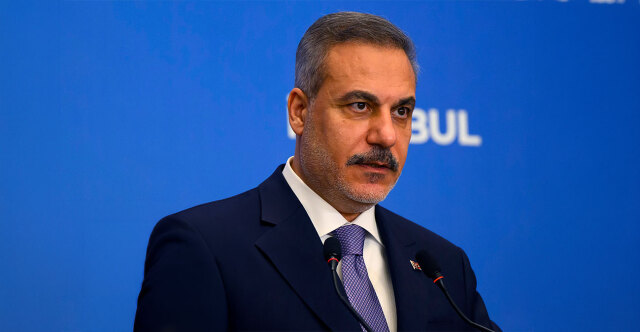
Greek and Israeli lobbying groups in the United States are responsible for the difficulties Ankara is facing in its efforts to secure the lifting of US sanctions imposed over its purchase of Russian S-400 air defence systems, according to Turkish Foreign Minister Hakan Fidan.
In an interview with Turkish television network TGRT Haber, Fidan claimed that the administration of US President Donald Trump had the political will to resolve the issue, but was facing both constraints imposed by American legislation and pressure from interest groups which, he said, were seeking to prevent a rapprochement between Turkey and Washington on defence cooperation.
The head of Turkish diplomacy also made revelations about his discussions with his US counterpart, Secretary of State Marco Rubio, claiming that Rubio had acknowledged that the legislation governing the sanctions significantly restricted the US administration’s room for manoeuvre.
Fidan argued that the continued sanctions could not be explained solely by Turkey’s decision to purchase the Russian S-400 systems. He pointed out that other countries had also bought Russian defence systems without facing similar measures from the United States.
Turkish Foreign Minister Hakan Fidan: There are a ton of countries that have purchased Russian defense systems. Which of them has the U.S. sanctioned under CAATSA? But Türkiye’s natural stance, determination, principles, and values it defends in the region are, of course, not something that the major powers in the region, particularly Israel at this point, are happy about. Israel is lobbying heavily in Washington. This has turned into something of a lobbying war. Here, too, we will see a struggle between those who say America First and those who say Israel First. The Israeli lobby and the Greek lobby come into play, carry out various activities, and influence domestic politics.
— Clash Report (@clashreport) November 21, 2026
“There are so many countries that have bought Russian defence systems. How many of them have had CAATSA sanctions imposed on them by the US?” he asked.
According to the Turkish foreign minister, Ankara’s position on regional developments is unacceptable to certain powers, particularly Israel. He claimed that Israel and other actors were seeking to limit Turkey’s defence cooperation with the United States.
In this context, he explicitly referred to Greek and Israeli lobbying groups – without presenting any evidence – claiming that they intervene in the American political arena and influence decisions taken in Washington.
According to Fidan, the issue has become a confrontation between different pressure groups over the direction of US foreign policy.
“Here, we will see a clash between those who say ‘America first’ and those who say ‘Israel first’,” he said. Nevertheless, he expressed the view that the current US administration wanted to overcome the problem, adding that Turkey would continue to work systematically towards that goal.
According to Fidan, Donald Trump has instructed Rubio to seek a solution to the issue of the sanctions that remain in force against Turkey. Fidan claimed that, during their discussions, the US secretary of state had highlighted how restrictive the relevant legislation was.
The Turkish foreign minister said Rubio, who previously served as a senator, had explained to him that certain legislative provisions had been drafted in such a way as to leave the executive branch with very little room for manoeuvre.
Indeed, according to Fidan’s account, Rubio had jokingly remarked that, had he known he would one day hold government office, he would have used different wording when drafting such restrictions into law.
The Turkish minister noted that the Trump administration had already resolved certain outstanding issues in defence cooperation, particularly those concerning licences for the supply of ammunition.
However, he clarified that the US administration had far less scope to intervene in matters governed by legislation, such as the CAATSA sanctions.
Addressing the broader balance of relations between Greece and Turkey, and between the US and Turkey, in the defence sector, Hakan Fidan linked the CAATSA sanctions to the unresolved issue of Turkey’s participation in the F-35 fighter jet programme. He argued that these matters should be definitively settled through talks between Turkish President Recep Tayyip Erdoğan and Donald Trump.
“When Mr Trump and Mr Erdoğan meet, this issue must be finished, closed and taken off our agenda,” he said, arguing that the continuation of the restrictions served neither the interests of the United States.
“Nobody can make sense of this situation. In reality, this is not a policy that serves America either,” he said.
He also emphasised the importance of the personal relationship between Erdoğan and Trump, arguing that cooperation between the two leaders had helped address problems affecting relations between the two countries.
The dispute over the S-400s remains one of the most significant unresolved issues in Ankara’s relations with Washington. Turkey went ahead with the purchase of the Russian air defence system despite objections from the United States and other NATO allies.
Washington argued that the operation of the S-400s by a country belonging to the North Atlantic Treaty Organization (NATO) posed risks to the security of sensitive military technologies, particularly those associated with the US-made fifth-generation F-35 fighter jets.
In 2019, Turkey was removed from the F-35 programme, while in December 2020 the US imposed sanctions under the Countering America’s Adversaries Through Sanctions Act (CAATSA), which provides for measures against countries and entities conducting significant transactions with Russia’s defence sector.
Since then, the Turkish government has been seeking the lifting of the restrictions and a reassessment of its participation in the American fighter jet programme.
Ask me anything
Explore related questions




