





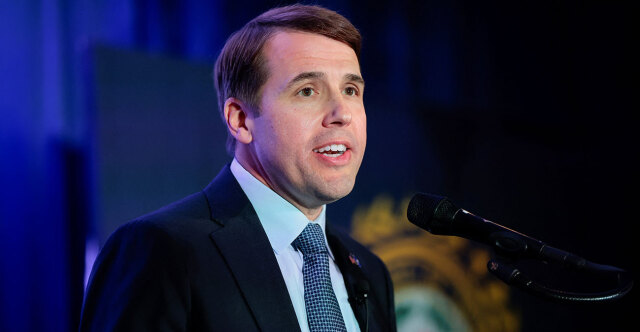
Greek-American Democrat Chris Pappas has secured a historic victory in New Hampshire’s US Senate election, defeating Republican former senator John Sununu in a contest closely watched by both parties and the Greek-American community.
The 46-year-old congressman’s triumph marks the return of Greek-American representation to the Senate after nearly 14 years, while also making him the first openly gay man elected to the upper chamber of US Congress. His victory comes amid sweeping Democratic gains in the 2026 midterm elections, which have handed the party control of both the House of Representatives and the Senate.
For Greece and Cyprus, the outcome is particularly significant. Pappas, whose family traces its roots to the village of Livadi near Elassona in central Greece, has consistently championed Greek interests in Congress, particularly on issues involving Turkey, defence cooperation and security in the Eastern Mediterranean.
His election also represents a personal defeat for US President Donald Trump, who had endorsed Sununu and identified New Hampshire as a potential opportunity for Republicans to gain a Senate seat.
Chris Pappas makes history as first openly gay male senator after defeating John Sununu in New Hampshire https://t.co/rCNYwq9bCu https://t.co/sn5mTfU1AW
— New York Post (@nypost) November 4, 2026
A historic victory for Greek-American representation
Pappas’s election brings an end to a lengthy absence of Greek-American lawmakers from the Senate, where the community previously enjoyed substantial political influence through prominent figures from both major parties.
The last Greek-American to serve in the chamber was Republican Olympia Snowe, who represented Maine for three six-year terms between 1995 and 2013, following 16 years in the House of Representatives.
Between 1995 and 2007, Snowe served alongside another influential Greek-American senator, Democrat Paul Sarbanes of Maryland, whose Senate career spanned three decades, from 1977 until 2007.
Together, they provided a powerful bipartisan voice on issues important to Greece and Cyprus, including the 1996 Imia crisis and Cyprus’s path towards membership of the European Union.
Pappas now enters the Senate at a time when Greek-American relations are exceptionally strong, but tensions involving Turkey continue to create challenges for regional security.
Athens remains concerned about Ankara’s Blue Homeland doctrine, Turkish claims in the Aegean, the Turkey-Libya maritime agreement and developments concerning Cyprus.
Pappas has previously demonstrated a willingness to engage directly with these issues, making his arrival in the Senate particularly important for Greek diplomacy and the wider diaspora.
Thank you, New Hampshire. https://t.co/AIIfpYj2IS
— Chris Pappas (@ChrisPappasNH) November 4, 2026
His record on Greece, Cyprus and Turkey
Throughout his career in the House of Representatives, Pappas has maintained close ties with the Greek-American community and the Greek Orthodox Church in the United States.
He has repeatedly expressed pride in his Greek heritage and emphasised the historical and cultural connections between Greece and the United States.
As co-chair of the Congressional Hellenic Caucus, alongside Republican congressman Gus Bilirakis, Pappas has helped promote bipartisan initiatives designed to strengthen relations between Washington and Athens.
Working with Bilirakis and fellow representatives Dina Titus of Nevada and Nicole Malliotakis of New York, he supported legislation aimed at expanding US-Greek defence cooperation.
The initiative included a proposed five-year extension of assistance to Greece under the International Military Education and Training programme, known as IMET, intended to improve military cooperation and interoperability between the two countries.
In September 2025, Pappas also participated in a bipartisan appeal to Secretary of State Marco Rubio and Defence Secretary Pete Hegseth opposing potential American sales of F-16 and F-35 fighter aircraft to Turkey.
In March 2026, he condemned what he described as the illegal deployment of Turkish F-16 aircraft to occupied northern Cyprus, warning that such developments threatened the island’s sovereignty and risked further destabilising the Eastern Mediterranean.
His established record suggests that Greek and Cypriot concerns will continue to have an experienced advocate in the US Senate, although his influence will ultimately depend on congressional priorities and the political balance in Washington.
Chris Pappas (D) defeated John E. Sununu (R) in New Hampshire’s Senate race, keeping the seat in Democratic hands. Pappas, the first openly gay man elected to the U.S. Senate, called the results a “wake-up call for billionaires.” https://t.co/tJxaHBrGDT https://t.co/OSHIPfyME6
— The Washington Post (@washingtonpost) November 4, 2026
Why Pappas entered the Senate race
Pappas announced his decision to seek election to the Senate in April 2025, after Democrat Jeanne Shaheen, who had represented New Hampshire in the chamber for three terms, revealed that she would not seek re-election.
Shaheen’s retirement created an open-seat contest and offered Pappas the opportunity to move from the House of Representatives to the Senate after four consecutive electoral victories.
Explaining his decision, Pappas placed economic security, democratic institutions and the future of his home state at the centre of his campaign.
He promised to defend New Hampshire residents against policies he argued disproportionately benefited wealthy individuals and powerful corporate interests.
His campaign also emphasised that the state needed a senator with a deep understanding of its communities, economic challenges and political traditions.
Pappas had previously worked as a political aide to Shaheen, strengthening his connections with the state’s Democratic establishment.
From the beginning of the campaign, he was regarded as a strong contender, benefiting from his name recognition, experience in public office and history of winning competitive elections.
I’m in. Today I’m announcing my campaign for U.S. Senate because New Hampshire needs a fighter who gets things done. Let’s do this. https://t.co/bAyE5u4LSk
— Chris Pappas (@ChrisPappasNH) April 3, 2025
Four victories in the House and a long political career
Pappas’s political career began at an unusually young age.
Born on 4 June 1980 in Manchester, New Hampshire, he entered elected politics at 22, winning a seat in the New Hampshire House of Representatives.
He subsequently held several state and local positions before making the transition to federal politics.
In 2018, he was elected to represent New Hampshire’s 1st Congressional District, defeating Republican Eddie Edwards with 53.6% of the vote against 45%.
Two years later, he retained his seat against Republican Matt Mowers, winning 51.3% to 46.2%.
In 2022, he defeated Karoline Leavitt, who would later become Trump’s White House press secretary, securing approximately 54% of the vote.
He repeated that success in 2024 against Republican Russell Prescott, collecting 218,577 votes compared with his opponent’s 185,936.
These victories established Pappas as one of New Hampshire’s most electorally successful Democratic politicians and strengthened his reputation as a moderate capable of appealing beyond the party’s traditional base.
A bitter Democratic primary over Israel and campaign funding
Before confronting Sununu, Pappas faced a politically charged Democratic primary that exposed ideological divisions within his party.
His principal opponent was Karishma Manzur, a physician and humanitarian organisation leader who positioned herself to the left of the congressman.
In the 8 September primary, Pappas secured a decisive victory with 64.6% of the vote, or 60,119 ballots, against Manzur’s 33.2%, representing 30,942 votes. Three additional candidates each received less than 1%.
The contest was nevertheless marked by sharp disagreements over foreign policy, particularly US support for Israel and the influence of pro-Israel political organisations.
Pappas faced criticism from progressive Democrats over financial contributions associated with the American Israel Public Affairs Committee, commonly known as AIPAC.
According to figures cited by the New Hampshire Journal from Federal Election Commission records, he had received approximately $689,000 in direct and targeted contributions from AIPAC and affiliated organisations over the course of his federal political career.
The controversy reflected wider divisions within the Democratic Party over Israel, campaign finance and the political influence of major donors.
Pappas defended his campaign’s financing, pointing to support from approximately 200,000 individual contributors and emphasising that he had not accepted donations from corporate political action committees.
His overwhelming primary victory demonstrated that those criticisms had not significantly weakened his support among Democratic voters.
It also reinforced his position as a relatively moderate candidate heading into the general election, where appealing to independents and disaffected Republicans was essential.
I’m fighting to overturn Citizens United and get dark money out of our politics. My opponent wants to maintain the status quo because his campaign is propped up by millions of dark money dollars. https://t.co/is7VTQ3DAM
— Chris Pappas (@ChrisPappasNH) October 29, 2026
Facing the Sununu political dynasty and Donald Trump
The general election presented a different challenge.
Pappas’s Republican opponent, John E. Sununu, was not only a former senator but also a member of one of New Hampshire’s most prominent political families.
Sununu, 62, represented the state in the US Senate between 2003 and 2009, having previously served in the House of Representatives.
His father, John H. Sununu, was governor of New Hampshire and later White House chief of staff under President George H. W. Bush.
His brother, Chris Sununu, also served as the state’s governor, extending the family’s influence over New Hampshire politics.
The race therefore pitted two experienced political figures against each other, both with established local connections and substantial electoral experience.
Trump threw his support behind Sununu, viewing the open Senate seat as an opportunity to strengthen Republican representation in New England.
Although Sununu had previously disagreed with Trump on several issues, the president’s endorsement became a prominent feature of the campaign.
Pappas repeatedly sought to associate his opponent with the Trump administration’s economic and foreign policies, arguing that electing Sununu would give the president another reliable vote in Washington.
The Republican candidate, meanwhile, questioned Pappas’s legislative record and argued that his eight years in Congress had failed to deliver sufficient improvements for New Hampshire residents.
Both campaigns focused heavily on the economy and the rising cost of living, recognising that household financial pressures were among voters’ leading concerns.
The final debate: Iran, tariffs and pensions
The differences between the candidates became particularly apparent during their final televised debate on 28 October, organised by WMUR.
Pappas criticised Trump’s tariffs, the war with Iran and rising consumer prices, presenting Sununu as a politician who would support the administration’s policies rather than challenge them.
Sununu countered by attacking Pappas’s record in Congress and questioning whether the Democrat could deliver meaningful changes for voters.
One of the sharpest exchanges concerned Social Security, the American retirement benefits system.
Pappas accused Sununu of having previously supported proposals that would have partially privatised the programme, potentially undermining its financing.
He argued that a proposal advanced in 2005 would have reduced the number of workers contributing to the existing system, creating additional pressures on benefits for current pensioners.
Sununu rejected that interpretation, maintaining that his proposals would have preserved a guaranteed minimum benefit.
The candidates also clashed over healthcare, taxation, foreign policy and government accountability.
Pappas framed the election as an opportunity for a new generation of leadership, claiming that Sununu would contribute to higher costs, reduced healthcare protection and continued military involvement overseas.
Pre-election polling had consistently favoured Pappas, with one University of Massachusetts and YouGov survey giving him a seven-point lead and a Rasmussen Reports poll placing him six points ahead.
The election ultimately confirmed that advantage, as Pappas emerged victorious and kept the seat under Democratic control.
Ask me anything
Explore related questions




