





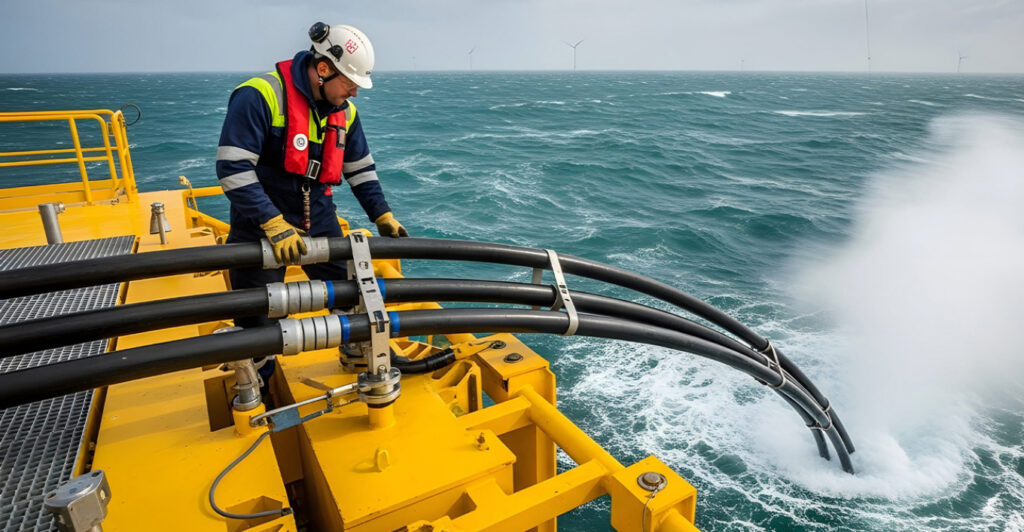
A NAVTEX authorising the resumption of surveys for the installation of the Cyprus–Crete electricity interconnector (GSI) is expected to be issued, most likely over the weekend, bringing an end to a major outstanding issue not only for this important project itself, but also for Greece’s exercise of its sovereign rights.
According to reports, on 2 November members of the special interministerial committee (EXAETH), which operates under the auspices of the Ministry of Foreign Affairs, were briefed and asked to submit their recommendations on the project’s licensing by tomorrow, Friday. If the expected positive decision is given, the Hellenic Coast Guard will issue an ‘exemption permit’ for the French-flagged vessel Abeille Marengo. The project management company will then submit an official request for the issuance of a NAVTEX, which will be forwarded to the Ministry of National Defence, allowing the Hellenic Navy Hydrographic Service to issue the notice without delay.
According to the same sources, the NAVTEX will take effect immediately. This means that the French research vessel, which remains in the port of Heraklion, will set sail for the survey area as soon as it is issued.
Well-informed sources believe that the prevailing circumstances, particularly following the US midterm elections, have created a favourable window for the resumption of the surveys and reduced the likelihood of a repeat of the 2024 incident, when the work was halted following the intervention of Turkish warships. It is estimated that, following the understanding reached between the French and Turkish sides, Ankara will either refrain from responding or limit its reaction to the customary practice of hailing – harassment via radio communications – which is increasingly becoming the norm.
With a new Congress in which the Democratic Party holds control, thereby limiting President Trump’s room for manoeuvre in meeting Ankara’s demands – foremost among them Turkey’s return to the F-35 programme – it is believed that the Turkish side will avoid any serious escalation that could bring it under the scrutiny of Congress.
Furthermore, at a time when Ankara is watching with satisfaction as Israel’s influence in the United States wanes, and particularly as Israel comes under fire over the war in Iran – which is widely blamed for the economic crisis that helped determine the US election result – provoking tensions in the region would be a high-risk move for Turkey. Such a development would also undermine Ankara’s own argument that Netanyahu and Israel are the region’s ‘troublemakers’, potentially putting Turkey itself in the firing line.
Of course, this does not mean that Ankara is willing to accept moves it considers contrary to its own objectives and claims. Turkey has warned that it will ‘protect its rights’ and will not allow ‘unauthorised surveys in the area of the Turkish continental shelf’.
Nevertheless, according to reports, the French proposal to ‘inform’ the Turkish side about the surveys appears to have been accepted by Ankara, as it provides a diplomatic way out. However, some observers have pointed out that this arrangement has ‘grey areas’, since there is no obligation to notify any state other than the coastal state whose continental shelf is concerned, and which receives the licensing application and issues the relevant NAVTEX.
The Turkish side will most likely present this ‘notification’ as a request for permission, and is therefore expected to issue its own NAVTEX for the surveys. In response, in line with established practice, the Heraklion station will issue a counter-NAVTEX, stating that the surveys are being conducted within the Greek continental shelf and that the Greek NAVTEX is the one issued by the station with the relevant jurisdiction.
Ask me anything
Explore related questions




