





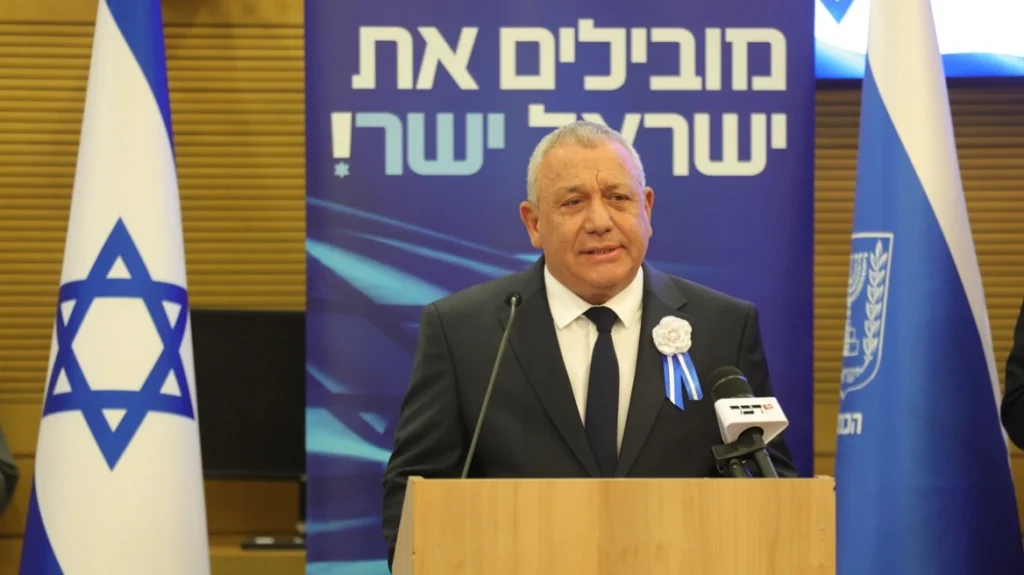
Gadi Eisenkot has reiterated his red lines for the formation of Israel‘s next government, making clear that he will not abandon the principle of military, national or civilian service for all citizens. At the same time, Avigdor Lieberman has expressed confidence that a 61-seat majority can be secured with the participation of the two ultra-Orthodox parties, firmly ruling out a minority government dependent on the Arab parties.
Speaking at a meeting of the Yashar parliamentary group ahead of the swearing-in of the 26th Knesset, Eisenkot described Israel as a country at a critical crossroads in terms of “security, strategy, the economy and international relations”, saying it was facing one of the most difficult periods since the state’s establishment.
The political leader, who has received a mandate to form a government from President Isaac Herzog, pledged to establish a “national emergency government as soon as possible”, without, as he put it, abandoning his party’s core principles.
Yashar, he noted, remains committed to the vision of a Jewish, democratic, liberal and equal Israel, and will work with its partners in B’Yachad, the Democrats and Yisrael Beiteinu.
‘We will not lower the flag of service for all’
Eisenkot left the door open to any party willing to accept the coalition’s core principles, but made clear that universal compulsory service remains non-negotiable.
“Service for all, for all citizens of Israel. Military service, national service, civilian service. We will not lower this flag,” he stressed.
Although he did not specifically name the ultra-Orthodox or Arab parties, he said he would explore every possible avenue to broaden his government, with the aim of securing the widest possible national consensus.
Eisenkot has set out four key conditions for joining his government: recognition of Israel as a Jewish and democratic state; acceptance of the values enshrined in the Declaration of Independence; compulsory service for all; and recognition of Hamas as a terrorist organisation, together with a commitment to dismantling its military and administrative capabilities.
He also said his party remained committed to achieving the objectives of the war in Gaza, which, in his assessment, had yet to be accomplished. These include the destruction of Hamas’s military and political capabilities.
During his speech, he briefly stumbled while listing the state’s three branches of government, smiling until he remembered the judiciary. “We must not forget the judicial branch,” he remarked, referring to the need for a balance between the institutions.
Lieberman: 48 plus 13 seats can deliver a government
Avigdor Lieberman, for his part, expressed confidence that a government with a clear majority of 61 MPs could be formed.
His plan is based on the 48 seats held by the Eisenkot bloc and the 13 seats held by the two ultra-Orthodox parties: seven for United Torah Judaism (UTJ) and six for Shas.
UTJ did not nominate a candidate for prime minister during its consultations with President Isaac Herzog, while Shas backed Benjamin Netanyahu.
Lieberman reiterated that he would not support a government dependent on the two Arab parties, not even on a temporary basis if only UTJ were included in the governing coalition.
“I am working to end Netanyahu’s rule once and for all. Not temporarily,” he said, adding that any minority government would quickly collapse and pave the way for another Netanyahu election victory.
Lieberman has warned that such an outcome could return Netanyahu to power with an even larger majority. This is why he favours an agreement with the ultra-Orthodox parties, despite the deep differences he has had with them over the years.
Compromise on the military conscription bill
The leader of Yisrael Beiteinu acknowledged that his original aim had been to form a government without the ultra-Orthodox parties. However, the election result, which gave the bloc 48 seats, forced it, he said, to reconsider its strategy. “We must find compromises and show flexibility,” he noted.
Lieberman admitted that a different approach would also be needed on the particularly sensitive issue of Haredi conscription, departing from the position he had advocated during the election campaign.
According to him, the aim is to introduce legislation that can withstand scrutiny by the Supreme Court without triggering another political crisis and fresh elections.
The challenge will be to find a formula acceptable both to the judiciary and to Rabbi Dov Landau, the spiritual leader of UTJ.
‘Eisenkot is leading; I am standing alongside him’
Lieberman also dismissed what he described as “lies and fabrications” concerning his personal ambitions.
He stressed that his party had immediately and unconditionally backed Eisenkot for prime minister, making clear that Eisenkot was the person responsible for forming the government.
“He is leading, he is responsible, and I am standing alongside him,” he said.
He identified the replacement of the Knesset Speaker, the appointment of a State Comptroller and the introduction of a two-term limit for the prime minister as the priorities for the new Knesset. Addressing the controversial judicial reform would follow.
He also stressed that the first decision of a new government should be to establish a state commission of inquiry into the 7 October 2023 massacre.
Lieberman: I will summon the heads of the security services
As the incoming chairman of the powerful Foreign Affairs and Defence Committee, Lieberman said he intended to summon Shin Bet chief David Zini, IDF Chief of Staff Eyal Zamir and Mossad chief Roman Gofman to provide explanations.
He wants answers from Zini regarding investigations into allegations of electoral fraud and foreign interference, pointing out that there are significant discrepancies between the positions put forward by the Shin Bet and law enforcement authorities.
From the other two security chiefs, he intends to seek clarification over reports concerning Iranian chemical weapons and operational plans against Iran, referring to media reports according to which Netanyahu had attempted to approve an operation on the eve of the elections.
“There is no effective parliamentary oversight of the security establishment,” he argued.
Bennett: ‘We are quietly working towards a Zionist government’
Former prime minister and B’Yachad leader Naftali Bennett said in a message to his supporters, which was leaked to the press, that his party was working “quietly” to help Eisenkot form a “Zionist government of recovery”.
“We are doing everything, absolutely everything, to help Eisenkot establish a Zionist government of recovery, so that there can be a change of leadership as soon as possible,” he said, according to a recording published by a Kan journalist.
Bennett reiterated the message as he arrived at the Knesset, linking a change of government to the need to reduce the burden on reservists.
His remarks suggest that he remains opposed to the continuation of the blanket exemption from military service granted to the ultra-Orthodox, although he did not explain how a government could be formed without the support of Haredi or Arab parties.
Abbas: Recognition of Hamas as a terrorist organisation on the table
Meanwhile, fresh movement is also being reported on the part of the Arab Ra’am party.
According to Israeli media reports, party leader Mansour Abbas has conveyed to members of the anti-Netanyahu bloc that he is prepared to explicitly recognise Hamas as a terrorist organisation, provided he is offered a “genuine partnership” in the new political coalition.
Such a move could remove one of the main obstacles to potential cooperation between the Arab party and Eisenkot, since recognition of Hamas as a terrorist organisation is one of the four conditions set by the Yashar leader.
Democrats leader Yair Golan appeared to confirm that the issue was under discussion, saying he did not believe recognition would pose an obstacle for Abbas and that negotiations would take place.
Abbas himself avoided commenting on specific discussions, but reiterated that Ra’am had repeatedly accepted the disarmament of Hamas as part of Donald Trump’s peace plan and that it “rejects and condemns all forms of terrorism”.
Just a few days earlier, during consultations with President Herzog, Abbas had avoided explicitly describing Hamas as a terrorist organisation, citing his role as a “bridge” as well as concerns for his own safety and that of his family.
Ask me anything
Explore related questions




