





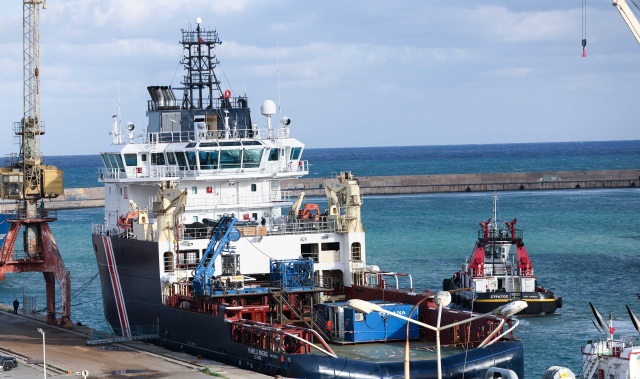
The French research vessel Abeille Marengo initially headed northwest of the port of Heraklion, Crete, during the night, following its departure on Tuesday afternoon, marking the start of work on the Greece-Cyprus electricity interconnector project.
As the company responsible announced upon its departure, the vessel will first calibrate its equipment before proceeding with the surveys outlined in the NAVTEX notices issued by the competent Greek and Cypriot authorities.
The position of the Abeille Marengo shortly before 9am on Wednesday.
Preparatory work
In practical terms, this means that following its departure, the research vessel began procedures to calibrate its instruments and eliminate potential recording errors, ensuring the reliability of the measurements it will carry out. This explains why the vessel initially appeared to be travelling in the opposite direction to its planned route, which is determined exclusively by the Greek and Cypriot NAVTEX notices. However, this stage concerns only the verification of its equipment readings, allowing it to proceed with its scheduled voyage.
The route
More specifically, once the Abeille Marengo completes its scheduled calibration work outside the port of Heraklion, it will initially follow the route specified in the Greek NAVTEX before proceeding towards the coordinates outlined in the Cypriot NAVTEX.
The vessel’s speed
For the time being, it remains unclear at what speed, measured in knots, the vessel will travel or exactly how long it will take to reach the area around Karpathos. Although the French research vessel Abeille Marengo is capable of operating around the clock, its navigation and survey activities are affected by weather conditions, with any deterioration potentially making its work more difficult.
Duration of the operation
Although the Greek NAVTEX is valid for six months, covering the period until March 2027, this does not rule out the possibility of an extension, as occurred very recently during the installation of a fibre-optic cable.
Turkish objections
Meanwhile, the fact that the French research vessel, chartered by Nexans, is operating strictly in accordance with the Greek and Cypriot NAVTEX notices has prompted objections from Turkey. Late on Tuesday evening, Ankara issued a NAVTEX through its Antalya station, considered unlawful by Athens, in an attempt to assert jurisdiction over the surveys being carried out by the Abeille Marengo.
Athens responded immediately, issuing a counter-NAVTEX within minutes to reject yet another Turkish attempt to claim a role in the French vessel’s survey operations.
The precedent
It is worth noting that Ankara’s actions did not catch the Greek side by surprise. A precedent had already been established during the laying of a fibre-optic cable, when successive NAVTEX notices allowed Athens to assess Turkey’s reactions and respond effectively. Moreover, the fact that Athens and Nicosia granted the French research vessel the necessary authorisations almost simultaneously has effectively established the framework governing its movements from this point onwards.
The permits
Furthermore, the Greek counter-NAVTEX, numbered 1441/26, issued in the early hours of Wednesday as the official response to Turkey’s FA76-1127/26, explicitly lists three Greek authorisation decisions: 31373/07.06.2024, 9020/11.02.2026 and 65808/06.11.2026. It also stresses that the Greek NAVTEX HA15-1411/26 remains fully in force. In this context, diplomatic sources explained that Greece and Cyprus were the only countries to receive requests for authorisation from the company, unlike Turkey, which claimed to have granted its consent despite never having been asked for permission.
Ask me anything
Explore related questions




