





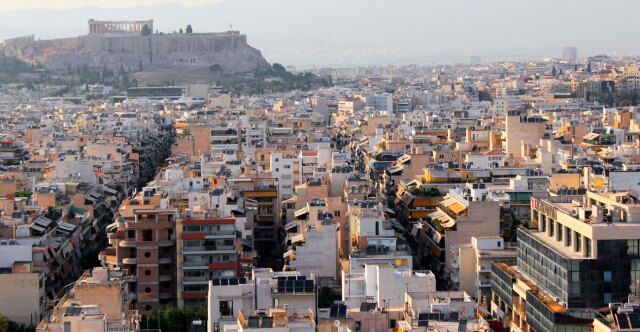
The proposed changes to building density regulations affecting several municipalities in the northern suburbs of Attica are becoming a political problem for the Greek government, as the creation of new Building Rights Reception Zones (ZYS) could substantially increase construction in already heavily developed urban areas.
The new zones, which have been under discussion for more than four decades, have been put out to public consultation by the Ministry of Environment and Energy. Although the ministry has clarified that building rights may only be transferred within the same municipality, opposition to the proposals continues to grow.
The main resistance is concentrated in Athens’ northern suburbs, where many mayors are politically aligned with New Democracy and the governing party enjoys considerable electoral support. On Wednesday, six mayors whose municipalities would be particularly affected by the proposed changes sent a letter to Prime Minister Kyriakos Mitsotakis, expressing concern about the impact of additional construction on their already strained communities. The letter was signed by the mayors of Lykovrysi-Pefki, Nea Ionia, Papagou-Cholargou, Kifissia, Filothei-Psychiko and Chalandri. They called for the withdrawal of the Strategic Environmental Impact Assessment currently under consultation and for the entire plan to be reconsidered from scratch. In the Northern Athens regional unit alone, the proposals envisage an additional 584,400 square metres of construction.
The mayors question the methodology used to select the building rights reception zones, arguing that the planning process lacks sufficient documentation and fails to adequately assess the consequences of increased construction. They point out that road networks, stormwater drainage and sewerage systems, as well as available parking spaces, are already operating at or near capacity.
The campaign is now acquiring a broader institutional dimension, with the Regional Union of Municipalities of Attica (PED Attica) becoming involved. Its president, Galatsi Mayor Giorgos Markopoulos, has convened a meeting of mayors at the union’s offices on Friday morning to coordinate their next steps and seek intervention by the Central Union of Municipalities of Greece (KEDE).
At the forefront of the opposition is the Municipality of Filothei-Psychiko, whose mayor, Charalambos Bonatsos, has made the local authority’s position clear: “Either the study is withdrawn or we are exempted.” The primary demand is the complete withdrawal of the proposals for Northern Athens. If that proves impossible, the municipality wants Filothei, Psychiko and Neo Psychiko excluded from the planned arrangements.
Emergency council meeting attended by New Democracy MP Zoi Rapti
An emergency meeting of the Filothei-Psychiko Municipal Council was held on Wednesday afternoon, focusing exclusively on the proposed building density changes. Meanwhile, the six mayors who signed the letter to the prime minister are considering organising a joint event towards the end of November to demonstrate their opposition. The municipalities also intend to challenge the studies through legal proceedings if they are finalised, although they cannot currently do so because the proposals remain at the public consultation stage.
Strong language was used during Wednesday’s meeting. Municipal legal adviser Vasilis Papadimitriou declared that “property developers have smelt blood”. The attendance of New Democracy MP Zoi Rapti was particularly significant. Rapti called on the government to withdraw the study, expressed her unequivocal support for the municipal council and questioned the legal basis of the proposals. Mayor Charalambos Bonatsos also insisted that there was no room for even another millimetre of concrete in an area whose distinctive character had been preserved through years of determined efforts.
Similar concerns have emerged among New Democracy MPs representing Eastern Attica, parts of which have also been designated as new reception zones for additional building rights. However, organised opposition from local mayors has yet to materialise there.
Government spokesman Pavlos Marinakis intervenes
Local opposition has already reached senior New Democracy figures who represent or are politically active in Athens’ northern suburbs. Many believe the studies will never progress beyond the public consultation stage. Nevertheless, the proposals have not been withdrawn, despite repeated government assurances that there is no question of transferring building rights between municipalities.
The intervention of government spokesman Pavlos Marinakis, who is also politically active in the Northern Athens constituency, was particularly significant. During an event with residents in Kifissia on Wednesday, he was questioned about the proposed changes. According to information obtained, Marinakis stressed that the character of the areas would remain intact and that the distinctive identity of municipalities such as Kifissia would not be altered. He insisted that consultation with local government would precede any decisions and that additional construction floor space was not under discussion. Nevertheless, opposition remains strong.
Bonatsos: No additional burden on the garden suburbs
During the emergency Filothei-Psychiko Municipal Council meeting, reference was also made to a planned public information event at Athens College on 30 November, where residents will be briefed on the proposals and their potential consequences.
Addressing the council, Mayor Charalambos Bonatsos stressed that preserving the suburban character of the area was the result of decades of efforts by successive municipal administrations and local residents. He also referred to the distortions created by the New Building Regulation, known as the NOK.
Bonatsos emphasised the need to protect the residential character of the northern suburbs, particularly in the context of climate change, and expressed his categorical opposition to additional construction. As an example of the consequences of increased building density, he cited the large building complexes developed along Kifissias Avenue in Marousi. “We cannot accept another millimetre of concrete,” he declared.
Referring to the joint letter to the prime minister, he said the municipalities of Northern Athens included in the proposed building rights reception zones had formed a united front demanding the withdrawal of the relevant provisions. He also made clear that, although no legislative measure currently exists that could be challenged before the Council of State, the municipalities are determined to exhaust every available legal remedy.
The mayor firmly rejected the prospect of further increases in building density, arguing that the affected areas had already reached the limits of what they could accommodate.
He highlighted the severe traffic congestion affecting major roads, including Kifissias and Mesogeion avenues, as well as the daily traffic generated by large private schools operating in the area.
The discussion also addressed other pressures on local infrastructure, including the planned relocation of the casino to Marousi. According to the municipal authorities, this makes it even more important to assess the cumulative impact of development on existing infrastructure.
The municipality argues that protecting Psychiko and Filothei cannot be regarded solely as a question of building density coefficients, as it is closely connected to preserving green spaces, open areas, low-rise buildings and residents’ quality of life.
Alexopoulou outlines proposed increases and 34,313 additional square metres
At the beginning of the council meeting, its president, Aikaterini Alexopoulou, presented the background to the study, its provisions and the proposed changes to building density coefficients, highlighting the scale of the additional development that could result across the municipality’s three districts.
According to the figures she presented, the proposed zones cover approximately 251,000 square metres of land and could allow an additional 34,313 square metres of construction.
In Psychiko, a zone covering 53,206 square metres would see the building density coefficient increase from 0.60 to 0.80, a rise of 33.3%. Permitted building heights would increase by one storey, while maximum site coverage could reach 60%. The potential additional construction amounts to 7,570 square metres, with an estimated population increase of 144 residents.
In Filothei, the proposed zone covers 108,723 square metres, with the building density coefficient likewise increasing from 0.60 to 0.80. The same height and site coverage provisions would apply. The potential additional construction would amount to 15,225 square metres, with an estimated increase of 274 residents.
In Neo Psychiko, the proposed zone covers 89,197 square metres and provides for different increases in the building density coefficient. In the first section, the coefficient would rise from 1.20 to 1.43, with permitted building heights increasing by one storey and site coverage reaching 60%. In the second section, the coefficient would increase from 1.20 to 1.30, with the same height and coverage provisions. Potential additional construction is estimated at 11,518 square metres, with a projected population increase of 259 residents. Overall, according to the figures presented to the council, the study could allow 677 additional residents to settle across the municipality’s three districts.
Alexopoulou also recalled that, since the 1990s, the Council of State has repeatedly annulled arrangements concerning the transfer of building rights following legal challenges brought by the municipality, ruling that they were incompatible with Article 24 of the Greek Constitution, which provides for environmental protection.
Protecting the garden suburbs and previous Council of State rulings
The municipal council president placed particular emphasis on safeguarding the planning character of Filothei and Psychiko, citing their special status as garden suburbs and the relevant case law of the Council of State.
As noted during the meeting, the study acknowledges their status as garden suburbs but also states that they do not fall within areas of particular natural beauty, a description that provoked objections from municipal representatives.
Alexopoulou argued that low building density coefficients, restricted site coverage and special building height requirements are fundamental elements of the area’s planning protections and cannot be treated as an opportunity for additional development.
She specifically referred to an argument reportedly included in the study that Psychiko’s building density coefficient of 0.60, compared with higher coefficients in neighbouring areas such as Chalandri, creates scope for increased construction.
The municipal administration rejects that approach, maintaining that the special restrictions are not a planning privilege that can simply be overturned but an integral part of the identity of these garden suburbs.
Regarding Neo Psychiko, which does not enjoy the same garden suburb designation, reference was made to its particular planning regulations and previous legal battles to protect its residential character.
Papadimitriou: “Property developers have smelt blood and want to sweep everything away”
Municipal legal adviser Vasilis Papadimitriou spoke in particularly forceful terms about property development interests and the pressure for additional construction, linking the proposed Building Rights Reception Zones to the risk of dismantling the planning restrictions that protect the area.
“Property developers have smelt blood and want to sweep everything away,” he said, expressing concern about the opportunities for additional construction that the proposed arrangements could create.
Papadimitriou recalled previous legal battles over the transfer of building rights and the municipality’s successful challenges before the Council of State. He also referred to property developer Babis Vovos during his historical review of earlier disputes involving the transfer of building rights.
He placed particular emphasis on the risk of development rights being transferred from other municipalities into the proposed reception zones in the northern suburbs, arguing that the central issue was not merely the scale of additional construction but also the origin of the development rights that could be exercised.
According to his interpretation, Law 4759/2020 does not explicitly prohibit the transfer of building rights between municipalities. He argued that this creates a risk that reception zones could be burdened with additional construction without any corresponding local planning benefit.
Ask me anything
Explore related questions




