





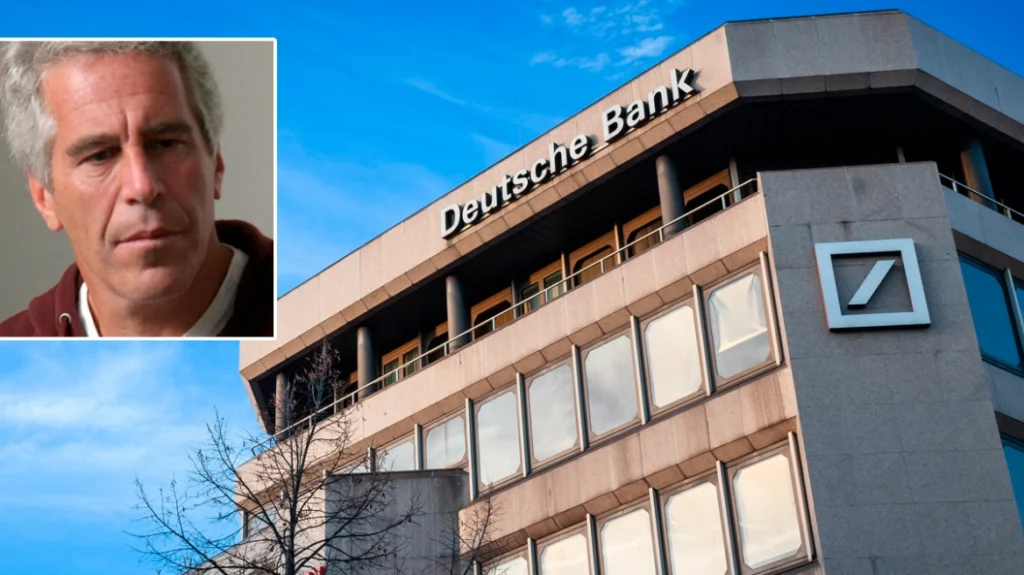
Internal Deutsche Bank documents reveal a far greater scale of suspicious financial transactions linked to Jeffrey Epstein than had previously been known, shedding light on the pivotal role played by Germany’s largest bank in managing the financial affairs of the American financier, who had been convicted of sex offences.
According to an investigation by the Financial Times, Deutsche Bank had identified money transfers totaling $582 million, which it included in suspicious activity reports submitted to US authorities in 2019, the year Jeffrey Epstein died in prison.
The amount is more than double the figure previously disclosed as part of an investigation by the US Senate, highlighting the extent of the financial transactions that had come under scrutiny.
The reports included payments to women, suspicions of misuse of charitable donations, and transfers of funds from some particularly wealthy businessmen, including Apollo Global Management co-founder Leon Black and billionaire hedge fund manager Glenn Dubin.
The two men appeared in the relevant documents as potential sources of funding for Epstein, although this does not constitute evidence of their involvement in his criminal activities.
The information comes from a leak of millions of internal Deutsche Bank documents, which were examined by the Financial Times in collaboration with more than 200 journalists worldwide, from media outlets including Der Spiegel, Le Monde and Paper Trail Media.
The 3,200 transactions and the 21 reports to US authorities
In 2019, Deutsche Bank filed a total of 21 suspicious activity reports (SARs), covering approximately 3,200 payments directly or indirectly related to Epstein.
The scrutiny extended beyond electronic fund transfers to include cheques, transactions through other banks, and payments linked to corporate entities associated with the financier, such as Southern Trust and Butterfly Trust. Suspicious activity reports are a tool for monitoring banking transactions and do not automatically mean that all the payments they contain were illegal.
Nevertheless, the total amount of $582 million reflects the particularly extensive scope of the financial activities that Deutsche Bank considered necessary to disclose to the relevant authorities following Jeffrey Epstein’s arrest and death.
The new revelation significantly exceeds the findings of an earlier investigation by Ron Wyden, the leading Democrat on the US Senate Finance Committee. In a report published in August, his investigators stated that Deutsche Bank had flagged more than $250 million in electronic transfers to and from Jeffrey Epstein’s accounts as suspicious. A single report included 1,140 transactions worth $147 million, carried out between 2013 and 2019.
The discrepancy between the two amounts may be explained by the broader scope of Deutsche Bank’s internal investigation, which examined more categories of payments and transactions through affiliated companies and other financial institutions.
The relationship that began despite Jeffrey Epstein’s conviction
Deutsche Bank accepted Epstein as a client in 2013, despite the fact that he had already been convicted in 2008 in a case involving the solicitation of a minor for prostitution. Jeffrey Epstein had previously ended his relationship with JPMorgan Chase, which had decided to remove him from its client portfolio.
He followed his long-time personal banker, Paul Morris, to Deutsche Bank after Morris moved to the German financial institution.
The bank initially treated Epstein as a particularly important client, not only because of the size of his wealth but also because of his connections with some of the wealthiest people in the United States. Executives believed that the relationship could create opportunities to attract new major clients, including Leon Black.
However, according to the Financial Times, Deutsche Bank ignored repeated internal warnings about the risks involved in maintaining its relationship with Epstein. The decision to end the relationship was not taken until late 2018, when new media reports once again brought allegations of the sexual abuse of young women into the spotlight.
The case has already cost Deutsche Bank $225 million in fines and settlements related to its transactions with Epstein.
The millions from Black and Dubin – What they say in response
The references to transactions linked to Leon Black and Glenn Dubin, two prominent figures in the American investment community, are particularly significant in the internal documents.
A spokesperson for Dubin clarified that the businessman had never invested money through Jeffrey Epstein, nor had he sought financial advice from him. According to the same statement, Epstein was one of hundreds of passive investors in Highbridge Capital Management, the hedge fund co-founded by Dubin. Highbridge had paid Epstein $15 million as a brokerage fee because he had introduced the company to JPMorgan Chase, which acquired a majority stake in the fund in 2004 for $1.3 billion.
For his part, Leon Black’s lawyer cited an independent investigation, according to which the businessman’s payments to Jeffrey Epstein were exclusively for tax advice and wealth and estate planning services. He also maintained that Black was unaware of the criminal activities that led to Epstein’s arrest in 2019.
“Mr Black regrets ever having had any dealings with Jeffrey Epstein. He feels deep sorrow for his victims,” his lawyer said.
Deutsche Bank’s high expectations that were never fulfilled
Despite the enormous scale of the transactions linked to Jeffrey Epstein, the relationship proved far less profitable than Deutsche Bank executives had initially expected.
Before Jeffrey Epstein was added to the bank’s client portfolio in 2013, Paul Morris had estimated that the relationship could generate annual revenues of between $2 million and $4 million. These projections were based on the expectation that Jeffrey Epstein would conduct financial transactions worth between $100 million and $300 million annually, or even more. In practice, however, the results were considerably lower.
According to the internal documents, the volume of business attributed to Jeffrey Epstein amounted to approximately €300 million in 2015, but had fallen by more than a third, to €190 million, during the first half of 2018. At the same time, Deutsche Bank’s wealth management division generated revenues of just $1 million annually from this particular client for much of the 2015–2018 period.
Epstein carried out investment transactions across various markets, ranging from equities to foreign exchange derivatives. However, the bank generated most of its revenue from his deposits rather than from the higher-yielding commissions on securities transactions. Even its cost-to-income ratio was worse than the average for its wealthiest clients.
For every dollar in revenue it generated from Jeffrey Epstein, Deutsche Bank incurred costs of 48 cents. By contrast, the average equivalent ratio for a group of 220 ultra-high-net-worth clients assessed by the bank in 2016, which included Epstein, was 34 cents in costs for every dollar of revenue.
These figures show that Deutsche Bank maintained a relationship involving significant reputational and compliance risks without ultimately achieving the financial benefits it had initially anticipated.
The troubling finding: 40% of executives did not see what needed to change
Beyond the financial transactions, the Financial Times investigation highlights another issue: Deutsche Bank’s corporate culture and the way the Epstein scandal was handled internally.
According to the leaked documents, independent external auditors conducted an assessment of the US wealth management division’s operations in 2021. The results raised concerns. Approximately 40% of the relationship managers who took part in the interviews were unable to identify what the bank should have done differently in the Epstein case.
The auditors considered this finding particularly concerning, as it suggested that a significant proportion of employees had failed to recognise the mistakes that had led to the crisis. The relevant report warned that the finding could reflect either a failure by management to communicate the lessons of the case effectively or a deeper problem with the corporate culture surrounding compliance.
In other words, even after the scandals had been made public and substantial financial penalties had been imposed, the bank appeared to be struggling to ensure that its employees understood precisely what had gone wrong.
Deutsche Bank’s response
Responding to the revelations, Deutsche Bank said that it “regrets its past relationship” with Jeffrey Epstein, arguing that it has since made significant investments to strengthen its internal control mechanisms.
The bank pointed out that it had cooperated with regulatory authorities, law enforcement agencies and the US Congress during the investigation into the case. However, it declined to comment on the contents of the specific suspicious activity reports, citing the legal restrictions governing the disclosure of such documents.
Management maintains that it has taken measures to address the weaknesses that allowed the relationship with Epstein to continue for several years. Despite these assurances, the new leak brings renewed attention to the question of the responsibility of banking institutions when they take on the management of the wealth of clients with serious criminal histories.
The $582 million, the repeated internal warnings and the inability of many executives to recognise the bank’s mistakes in retrospect combine, according to the investigation, to paint a picture that goes beyond isolated failures.
Ask me anything
Explore related questions