





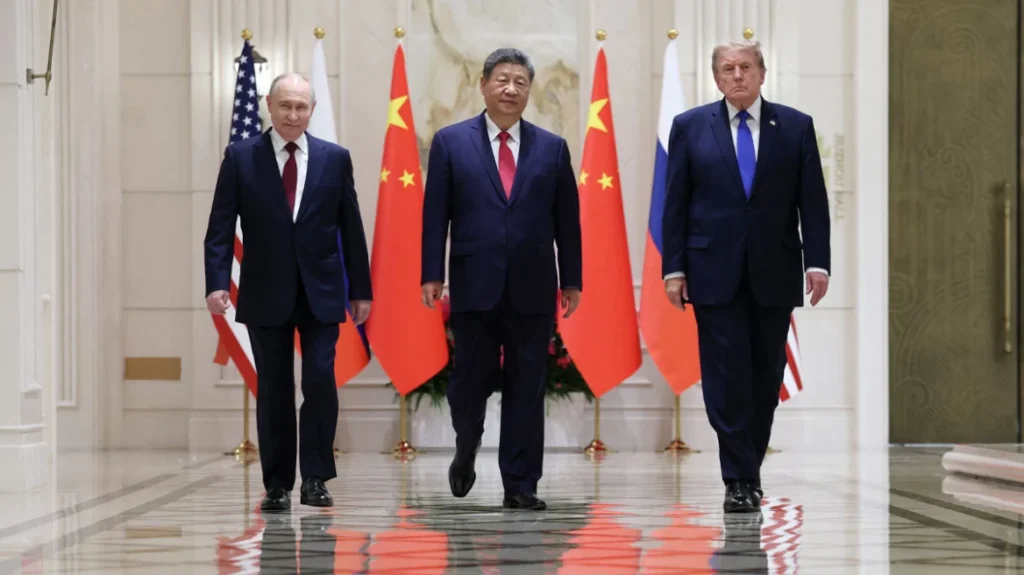
Ukraine and Iran were the two wars that Donald Trump said made it worthwhile to sit down at the same table with Xi Jinping and Vladimir Putin. Neither is mentioned in the “Declaration for Peace” released by Beijing and Moscow.
During the approximately 80 minutes that the trilateral meeting in Shenzhen lasted, the three leaders found common ground on immunity for government officials, oil refining and the self-evident principle that a nuclear war must never be fought. There was not even a single line left for a ceasefire, however temporary, even on just one front.
The expectation of a “new Yalta” had a specific origin. Last week, following the talks in Abu Dhabi, Russian negotiator Vladimir Medinsky explicitly invoked Yalta and Potsdam as models for a new settlement. For Moscow, the historical analogy was flattering from the outset.
It placed Putin in the position of one of three leaders who would decide what comes next, while the war he himself started is approaching its fifth year. Shenzhen gave him a seat at the table. As for Ukraine’s future, however, none of the three was able to describe it.
Xi got what he wanted before the discussions even began
The clearest winner was the host. For years, Xi has argued that the era of American primacy is coming to an end. In Shenzhen, he had the opportunity to explain what he meant, with the US president seated beside him. He spoke about each power’s “red lines”, called for mutual restraint from interfering in domestic affairs, and allowed Trump to explain why the three countries bear a special responsibility for global security.
The measure of China’s success had become apparent earlier, during the one-on-one meeting between the two presidents. Trump immediately brought Ukraine into the discussion and went so far as to say that he could also speak on Xi’s behalf about their shared desire to end the war. When Xi himself took the floor, he did not even mention Ukraine in his opening remarks. A few hours later, the joint statement contained no Chinese commitment whatsoever to exert pressure on Moscow or Tehran.
Xi secured for China the recognition it seeks as a power with global influence. How and when he will exercise that influence remained entirely up to him.
Putin secured the most personal paragraph in the communiqué
The Russian president discussed Ukraine privately with Trump for approximately 40 minutes. No outcome from that meeting was announced. In the trilateral meeting that followed, however, Putin secured something very specific politically. The three leaders described respect for the immunity of government officials as fundamental and called on the International Criminal Court to refrain from abusing its powers.
Since March 2023, the Court has issued an arrest warrant against Putin over alleged war crimes involving the unlawful deportation and transfer of children from occupied areas of Ukraine to Russia. The declaration does not alter the validity of the warrant. It does, however, allow the Kremlin to invoke a shared position with Washington and Beijing regarding the limits of the Court itself.
Of the four paragraphs in the Shenzhen declaration, this one has the clearest political beneficiary. And to secure it, Putin did not have to make any public commitment to Kyiv.
Trump raised the bar himself
The US president can take credit for opening a direct channel of communication between the three largest nuclear powers. Its value will become apparent if the three governments use it during a crisis.
For this particular summit, however, Trump himself had set a much more ambitious goal. He spoke publicly about reducing the number of nuclear weapons. The document provides for dialogue on reducing nuclear risk. The gap between the two is easy to measure. Not a single country committed to withdrawing even one warhead.
Even the statement that a nuclear war cannot be won had already been agreed upon, in exactly the same wording, by the five nuclear powers back in January 2022.
On energy, the stated intention concerns increasing the production and supply of refined petroleum products. It does not specify which country will make additional quantities available, how much, or from when.
As for the Strait of Hormuz, through which the crucial debate over energy supplies passes, the declaration makes no provision whatsoever.
Similarly, regarding UN reform, three permanent members of the Security Council agreed that the Organisation should become more effective, without naming a single change they would jointly support.
Trump had already described his reception by Xi at the airport as a success. Politically, however, he was the only one of the three who had so explicitly linked the meeting to ending two wars and reducing nuclear arsenals. Judged by his own expectations, he is returning to Washington with the least to show for it.
What the absentees lost
For Ukraine, the assessment is more complicated. No territorial settlement concerning Ukraine was announced in its absence in Shenzhen, as Kyiv had feared. Nor did Russia secure recognition of its territorial claims from the other two countries.
A precedent was nevertheless established. The leader of the country that invaded Ukraine participated in a conference on international peace, secured a reference to the immunity of government officials, and left without the final document even naming the country in which the war is still being fought.
For Europe, the problem became apparent in the statement by French Foreign Minister Jean-Noël Barrot. Among the world’s three greatest powers, he said, he would rank the United States, China and the European Union. In the Shenzhen photograph, however, the third place belonged to Russia.
Europeans remain indispensable when it comes to financing Ukraine and providing any credible security guarantees to Kyiv. Nevertheless, the American president chose Beijing and Moscow as his interlocutors on how a war being fought on European soil might be brought to an end.
If the question is who benefited from the meeting, the answer lies in the order in which the protagonists emerged politically satisfied. Xi hosted the first trilateral summit on his own terms. Putin secured wording that concerns him personally. Trump got the historic meeting he had announced in advance.
If the question is what changed after those 80 minutes for Ukraine, Iran or the number of nuclear weapons held by the three countries, the balance sheet of the “new Yalta” is much shorter.
Zero plus zero equals zero.
Ask me anything
Explore related questions




