





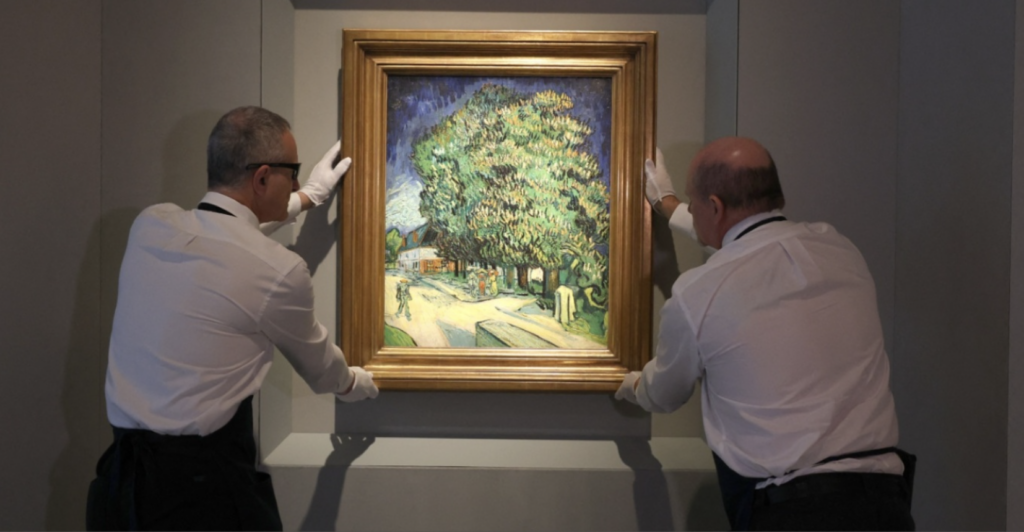
A painting by Vincent van Gogh sold for $190.4 million at Sotheby’s on Wednesday evening (18 November), setting a new auction record for a work by the Dutch artist. The sale followed a heated dispute over the painting’s provenance and ownership, which was settled just two days before the auction.
The painting, entitled Châtaigniers en Fleurs (Chestnut Trees in Blossom), dates from 1890 and depicts a large flowering chestnut tree bathed in the light of dusk. The work was the most expensive lot at the biggest art auction of the year, having previously been at the centre of an ownership claim by the heirs of a Jewish publisher, whose family had sold it in 1936 amid Nazi persecution.
Unseen in public in almost 60 years, Vincent van Gogh’s ‘Châtaigniers en fleurs’ set a new auction record for the artist when it sold for $190.4 million in the Sotheby’s New York sale room tonight. https://t.co/6WZdr69inz
— Sotheby’s (@Sothebys) November 18, 2026
A record price and an awkward atmosphere at the auction
Although Sotheby’s auction room was packed, the sale of the painting was not accompanied by the intense bidding war one might have expected for a work of such value.
The record price, which includes fees, had effectively been secured before the auction began, thanks to a guarantee covering the sale.
Auctioneer Oliver Barker spent more than three minutes trying to attract further bids, but failed to generate any competition.
At the back of the room, Patrick Drahi, a major shareholder in Sotheby’s, watched the proceedings with a sombre expression.
Despite the subdued auction, the final price far exceeded the previous record for a Van Gogh painting. That record had been set at Christie’s in 2022, when a landscape from the collection of Microsoft co-founder Paul Allen sold for $117.2 million, equivalent to approximately $133 million in today’s money.
The heirs’ claim and the sale under Nazi persecution
The auction was at risk of being cancelled when, just the previous week, the heirs of a former owner of the painting came forward to assert their rights over the work.
They are the descendants of Samuel Fischer, a German-Jewish publisher whose family sold the painting in 1936.
According to the heirs, the sale did not take place under free conditions, but rather under the pressure of the persecution Jews faced under the Nazi regime.
The claim prompted urgent negotiations with the current sellers, the Argentine Blakiere-Arrieta family, which owned the painting.
Following lengthy discussions on Monday (16 November), the two sides reached an agreement, the financial and legal terms of which were not made public.
The agreement allowed Sotheby’s to proceed with the auction as planned, avoiding a potential cancellation of the sale.
Some experts specialising in the restitution of artworks confiscated or sold under duress during the Nazi era nevertheless questioned why the auction house had not contacted Fischer’s heirs earlier.
Sotheby’s declined to disclose details of the agreement.
The heirs’ lawyer, Gunnar Schnabel, who attended the auction, said after its conclusion:
“The family hopes that the significant public interest in this case, together with its swift, fair and honest resolution, will offer some encouragement to other families who suffered persecution during the Nazi era.”
A painting created shortly after Van Gogh left the asylum
The work is also particularly significant because of the period in which it was created.
Van Gogh painted the sunlit street scene just four days after arriving in Auvers-sur-Oise, the small French town where he settled in 1890, having previously spent a year in a psychiatric institution.
The painting is considered the most important work in the Blakiere-Arrieta collection, a distinguished collection of Impressionist and modern art assembled by Nelly Arieta de Blakiere, an heiress to a substantial fortune from Argentina’s sugar industry, and her husband, Carlos Pedro Blakiere.
The collection had been a target of Sotheby’s for years, with the auction house seeking to secure the rights to sell it.
“We have been dreaming about this collection for 20 years,” said the auction house’s senior adviser, Simon Shaw.
Thanks to the settlement reached with Fischer’s heirs, Sotheby’s avoided the possibility of the long-awaited sale turning into a legal and commercial deadlock.
Ask me anything
Explore related questions




