





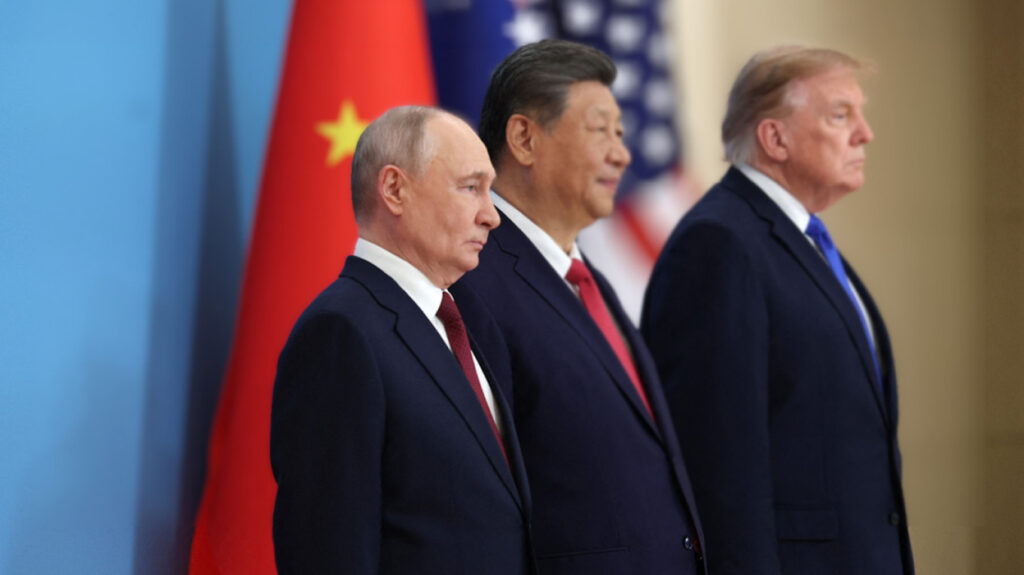
Vladimir Putin used a press conference after his meeting with US President Donald Trump and Chinese Premiere Xi Jinping in Shenzhen to press Kyiv to accept compromises he said Washington had proposed before the Anchorage talks. The Russian president also said Moscow had invited European countries through diplomatic channels to present their positions on a settlement, while ruling out any deployment of foreign troops in Ukraine.
In a further warning, Putin said Russian forces would continue operations in several areas to push back Ukrainian troops and establish what he called “security zones” along Russia’s border with Ukraine. He linked the plans to the strike on the Crimean Bridge.
BREAKING The presidents of China, the United States and Russia kicked off their first trilateral talks in China on Thursday, aimed, according to Beijing, as "safeguarding world peace" https://t.co/GdkWeP827I
— AFP News Agency (@AFP) November 19, 2026
What Putin said about a settlement in Ukraine
“If [the Ukrainian authorities] want to end the conflict, let them agree to the compromises the Americans proposed before Anchorage. We agreed to them, and now it is up to Ukraine,” Putin said. He claimed that Kyiv and its European partners were still unwilling to compromise and accused Ukraine’s leadership of seeking to preserve its funding and avoid elections by prolonging the war.
Putin said Moscow had agreed to a proposal from US negotiators to address Ukraine’s security within a broader European security framework. He said Ukraine had a right to security and insisted that Russia’s own security “must be guaranteed”, complaining that “nobody wants to discuss it”. He reiterated Moscow’s opposition to European plans to send troops, saying that “the entry of any troops into Ukrainian territory is unacceptable to us”.
Putin said it would be “strange to discuss European security without Europe” and that Moscow wanted to hear what European countries would bring to the negotiations. He also described what he saw as the European Union’s ambition to become a military and political alliance as a “serious challenge” for Russia.
A historic first on the world stage. President Donald J. Trump, President Xi, and President Putin hold trilateral talks in China. https://t.co/w2qDiJo8W5
— The White House (@WhiteHouse) November 19, 2026
The Crimean Bridge and Russia’s plans for buffer zones
Putin said Russia would push Ukrainian forces back in several areas and create zones along the border. “This will also be one of the consequences of the strike on the Crimean Bridge,” he said. He vowed to restore the bridge fully and said its railway section had already been repaired. He described the bridge as “exclusively civilian infrastructure” and claimed it was never used to transport military equipment.
Putin also repeated Moscow’s account of the origins of the war, claiming that Ukraine’s authorities had started a war in 2014 against areas that refused to recognise them, and that Russia had recognised the self-proclaimed Donbas republics and begun helping them after eight years of fighting.
What Trump, Xi and Putin agreed in Shenzhen
The first trilateral meeting between the leaders of the United States, China and Russia lasted just under 90 minutes and took place on the sidelines of the Asia-Pacific Economic Cooperation summit. Their joint declaration reaffirmed that a nuclear war must never be fought. They also pledged to pursue United Nations reform, increase the supply of refined petroleum products to all countries and uphold the immunity of state officials before international courts.
The leaders discussed Ukraine, the conflict in the Middle East and the Korean Peninsula behind closed doors. Putin said they also agreed on the need to monitor certain uses of artificial intelligence that could pose security risks. He cited the work of Russia’s Sberbank and Yandex and argued that the country’s energy resources gave it an advantage as demand for power from data centres grows.
😴 Trump dozed off a little during Xi Jinping’s speech at the APEC summit Cameras caught the US president sitting with his eyes closed and his head lowered. China is 13 hours ahead of Washington, DC. While it was morning in Shenzhen, it was still the previous evening in the US capital. And jet lag from traveling across multiple time zones may have taken its toll.
— NEXTA (@nexta_tv) November 19, 2026
What Trump, Xi and Putin said about the talks
Xi stressed the need for the three countries to communicate and work together on nuclear disarmament. Trump also spoke about reducing nuclear arsenals, acknowledged how difficult that would be and criticised leaders who refuse to keep channels open with Moscow and Beijing. Putin emphasised the three countries’ responsibility for maintaining global peace.
Putin called the closed-door discussion “free and frank”, credited Xi with creating the conditions for an open exchange and said he would like the format to continue. He described Trump as genuinely committed to resolving the war in Ukraine and said the US administration’s approach gave him grounds for optimism about relations between Washington and Moscow.
Asked whether he would take up Trump’s invitation to attend December’s G20 summit in Miami, Putin said he would weigh developments at home. He said a high-level Russian delegation would attend. After the Shenzhen summit, he left for Tajikistan for talks with President Emomali Rahmon.
Russian President Vladimir Putin leaves the meeting venue following the summit, without any official announcement confirming that his plane has taken off and left Chinese territory so far. https://t.co/CFurJIamNg
— MOSCOW NEWS 🇷🇺 (@MOSCOW_EN) November 19, 2026
How Europe reacted to the summit
Polish Prime Minister Donald Tusk responded to Trump’s description of Putin and Xi as friends by writing on X, “God, save us from such friends.” Tusk was in Berlin for a meeting of the Coalition of the Willing, the group of countries supporting Ukraine.
Wolfgang Ischinger, chairman of the Munich Security Conference and a former German ambassador to the United States and Britain, called the meeting “a rather sad moment in history” and described it as a sign of “the end of the West as we knew it”, referring to a transatlantic community founded on shared values.
Jonathan Eyal, international director at the Royal United Services Institute in London, singled out the declaration’s language on international courts and said Putin had gained credibility and a way out of diplomatic isolation. “The great powers dictate the terms, the small ones suffer,” he said.
Trump’s trade announcement after the Asia trip
Separately, the White House announced more than $17 billion in trade deals and strategic investments for US companies in Southeast Asia following Trump’s two-day visit to the Philippines for the ASEAN summit. The package covers aerospace, defence, energy and artificial intelligence.
Ask me anything
Explore related questions




