





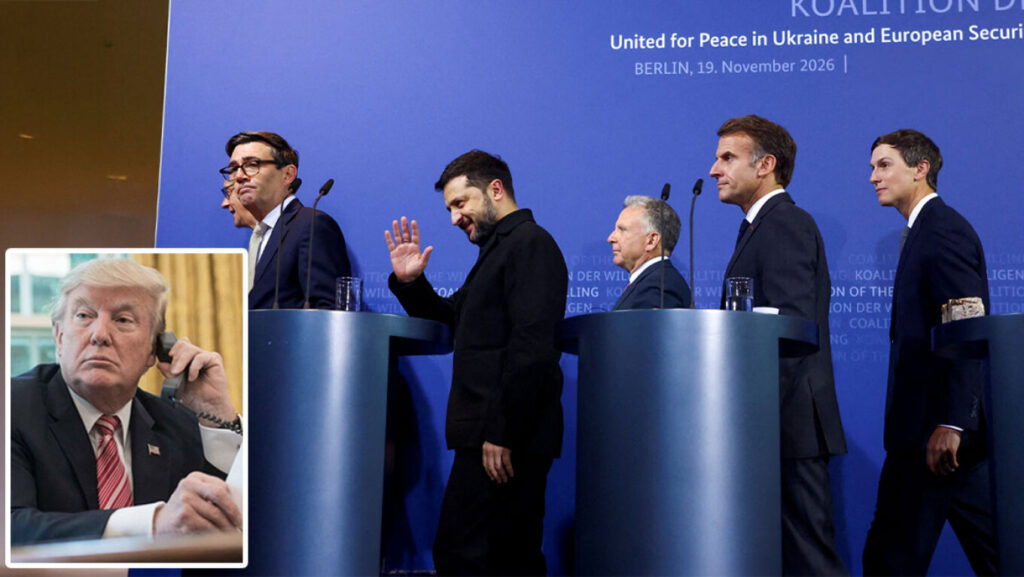
US President Donald Trump’s optimism about Vladimir Putin’s intentions, his strong reservations about continuing financial aid to Ukraine and European leaders’ determination to take part in peace negotiations dominated today’s Coalition of the Willing summit in Berlin, held just hours after the historic trilateral meeting between Trump, Putin and Chinese Premiere Xi Jinping in China.
Trump joined the meeting of European leaders by phone from Air Force One, expressing confidence that the Russian president was serious about reaching a peace agreement. He also questioned the case for spending billions more to support Kyiv, drawing reactions from participants.
German Chancellor Friedrich Merz made clear that any peace settlement would require the participation of Ukraine and Europe, warning that negotiations modelled on Yalta, with major powers deciding the fate of other countries, would fail to bring peace.
Trump’s call was one of the most talked-about moments of the summit. He phoned Berlin a few hours after concluding his talks with Putin and Xi in Shenzhen to brief his allies on the meetings in China.
Four European officials briefed on the call said Trump strongly questioned the continuation of military and financial aid to Ukraine. He reportedly argued that Putin was serious about peace negotiations and that countries supporting Kyiv should focus on ending the war.
Two participants described his remarks as an angry reaction, while a third official gave a more measured account. According to that official, Trump focused mainly on the lives lost and the vast sums being spent on a war that has lasted nearly five years.
The €70 billion figure was central to the discussion as Ukraine faces a funding shortfall in 2027. On Wednesday, the European Commission had proposed an additional €45 billion loan to cover part of Kyiv’s needs.
Trump’s intervention also drew questions at the closing press conference. Asked about reports of an angry outburst, British Prime Minister Andy Burnham did not confirm that description. He said Trump had spoken forcefully about the appalling loss of life in the war and pointed out that neither side stood to gain from its continuation.
Steve Witkoff defended Trump’s position, saying the US president had given his team clear instructions to work to end the war and co-operate with the Coalition of the Willing.
Kushner says Russia appears open to Article 5-style security guarantees
Beyond the discussion on funding for Ukraine, the most significant development at the summit concerned the security guarantees that could accompany a possible peace deal. Jared Kushner said the US had brought Moscow closer to accepting the idea that Ukraine’s future security could rest on guarantees similar to those under NATO’s Article 5.
Article 5 provides for the collective defence of NATO members if one of them comes under attack. Discussing similar guarantees for Ukraine, however, does not automatically mean it would join NATO.
Kushner acknowledged significant doubts over whether Russia would actually accept such an arrangement and said those doubts made it essential for Europe and Moscow to resume dialogue.
He also described a potential US security commitment along the lines of Article 5 as a significant step for Washington. He said Trump was open to the idea provided the commitment served US interests and formed part of a wider security agreement.
The US negotiator also reported progress in talks on Ukraine’s post-war economic reconstruction, security guarantees and a plan to exchange prisoners of war.
Merz says Europe will not allow a new Yalta
The German chancellor drew a parallel between the current negotiations on Ukraine and the post-war division of Europe.
Merz made clear that European countries would continue to support Kyiv for as long as necessary and stressed that any negotiations on Ukraine’s future and European security must involve those directly affected.
Referring to the 1945 Yalta Conference, at which the leaders of the major Allied powers settled key aspects of the post-war order, he warned against a return to an era in which the most powerful countries made decisions for everyone else.
In a symbolic gesture, he gave the leaders attending the summit pieces of the Berlin Wall as a reminder of the consequences of Europe’s division.
The German chancellor also recalled Ronald Reagan’s 1987 speech in Berlin, when the then US president called on Mikhail Gorbachev to tear down the Wall. Today, Merz said, the message to Putin was to end the war in Ukraine and pursue a diplomatic solution.
He confirmed that the aim was to hold multilateral talks involving Ukraine, Russia, Europe and the United States.
Macron says the meeting in China does not change the world order
Emmanuel Macron struck a similar note, playing down the significance attached to the historic trilateral meeting between Trump, Putin and Xi in Shenzhen. The French president said the joint declaration agreed in China did not amount to a reordering of the world.
He argued that the Berlin meeting was crucial to Europe’s security because European countries would have to deal directly with the consequences of any peace agreement.
Macron also stressed that Russia’s war in Ukraine threatened European security and that the diplomatic process had to be designed to secure a lasting outcome.
Burnham likewise said the country that launched the invasion could not unilaterally dictate the terms of European security.
He was cautiously optimistic about the prospects for diplomacy, saying he saw greater agreement among European allies. He acknowledged, however, that Putin’s position remained the decisive factor in whether talks could make progress.
Zelensky says Russia failed to divide Europe
Ukrainian President Volodymyr Zelensky focused on his country’s immediate military and financial needs as the war enters its fifth winter.
His talks with European leaders covered how to counter Russian drones and missiles, strengthen air defences, protect energy infrastructure and maintain funding for Ukraine.
Zelensky said European participation in the diplomatic process was essential and thanked allies for their continued support. At the end of the joint press conference, he said the summit had shown that Moscow had failed in its attempt to divide Europe.
Polish Prime Minister Donald Tusk offered a different assessment of the prospects for an immediate breakthrough. Speaking to reporters on his way back to Poland, Tusk acknowledged that Trump had sounded quite optimistic after meeting Putin and Xi.
He questioned, however, whether Russia’s leadership was genuinely prepared to make substantive concessions, observing that Trump’s faith in Putin’s good intentions appeared unshakeable.
Tusk said Russia was unlikely to enter serious negotiations before the end of winter, taking a more cautious view than the one Trump had conveyed to European allies.
The Berlin summit ended without an announcement of a new agreement with Moscow on security guarantees or a specific new joint funding package for Ukraine.
European leaders reaffirmed their willingness to continue providing military and financial support to Kyiv, while US negotiators signalled they were open to Europe taking part in the next stages of the diplomatic process.
The main outstanding issue is whether Moscow will accept security arrangements that set out specific commitments to protect Ukraine after the war ends.
Following the historic meeting in Shenzhen, European leaders made clear in Berlin that they expected to take part in decisions by the major powers on the future of Ukraine and European security.
Whether Trump’s optimism about Putin’s intentions can translate into a peace agreement remains the central question for the next round of talks.
Ask me anything
Explore related questions




