





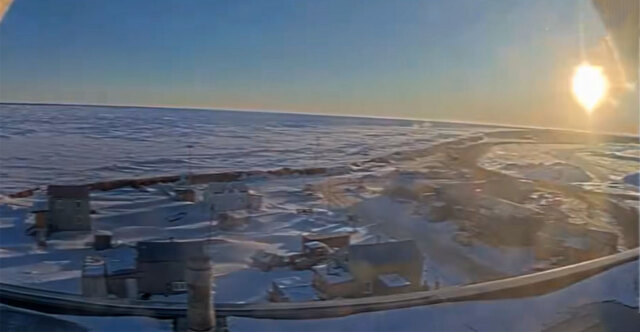
Residents of Utqiagvik, in northern Alaska, watched the sun set for the last time in 2026 as the city entered its polar night, a period during which the sun remains below the horizon for more than two months.
The final sunset was recorded on Wednesday, 18 November, at approximately 1:42pm local time, marking the beginning of a 65-day period without a single sunrise.
The approximately 5,000 residents of the remote Arctic city will have to wait until 23 January 2027, when the sun is expected to appear above the horizon again, shortly after 1pm local time.
Watch the video
This is a remarkable natural phenomenon that occurs every winter in regions located north of the Arctic Circle.
The city that will not see the sun for 65 days
Utqiagvik, formerly known as Barrow, is located on the coast of the Arctic Ocean, at a latitude of approximately 71.3 degrees north, and is the northernmost city in the United States.
Its unique geographical position means that residents experience extreme variations in the length of daylight and darkness throughout the year.
From 19 November 2026 until 22 January 2027, the sun will not rise even once.
The first sunrise of the new year is expected on Saturday, 23 January, at approximately 1:03pm, while the first day with sunlight will last less than an hour.
Despite the challenging conditions, polar night is a familiar part of everyday life for residents of the area, who adapt their activities to the unusual lighting conditions and extremely low temperatures.
What is polar night and why does it happen?
The phenomenon of polar night occurs in regions close to the North and South Poles, when the sun does not appear above the horizon for at least one full 24-hour period.
The cause lies in the tilt of the Earth’s rotational axis, which is approximately 23.5 degrees relative to the plane of its orbit around the sun.
During the winter months in the Northern Hemisphere, the North Pole is tilted away from the sun, meaning that certain Arctic regions receive no direct sunlight.
The closer a location is to the North Pole, the longer the polar night lasts.
In Utqiagvik, this period lasts approximately two months, while further north it can extend for a considerably longer time.
It does not mean complete darkness throughout the entire day
Although the sun remains below the horizon, polar night does not necessarily mean continuous and absolute darkness.
Around midday, a faint light can appear in the sky, resembling twilight.
This happens because some sunlight is scattered through the atmosphere, even when the sun is below the horizon.
As a result, for a limited period during the day, residents can see a blue or orange glow near the horizon, particularly when weather conditions are clear.
During the remaining hours, artificial lighting in homes, streets and businesses becomes essential to everyday life in the city.
In summer, the exact opposite happens
The same geographical characteristic that deprives Utqiagvik of sunlight during the winter creates an entirely opposite phenomenon during the summer months.
From mid-May until early August, the city experiences what is known as the “midnight sun”.
During this period, the sun remains continuously above the horizon, even at midnight, giving residents weeks of uninterrupted natural daylight.
In 2026, the city experienced approximately 84 days without sunset, from 10 May until 2 August.
The alternation between these two phenomena is one of the most distinctive features of life within the Arctic Circle.
For now, however, Utqiagvik has entered the darkest period of the year, with residents waiting for the sun to return on 23 January 2027, when its first rays will once again appear above the frozen Arctic horizon.
Ask me anything
Explore related questions




