





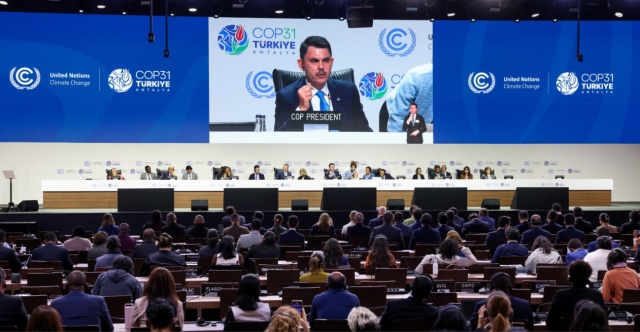
The COP31 climate summit in Antalya, Turkey, ended amid deep divisions between countries calling for a faster move away from fossil fuels and those insisting they should remain in use, leaving the most important issues in international climate policy unresolved. The failure to reach an agreement after two weeks of negotiations and a two-day extension does not invalidate countries’ previous commitments, but creates fresh uncertainty over their implementation.
The European Union and other countries refused to accept a text that made no mention of fossil fuels, while poorer economies left without the specific financial commitments they had been seeking.
What COP31’s failure means for international agreements
The collapse of the talks on Sunday (22 November) represents a serious setback for international cooperation on climate change, as the nearly 200 participating countries failed to reach a joint political declaration.
However, the failure does not mean that previous climate agreements have been scrapped, or that commitments already made by countries cease to apply.
The 2015 Paris Agreement remains the main framework for international efforts to limit global warming. The decision reached at COP28 in Dubai in 2023, which recognised the need to transition away from fossil fuels in energy systems, also remains in force.
What proved impossible in Antalya was to establish a new common political direction, with clearer commitments on the energy transition and financial support for developing countries.
The failure is particularly significant as global temperatures continue to rise and scientific assessments indicate that current government policies are insufficient to meet the goals of the Paris Agreement.
Europe’s ‘no’ and the divide over oil
The European Union, the United Kingdom and several developing countries refused to approve the final COP31 draft because it contained no explicit reference to fossil fuels.
The European side argued that an agreement to tackle climate change could not ignore oil, coal and natural gas, which are the main cause of human-induced global warming.
‘We will not approve a political decision or an Antalya agreement that does not even mention fossil fuels,’ was the message from the European delegation.
Irish Environment Minister Darragh O’Brien, who represented the EU in the negotiations, described the adoption of a climate agreement without such a reference as unthinkable.
Pacific nations, including the Marshall Islands, as well as Panama, took a similar position, insisting that a weak agreement would not constitute a meaningful response to the climate crisis.
On the other side, Saudi Arabia and other major oil-producing countries opposed the inclusion of clear commitments to reduce the use of fossil fuels.
Russia also warned that an excessively rapid energy transition could create problems with energy security and place additional pressure on economies.
The differing positions proved irreconcilable, despite repeated attempts to reach a compromise.
The dispute over carbon dioxide removal
A major point of contention was also the proposal to make greater use of technologies that remove carbon dioxide from the atmosphere.
The rejected draft agreement acknowledged that global temperatures are expected to exceed the 1.5°C threshold and provided for the accelerated development of technologies that could help reverse this overshoot in the future.
The wording was a key demand of oil-producing countries.
However, countries and environmental organisations expressed concern that the emphasis on carbon removal could be used as an argument for continuing oil and gas extraction.
Scientists recognise that such technologies can contribute to tackling global warming, but stress that they cannot replace the need for drastic cuts in greenhouse gas emissions.
A Saudi Arabian representative said he was surprised by the resistance to these technologies, arguing that they offered a genuine solution.
Poorer countries leave without new, specific financial commitments
Beyond fossil fuels, climate finance was the second major obstacle to reaching an agreement.
Developing countries were seeking clear financial commitments from wealthier economies to help them tackle the consequences of climate change, including floods, droughts and prolonged heatwaves.
At COP30 in Brazil in 2025, countries had agreed to triple funding for climate adaptation.
However, the new draft did not specify any amounts or the basis on which the funding would be calculated.
Poorer countries argued that without clear commitments they could not effectively plan measures to protect their populations.
The absence of the United States from the talks was another factor that limited the prospects of reaching a compromise on financing.
Guterres’s disappointment and Turkey’s message
United Nations Secretary-General António Guterres expressed his deep disappointment at the failure of the summit.
‘I share the deep disappointment of all those who hoped governments would rise to the demands of the climate crisis,’ he said.
He also stressed that ‘fossil fuels are the driving force behind the climate crisis’.
At the closing session of COP31, the Turkish president of the conference, Murat Kurum, announced that there was no longer any room for a new proposal.
‘There is nothing more we can do; we have done everything we could,’ he said, making clear that no further text would be presented.
Australian Minister for Climate Change and Energy Chris Bowen, who had taken the lead in guiding the negotiations, spoke of ‘red lines that could not be bridged’.
Meanwhile, Belgian Environment Minister Jean-Luc Crucke argued that rejecting the draft had been a difficult but correct decision.
‘This is not the end of multilateralism, but we must have the courage to say no,’ he said.
What COP31 ultimately achieved
Despite the failure to reach the central political agreement, the talks did not end without any results.
Participating countries made progress on a number of individual issues, including the development of a just transition mechanism, aimed at supporting workers and communities as economies shift towards cleaner forms of energy.
At the same time, more than 80 countries backed a target of increasing electricity’s share of global final energy consumption to 35% by 2035.
However, progress on individual issues did not make up for the failure to reach a common political agreement on the two most important pillars of climate action: fossil fuels and financing.
What comes next after the deadlock in Antalya
In the aftermath of the summit, the international community faces the question of whether the existing negotiating system can meet the growing demands of the climate crisis.
Decisions at UN climate summits are taken by consensus, allowing even a limited number of countries to block a joint political decision.
Simon Stiell, executive secretary of the UN Framework Convention on Climate Change, announced that he would consider proposals to change the way negotiations are conducted.
Speaking to the BBC, he recalled that the same system had made it possible to reach the Paris Agreement in 2015, while acknowledging the difficulties exposed in Antalya.
Attention is now turning to COP32, which will take place in November 2027 in Addis Ababa, Ethiopia.
Ethiopian Foreign Minister Gedion Timothewos said his country was seeking to restore trust and reinvigorate international cooperation.
The key question for the next summit will be whether governments can overcome the disagreements that led to COP31’s collapse without backtracking on targets already agreed.
The challenge is particularly great, as, according to UN estimates, current government policies put the planet on course for a temperature rise of around 2.8°C by the end of the century, far above the 1.5°C target set out in the Paris Agreement.
Ask me anything
Explore related questions




