





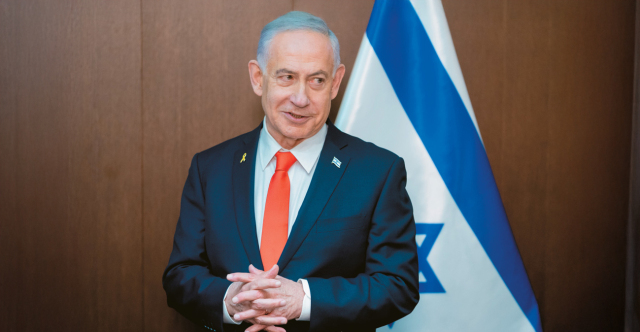
Israeli Prime Minister Benjamin Netanyahu has explained to US President Donald Trump why he wants to strike Iran again. The caretaker prime minister, however, has yet to explain to Israelis what makes a strike necessary in the coming weeks, what he hopes to achieve and how far he is prepared to go if Tehran responds. The question of timing is particularly important in Israel. Until 6 December, the mandate to form a government rests with Gadi Eisenkot, the former Israeli military chief who pledged during the election campaign to end Netanyahu’s premiership.
According to officials briefed on the talks, Netanyahu raised the issue personally with the US president and sent envoys to meet officials from the White House, the CIA and US Central Command.
In Israel, Netanyahu began publicly calling for a national unity government around the same time, a possibility he had ruled out until the 27 October election. The opposition sees a link between the two initiatives. The prime minister’s office rejects the accusation. “This threat does not follow a political calendar,” his spokesman, Doron Spielman, said.
What military commanders are advising
US participation carries decisive weight in discussions within the Israeli leadership. Three Israeli security officials describe the position military leaders presented to the prime minister. If Washington decides to take part in a joint operation, Israel should seize the opportunity. On the prospect of a unilateral strike, however, the same officials say many senior commanders see no urgent reason to act. Such a move could also cost Israel the chance to act jointly with the Americans later.
The Israeli government is also taking into account what happens in January, when Democrats take control of Congress. Israeli officials believe US participation in a new operation may then become politically harder. That assessment partly explains the pressure on Trump. It leaves open the question of what exactly has changed in Iran to warrant an immediate military response.
Two Israeli security officials say the military leadership’s most pressing short-term concern is intelligence about an Iranian chemical weapons programme. It remains unclear whether Tehran could use such weapons soon. Iran’s nuclear programme and its replenishment of ballistic missile and drone stockpiles are also back under discussion. Raz Zimmt, who leads Iran research at the Institute for National Security Studies in Tel Aviv, says the view that Israel will need to take pre-emptive action is gaining ground. On timing, however, his own assessment is clear. “Is immediate action really necessary? I doubt it.”
The numbers behind the unity proposal
Opposition parties won 67 of the Knesset’s 120 seats. These include the 19 seats secured by predominantly Arab parties, their strongest result to date. Likud remained the largest party with 27 seats, compared with 21 for Eisenkot’s Yashar party. Netanyahu is relying on that six-seat lead to stake his claim to the premiership in a broader coalition.
On 7 November, he called on Jewish parties in the Knesset, from left to right, to govern together, citing among other reasons the need to eliminate the Iranian nuclear threat. Two days later, he made clear who should lead. “This government should, of course, be headed by the largest party,” he said. Under Netanyahu’s terms, Eisenkot would have to abandon his central campaign pledge and join a government led by the man he promised to replace.
A new war would make it politically harder for Eisenkot to refuse. Both men know the precedent well. After the Hamas attack on 7 October 2023, Eisenkot agreed to join Netanyahu’s emergency government. He now warns publicly of the risk of conflating military timetables with political objectives. Two of his key allies, whom Netanyahu made a point of briefing on the security situation, have already taken different positions on the proposed unity government. Former prime minister Naftali Bennett would accept such an arrangement with Eisenkot serving as prime minister first. Avigdor Lieberman calls the proposal a “trap” and has ruled out serving in a government with Netanyahu.
Who can contain the next conflict?
For Trump, the decision has consequences well beyond Israel’s political crisis. During the previous conflict, he blocked a broader Israeli plan to strike Iranian oil infrastructure that was tied to an effort to bring down the regime. According to the three Israeli officials, the plan is under discussion again. Tehran has warned that, in such a case, its retaliation would extend to civilian infrastructure across the region. US allies in the Gulf have already suffered strikes on airports and energy and water facilities. In Israel itself, Iranian missiles hit apartment blocks.
The opposition cannot prove which motive weighs most heavily in Netanyahu’s decisions. It can, however, put to him the question raised by the military’s own advice. If senior commanders believe Israel has time and room to choose, what requires the caretaker prime minister to commit the country to a course of action before it is clear who will govern? Eisenkot has a firm deadline of 6 December. Netanyahu has yet to explain publicly why another strike on Iran would need to happen by any comparable deadline.
Ask me anything
Explore related questions




