





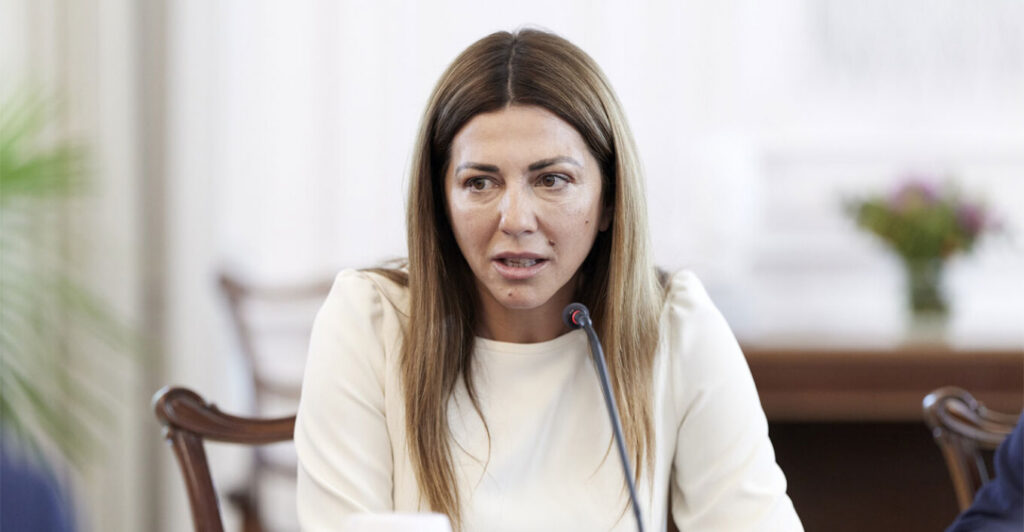
Education Minister Sofia Zacharaki has acknowledged serious problems and unmet needs in Greece’s school buildings while seeking to distance the Ministry of Education from responsibility for their condition, in response to Proto Thema’s recent investigation.
The Minister recognises that problems persist and some needs have yet to be met, but seeks to define the limits of her Ministry’s responsibility, citing legislation that assigns the maintenance, repair and management of school infrastructure to local councils.
The central question, however, goes beyond administration and concerns political accountability. To what extent does the councils’ statutory remit relieve the Ministry of Education of broader political responsibility for the conditions in which more than 1.2 million pupils attend 12,582 state schools every day?
The question is all the more pertinent given that the Minister herself describes upgrading school buildings as a strategic government priority. The distinction between operational responsibility and political accountability is at the heart of the debate opened by the investigation.
Zacharaki attributes the wide differences in the condition of school buildings partly to disparities in funding, technical capacity and staffing among the country’s 332 local councils. In response to the investigation’s findings, she also sets out the Government’s record since 2019, citing €2.2 billion in funding secured for school infrastructure and equipment, €1.107 billion in payments made and 1,415 funded projects worth a total of €1.895 billion.
According to the figures she provides, €935 million is for new school buildings, additions and extensions, €317 million for repairs, maintenance and upgrades to school buildings, €254 million for energy efficiency upgrades and €389 million for equipment. These amounts exclude the Marietta Giannakou programme, which aims to renovate a total of 2,000 schools by the summer of 2028.
The Minister also announced that the National School Infrastructure Map is still in the planning stage. The project would establish a single digital platform to record the age and condition of school buildings and the work they need. The announcement highlights one of the central issues raised by the investigation. The state has yet to establish a single system for routinely recording and monitoring the condition of school buildings so it can prioritise needs and allocate available resources accordingly.
The Minister also responds to criticism over the 11 outstanding parliamentary questions, saying that the 25-day deadline for a reply has yet to expire in every case.
In her lengthy response, Zacharaki also addresses the Ministry of Education’s wider work, including teacher appointments, digital education, the modernisation of school equipment and education reforms.
Despite the figures on funding, projects and planned work, the questions raised by Proto Thema’s investigation remain. What condition are school buildings actually in today, how many need urgent work, when will their problems be addressed and who is responsible for ensuring that the timetable is met? The allocation of duties between ministries and local councils still leaves the question of who will ensure that pupils have a safe, good-quality environment at school every day.
Zacharaki’s response in full
Ladies and gentlemen,
As a teacher and as Minister of Education, I know how important it is to keep improving the conditions in which our children grow, learn and develop. I have first-hand experience of everyday school life and understand the needs and challenges that both pupils and teachers face in the classroom.
We are talking about an education system with 12,582 state schools and more than 1.2 million pupils across 332 municipalities, from major urban centres to the most remote island and mountain communities. This system must ensure equal access to education every day, support children with disabilities or special educational needs, coordinate transport matters with the relevant authorities and respond to particularly complex needs. Keeping the system running and continually improving it takes an enormous daily effort from thousands of people.
First, it is important to clarify the legal framework governing school buildings in our country. Under current legislation, direct operational responsibility for maintaining, repairing and managing primary and secondary school buildings rests with local authorities. The law assigns that responsibility at local government level, outside the remit of the Ministry of Education and other central government departments.
This decentralised system, combined with differences in funding, technical capacity and staffing among the country’s 332 local councils, partly explains the variation we see from one municipality to another and even from one school to another.
We aim to address precisely this variation by strengthening central planning, recording needs systematically, prioritising work and cooperating with the relevant authorities, while respecting their statutory responsibilities.
Let us look at the Government’s overall efforts from 2019 to the present day. Prime Minister Kyriakos Mitsotakis himself has made this work a government priority.
By combining and leveraging national and European funding, we secured the following between 2019 and 2026.
- €2.2 billion in funding for school infrastructure and equipment.
- €1.107 billion in payments made.
- 1,415 funded projects worth €1.895 billion across the country, including the following.
- €935 million for 287 projects to build new schools or add to and extend existing ones.
- €317 million for repairs, maintenance and upgrades to school buildings.
- €254 million for energy efficiency upgrades.
- €389 million for school equipment.
These figures cover the work being carried out across government. It is a wider government effort involving cooperation between the relevant ministries, regions, local councils and other bodies delivering the projects.
The figures and projects above exclude the Marietta Giannakou programme. This major school renovation programme is continuing with the help of a donation from the banks, with the immediate aim of preparing more than 500 studies for the next round of work and renovating a total of 2,000 schools by the summer of 2028.
We are taking initiatives, seeking additional funding and identifying new European funding mechanisms. One example is the Ministry’s proposal for a programme to improve energy efficiency in schools with a total budget of about €40 million. The proposal was approved under the Modernisation Fund and could be expanded significantly in 2027.
We work closely with local authorities, the Ministry of the Interior, the Ministry of Infrastructure and Transport, Building Infrastructure S.A. (KTYP) and the Ministry of National Economy and Finance to make full use of every available funding opportunity.
At the same time, we are planning a new project to create a National School Infrastructure Map. This single digital platform will allow us to systematically record and monitor the condition of school buildings across the country. It will include continuously updated construction records, a full inventory of facilities and equipment, information on the age of buildings and a record of what work they need. Our aim is to help prioritise repairs and renovations and to use demographic trends to assess where new schools will be needed in the future. Data matters, and we want to make sure we collect it carefully and accurately.
I must also set the record straight about the parliamentary questions referred to in today’s article.
All 11 questions cited in the article are still within the deadline set by Parliament’s Standing Orders, which allow 25 days from the date of submission for a reply. Ministry officials are preparing the replies, which will be submitted to Parliament on time. (The appendix lists the questions and their respective deadlines in detail.)
Following the prescribed parliamentary procedure for answering questions, within the Ministry’s statutory remit and the deadlines set by Parliament’s Standing Orders, can hardly be described as “radio silence”.
I fully respect parliamentary scrutiny, just as I respect scrutiny by the media. Criticism is legitimate, necessary and welcome. It must, however, be based on an accurate and complete account of the facts.
It would also have been good journalistic practice, in the course of this investigation, to ask the Ministry of Education for detailed figures on all investment and work on school infrastructure across the country since 2019.
These figures are available to everyone, including Parliament, MPs, opposition parties and the media.
Just as we have a duty to highlight every real problem, we also have a duty to recognise every meaningful improvement. We should look at where we were seven years ago, where we are today and what still needs to be done. The public is entitled to that full picture.
Are there problems? Of course. Are there needs that have yet to be met? Undoubtedly. There are also hundreds of new or renovated schools, thousands of projects and significant improvements in our children’s daily lives.
Upgrading school buildings is an important part of the Government’s overall education policy. The Ministry of Education has a much wider remit. It covers the quality of education, what is taught, school staffing, equal access to education, support for children with special educational needs and, ultimately, preparing young people to become the citizens of tomorrow.
Over the past two years, we have been working intensively across several fronts. We are modernising school equipment, investing in digital education, improving teaching content in cooperation with the Institute of Educational Policy and strengthening equal access to education through the Digital Tutoring Programme. Onassis State Schools have opened and are operating, International Baccalaureate teaching has begun in state schools, new subjects are being offered and innovations in vocational education are being introduced. More than 15,000 of the 53,212 permanent appointments have been made in the past two years. At the same time, for the past nine months a structured national dialogue has been under way to develop a proposal for the National Baccalaureate, with constructive results and a focus on the quality of education and young people’s prospects.
Interactive whiteboards, educational robotics equipment, defibrillators, individual lockers for primary school pupils, new sports equipment, equipment to upgrade science laboratories and new equipment for music and arts schools have either been delivered or are scheduled for delivery through international tenders. This wide-ranging programme is changing daily life for hundreds of thousands of pupils.
In higher education, where the Ministry has more direct responsibility for funding infrastructure, we are using the available national and European resources for new facilities, student residences, laboratories and upgrades to university infrastructure.
We should also distinguish between statutory responsibility and political will. As Minister of Education, I take initiatives to solve problems even beyond my immediate remit, while the relevant authorities retain their responsibilities.
My political commitment is clear. I want to accelerate infrastructure upgrades at every level of education, make them one of the Government’s top strategic priorities and build on the substantial work already under way.
Much is being done. More still needs to be done. We have a plan, we know what is needed and we are working to secure the necessary resources.
Our wider mission is to prepare the citizens of tomorrow in an educational environment that gives them knowledge, values, skills and equal opportunities. Building schools is part of that mission.
As a teacher and as Minister of Education, I want every child in every corner of Greece to walk into a safe, modern school that lives up to their expectations each day. That is my personal goal, and I work towards it every day.
Yours sincerely,
Sofia Zacharaki
Minister of Education, Religious Affairs and Sports
Ask me anything
Explore related questions




