






Sponsored Content
Leading international experts in public health, tobacco control, law, and psychiatry warned today that the European Union risks squandering a historic public health opportunity if upcoming revisions to its tobacco and nicotine framework rely on prohibitionist restrictions rather than scientific evidence. The webinar organised by SCOHRE and titled “Evidence-Informed Regulation: Integrating Science and Public Consultation into European Policy” convened as the European Commission’s planned revisions of the Tobacco Products Directive (TPD3) and Tobacco Advertising Directive (TAD) encounter significant institutional pushback. Building on discussions initiated at the 9th Virtual Summit on Tobacco Harm Reduction in September 2026, panelists examined whether EU institutions are translating evolving scientific knowledge and stakeholder input into proportionate, effective policy.
The debate took place amid reports that the European Commission’s Regulatory Scrutiny Board (RSB) has issued a negative opinion on the draft impact assessment underpinning the TPD and TAD revisions, raising concerns on the proportionality of proposed measures, their tax implications, and their broader socioeconomic consequences. With 24% of Europeans still smoking and 700,000 smoking-related deaths occurring across the EU every year—roughly one-tenth of the global total—speakers stressed that regulatory missteps carry severe human and fiscal costs. Moderated by Dr. Konstantinos Farsalinos, MD, MPH, Senior Researcher, University of Patras and School of Public Health, University of West Attica, Greece, the panel featured Clive Bates, Director, Counterfactual Consulting Ltd, UK, Professor David Sweanor, J.D., University of Ottawa, Canada, and Dr. Stelios Kympouropoulos, Psychiatrist and former Member of the European Parliament, Greece.
Regulatory Scrutiny Failure and the Threat of Illicit Trade
Opening the webinar with an analysis of the EU legislative landscape, Clive Bates, former director of Action on Smoking and Health (ASH) UK, noted that the 2014 Tobacco Products Directive (TPD2) already subjects nicotine products to extensive rules covering nicotine limits, bottle sizes, labeling, warnings, ingredients, child-proof packaging, and advertising. While TPD2 established a workable baseline, Bates warned that proposals under consideration for TPD3 threaten to crush lower-risk alternatives to combustible cigarettes. Potential measures include treating all tobacco and nicotine products identically, wholesale or unilateral bans on nicotine pouches, stricter nicotine caps, flavor bans modeled on the Netherlands, cross-border sales bans, and a restrictive pre-market authorization regime. He also criticized an October letter from eight member states demanding a market freeze that would halt product innovation, characterizing it as “a gift to the cigarette trade”.
Citing International Monetary Fund (IMF) research (Rosenberg, C., & Van Oordt, M., 2026) that indexes combustible cigarettes at 100 while placing nicotine pouches, heated tobacco, e-cigarettes, snus, and nicotine replacement therapies one to two orders of magnitude lower in risk, Bates challenged European Commissioner Olivér Várhelyi’s public claims that novel products pose the same risks as traditional tobacco. “If you’re precautionary about safer alternatives to smoking, you’re being reckless about smoking,” Bates stated. “If you are resistant to harm reduction, you’re being positive to harm”.
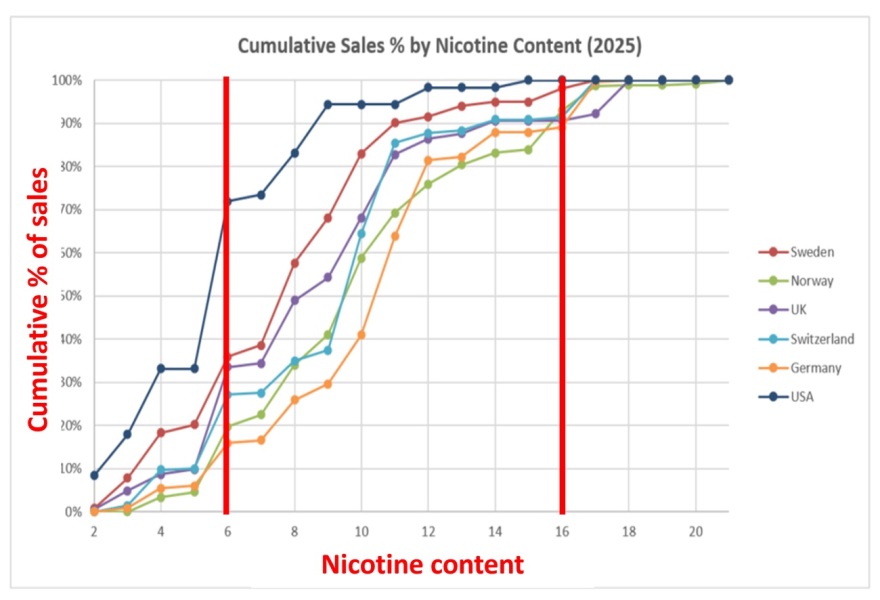
Bates further emphasized that EU policymakers are overlooking the expansion of illicit markets. Referencing Fraunhofer Institute research (2025) showing that 48% of the EU vape market is already irregular—35% illicit and 13% grey market—and that 80% of vapers in the Netherlands obtain products through illegal channels, he warned that prohibitionist policies accelerate organized crime. Similarly, industry analysis indicates that a 6-milligram nicotine cap on pouches would render roughly 70% of the market non-compliant. Given the RSB’s rejection of the draft impact assessment and the European Court of Auditors’ finding that the EU is “not up to the task” of combating illicit tobacco trade, Bates noted that the directive’s publication schedule is uncertain and that the Ordinary Legislative Procedure between the Parliament and Council will likely play out in 2027.
“An estimated €13 billion of budget revenue is lost to the illicit tobacco trade each year.”
Cherry-Picked Evidence, Consultation Data, and Real-World Warnings
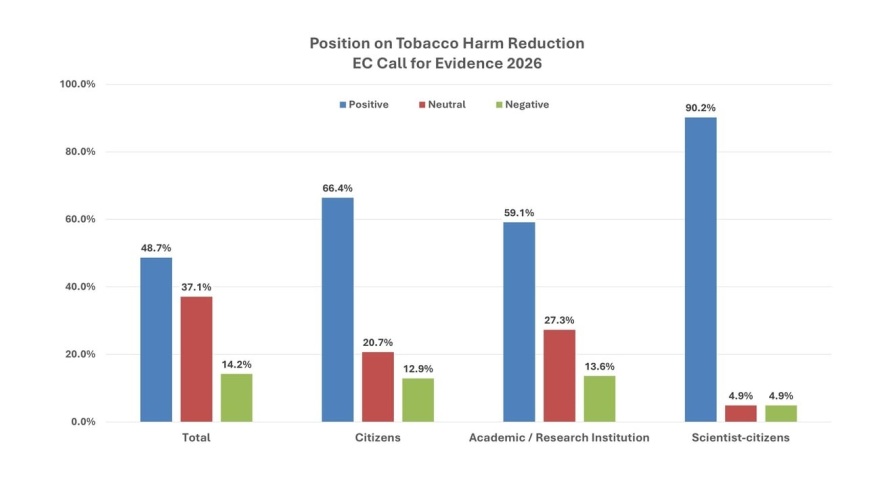
Dr. Konstantinos Farsalinos highlighted the paradox in Brussels’ regulatory approach, noting that official EU statements rarely address combustible cigarettes and focus almost exclusively on restricting non-combustible alternatives. “Normally, an evidence-based policy is that intentions and legislation follow the evidence,” Farsalinos observed. “The EU seems to be following the opposite route—having the evidence follow the intentions and decisions, which is called cherry-picking”.
To illustrate the real-world consequences of over-taxation and prohibition, Farsalinos presented official government and parliamentary data from Australia. Under Australia’s pharmacy-only prescription model, personal import bans, and punitive cigarette taxes, 96% of the vape market and 69 to 80% of the tobacco market have shifted to illicit channels, up from 10% a decade ago. Government excise revenues halved from 16 billion to 8 billion Australian dollars in five years and are projected to fall by nearly 90% by 2030, accompanied by extortion, firebombings, and violent crime. Meanwhile, youth vaping in Australia reached 15.7%, compared to 5.9% in the regulated U.S. market, where high school smoking dropped by nearly 90% between 2011 and today as vaping gained popularity.
Farsalinos also underscored Cochrane systematic review findings that e-cigarettes are nearly twice as effective as nicotine replacement therapies for smoking cessation, and noted that the UK government’s benchmark estimate that vaping is 95% less harmful than smoking is grounded in toxicant exposure science.
Product Substitution, Human Autonomy, and Global Credibility
Professor David Sweanor, Chair of the Advisory Board at the University of Ottawa’s Centre for Health Law, Policy & Ethics, placed European policy in a global and historical perspective. Recalling Professor Michael Russell’s conclusion over 50 years ago that people smoke for nicotine but die from inhaling smoke, Sweanor pointed to Sweden, where comparable overall nicotine consumption delivered primarily through snus and pouches has reduced lung cancer incidence to nearly one-third of the EU average.
Sweanor noted that consumers in countries including Norway, Iceland, New Zealand, Japan, the United States, the United Kingdom, and Greece have rapidly shifted toward non-combustible products, driving down cigarette sales despite regulatory resistance. He warned that nations like Canada, which look to Europe for rational, science-based governance, risk “leaving a blizzard to get hit with a tsunami” if Brussels embraces prohibition.
Framing harm reduction around human rights and individual empowerment, Sweanor warned that moralistic restrictions fuel illicit markets and erode public trust in democratic authorities on broader public health priorities. “Have some respect for individuals, have some respect for their rights, do not try to treat them as people who need to be told how to live their lives,” Sweanor said. “Empower them, respect them, acknowledge their autonomy, and you accomplish great things”. By adopting risk-proportionate regulation and taxation, he added, the EU could lead the world in “relegating cigarettes to the ashtray of history”.
Evidence Standards, Computational Science, and Policy Coherence
Psychiatrist and former MEP Dr. Stelios Kympouropoulos called for greater rigor in how European institutions evaluate scientific evidence. “Before we discuss whether regulation is evidence-informed, we should clarify what we mean by evidence,” he stated. Evidence of what, for whom, and compared with what? He emphasized that for adult smokers, the appropriate comparator is continued cigarette smoking, whereas for never-smokers it is remaining a non-user, requiring regulators to distinguish established facts from areas of uncertainty.
Kympouropoulos advocated using validated artificial intelligence and computational science to keep evidence reviews up to date, model how regulatory predictions shift under different assumptions, and monitor real-world outcomes once TPD and TAD rules take effect. From his psychiatric practice, he stressed that individuals with severe mental health conditions smoke at high rates and require accessible, affordable alternatives rather than policies that drive vulnerable populations toward illicit products.
Responding to an audience question on why the EU’s Cardiovascular Health Plan (Safe Hearts Plan) resolution acknowledged differing risk profiles across nicotine products while Europe’s Beating Cancer Plan resolution weeks later omitted any differentiation, Kympouropoulos cited uneven lobbying, issue framing, and the lack of consistent scientific standards across parliamentary committees.
Rejecting Coercive Bans and Engaging the Legislative Process
During the closing Q&A, panelists opposed generational smoking bans as ineffective, coercive, and intrusive on adult autonomy —comparing them to failed cannabis prohibitions— while noting that they fail to assist long-term adult smokers facing immediate disease risks. Speakers urged scientists, healthcare professionals, and consumers to engage actively ahead of the 2027 legislative deliberations by utilizing the European Parliament’s Committee on Petitions, contacting national Council representatives, and briefing Members of the European Parliament.
Watch the full webinar
* This webinar was organised by SCOHRE, the International Association on Smoking Control & Harm Reduction to examine how evolving scientific evidence can be translated into proportionate, adaptive, and effective European public health regulation.
ABOUT SCOHRE
SCOHRE is an International scientific Association of independent experts on Smoking Control & Harm Reduction, who seek an open and constructive dialogue to help come up with a new approach to smoking control policies.
Its purpose is to provide stakeholders with science-based balanced information. Tobacco harm reduction debate is still at an early stage and more research and publications are needed.
Ask me anything
Explore related questions




